
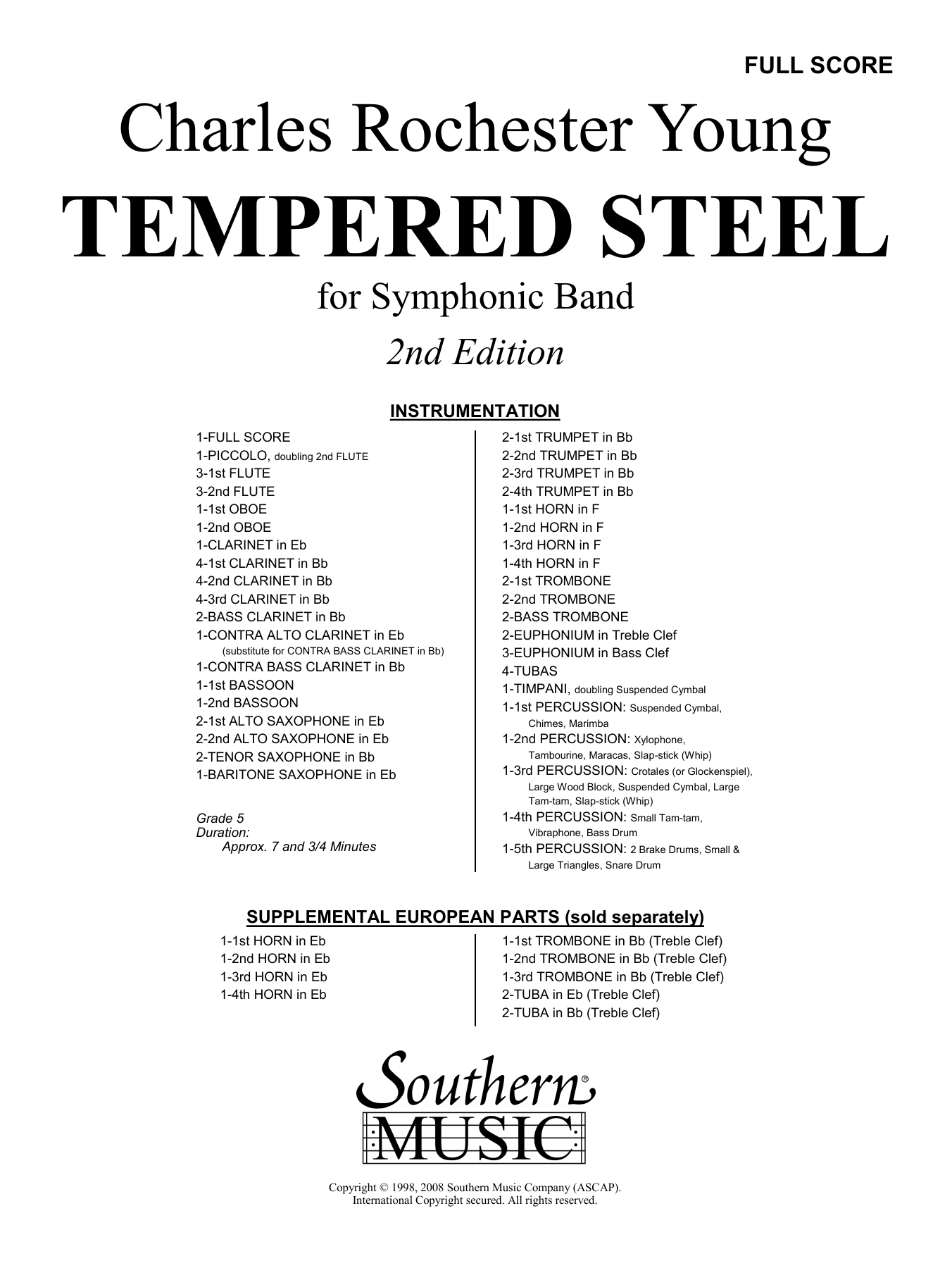

Tempered Steel: Concert Band Conductor Score & Parts
By Charles Young
Grade: 4
Item: 35-PK01469983
$150.00
Pickup currently not available
Buy Extra Parts (Digital PDF Download)
Parts Added to Cart!
Description
As we grow stronger and more resilient through hardship, we become "tempered." Tempered Steel is a celebration of our triumph over these unavoidable hardships and obstacles that we regularly face. As the title implies, the metallic sonorities of the wind band are continually explored and developed throughout the work, while the "tempest" is a symmetric hexachord that is exposed and developed through a variety of juxtaposed gestures and themes. Tempered Steel was "forged" in 1997 as the first work to be commissioned by the Big 12 Band Directors Association. This 2nd edition resulted from Dr. Young's request to make a few very minor changes in the work, based on his experience hearing dozens of performances, and hearing from conductors who have wrestled with the difficulties inherent in the score.


Tempered Steel: Concert Band Conductor Score & Parts isn't in MakeMusic Cloud just yet...but it could be. Let us know you'd like to see it, and you'll help shape what comes next. In the meantime, start a free trial and dive into thousands of interactive titles your students can play along with today.
Request This Title
Tell us you want it.
Start Your Free Trial
Explore everything that's ready to play right now.
Sample Audio
No sample audio found.
Sample Video
No sample videos found.
Additional Details
Publisher:
Hal Leonard
SKU:
35-PK01469983
More about this title
About the Composer: Charles Young
Charles Young is a composer whose work shaped the commissioning landscape for university band programs. His 1997 composition Tempered Steel holds the distinction of being the first work commissioned by the Big 12 Band Directors Association, establishing his voice as a significant contributor to the concert band repertoire. Young's willingness to revisit and refine his scores based on decades of performance feedback demonstrates a commitment to the practical realities of the rehearsal room.
Why we love this
Tempered Steel rewards repeated hearings because its architecture rewards careful listening. The hexachord foundation gives the work coherence across its surface variety, so students discover that the piece isn't random exploration of metallic colors but rather a unified argument about resilience unfolding across the full band. Young's second edition reflects genuine pedagogical wisdom, refining the score based on what actually works when dozens of groups wrestle with it in real time.
What to expect
Tempered Steel captures the sonority of a band transformed into an instrument of metallic brilliance. Beneath the sheen sits a purposeful architecture where gestures build and respond, creating the sense of being forged through adversity into something harder and more unified than before.
Who it's for
Grade 4 bands with secure fundamentals and comfort with contemporary harmonic language. This work suits groups ready to tackle a score that demands both technical precision and interpretive maturity, especially those whose directors value commissioning history and pedagogical substance.
How to get the most out of it
- Isolate the hexachord in sectional rehearsals so brass and woodwinds grasp how it transforms across its various contexts rather than treating each appearance as new material.
- Balance the metallic sonorities by bringing out the harmonic content underneath the instrumental color; the brightness serves the themes, not the reverse.
- Work the transitions between juxtaposed gestures with deliberate attention to tempo relationships; clarity in these shifts prevents the piece from feeling episodic.
How to use it
Program this as a centerpiece work on a concert that explores how contemporary composers shape wind band sonority. Its commissioning pedigree makes it ideal for a program note about ensemble advancement, and its thematic clarity pairs well alongside more tonal or programmatic concert band works.
Skills your students will build
- Hearing and balancing contemporary harmonic sonorities across the full ensemble
- Following thematic development through varied instrumental combinations
- Navigating abrupt textural and harmonic shifts with stylistic awareness
- Sustaining focus across a mid-length contemporary work with unified architecture