
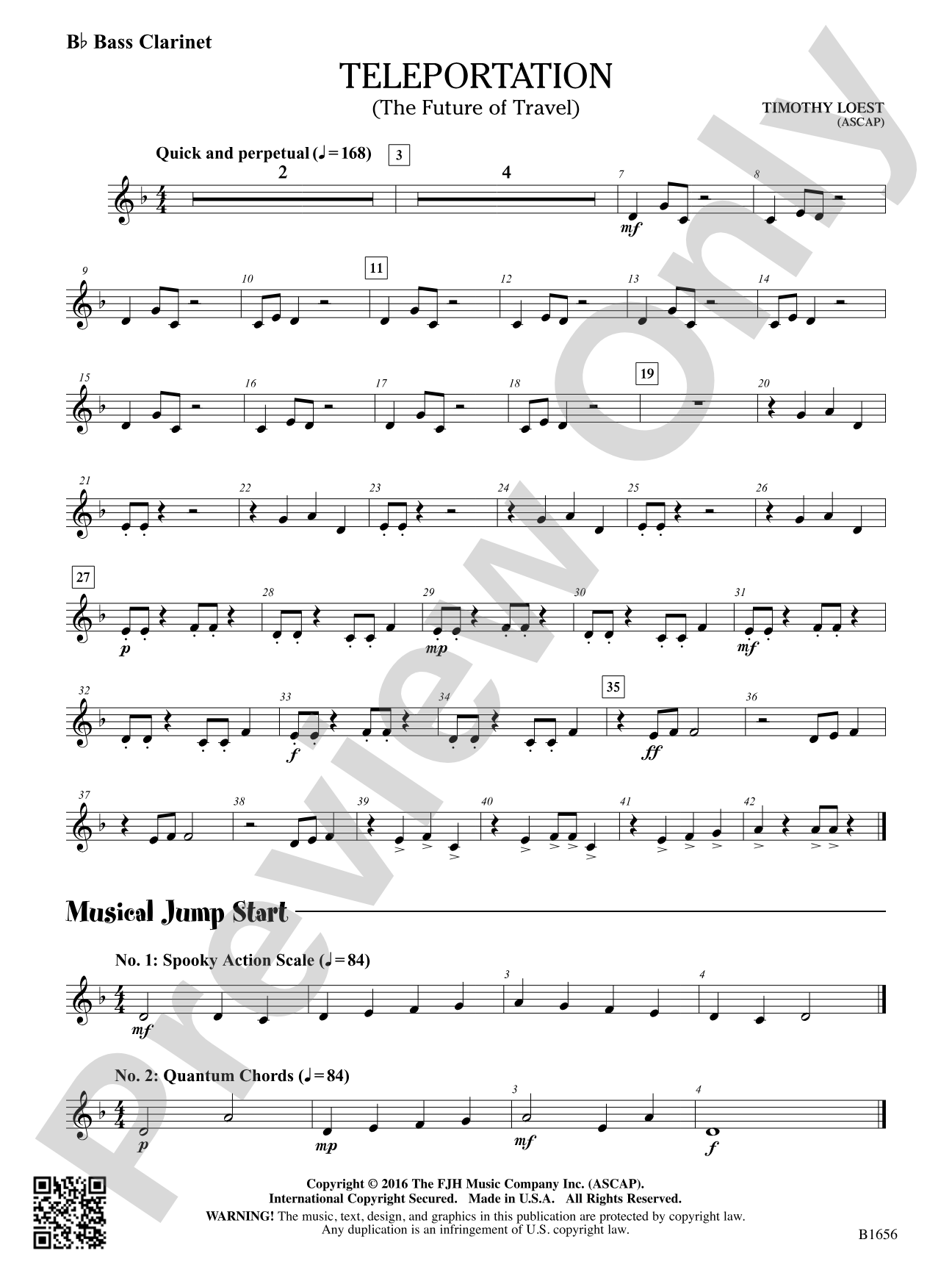

Teleportation: B-flat Bass Clarinet
By Timothy Loest
Level:.5
Item: 98-PC-DB1656_BC
$7.00
Pickup currently not available
Description
Take an imaginative departure from the typical band piece with this highly programmatic work. Depicting futuristic travel, the music takes the audience to a time when matter is broken down, beamed across space, and then reassembled elsewhere. Your students and audience will agree with Einstein, who said, "The greatest scientists are artists as well."


Don't just read it, hear it, play along with it, and watch your students grow with it. In MakeMusic Cloud, Teleportation: B-flat Bass Clarinet comes alive with professional accompaniment, adjustable tempo, and built-in practice tools that turn solo practice into real progress.
Open in the Player
Jump straight in and assign it today.
Start Your Free Trial
Open this title and explore the full library in minutes.
Sample Audio
1
Audio File
--:--
0:00
0:00
Sample Video
No sample videos found.
Additional Details
Series:
FJH Starter Series
Publisher:
The FJH Music Company, Inc.
SKU:
98-PC-DB1656_BC
More about this title
About the Composer: Timothy Loest

Timothy Loest has spent over thirty years in the classroom while establishing himself as a prolific composer whose works are performed by young bands across the country. His music combines pedagogical clarity with imaginative storytelling, and his impact extends beyond concert halls into television appearances on The Tonight Show Starring Jimmy Fallon, Good Morning America, and other major networks. In 2017, his composition Cloud Gate drew over 5,000 spectators to Chicago's Millennium Park, and that same year he received the Illinois Grade School Music Association's Cloyd Myers Memorial Award for Excellence in Music Education.
Loest's publisher credits span Warner Bros. Publications, C.L. Barnhouse Company, The FJH Music Company, and MakeMusic Publications, and in 2022 he founded Fanfare Music Press to produce high-quality band compositions and arrangements. His work on best-selling pedagogical resources including Measures of Success: A Comprehensive Musicianship Band Method and the Beyond series has shaped instrumental music instruction nationwide. He earned his Bachelor of Music Education with high honors from Illinois State University and his Master of Music degree with program honors from Northwestern University.
Why we love this
Loest writes story-driven band music that captures young musicians' imaginations while staying accessible to half-step ensembles. The programmatic arc of Teleportation gives conductors and students a narrative scaffold for musical interpretation, making it far more engaging than traditional exercises. It's the kind of piece that makes both players and audiences lean in.
What to expect
Imaginative and propulsive, with music that shimmers, shifts, and restructures itself before your ears. The piece carries listeners through a voyage of scientific wonder, with moments of disorientation and reassembly that keep the energy fresh throughout.
Who it's for
Beginning to early intermediate concert bands seeking engaging, accessible literature that rewards careful listening and playing. This piece works for ensembles at the half-step level who are ready to tackle programmatic sophistication without technical overwhelm.
How to get the most out of it
- Shape the transitions between the matter being broken down, beamed across space, and reassembled by shifting articulation and dynamics. Each section has distinct sonic character, so let your sound painting reflect the journey.
- Balance the programmatic elements with musical clarity. The storytelling is strongest when pitch integrity and rhythmic precision remain rock solid beneath the descriptive textures.
- Use this piece to discuss how composers build form through contrast. Have students identify the musical signposts that mark each stage of the teleportation process.
- Keep the ensemble engaged by reminding players they are sound designers, not just note readers. Their attention to balance and blend directly shapes how convincing the transformation scenes feel.
How to use it
Program this as a concert centerpiece when you want to spark curiosity in your audience about what young bands can express musically. Its futuristic narrative pairs well alongside more traditional selections, offering dynamic contrast and giving your program unexpected personality.
Skills your students will build
- Following and responding to detailed conductor gestures that shape programmatic storytelling
- Balancing blend and intonation through texture changes and sectional layering
- Interpreting written musical direction to enhance conceptual narrative
- Sustaining ensemble focus across contrasting musical sections without losing cohesion