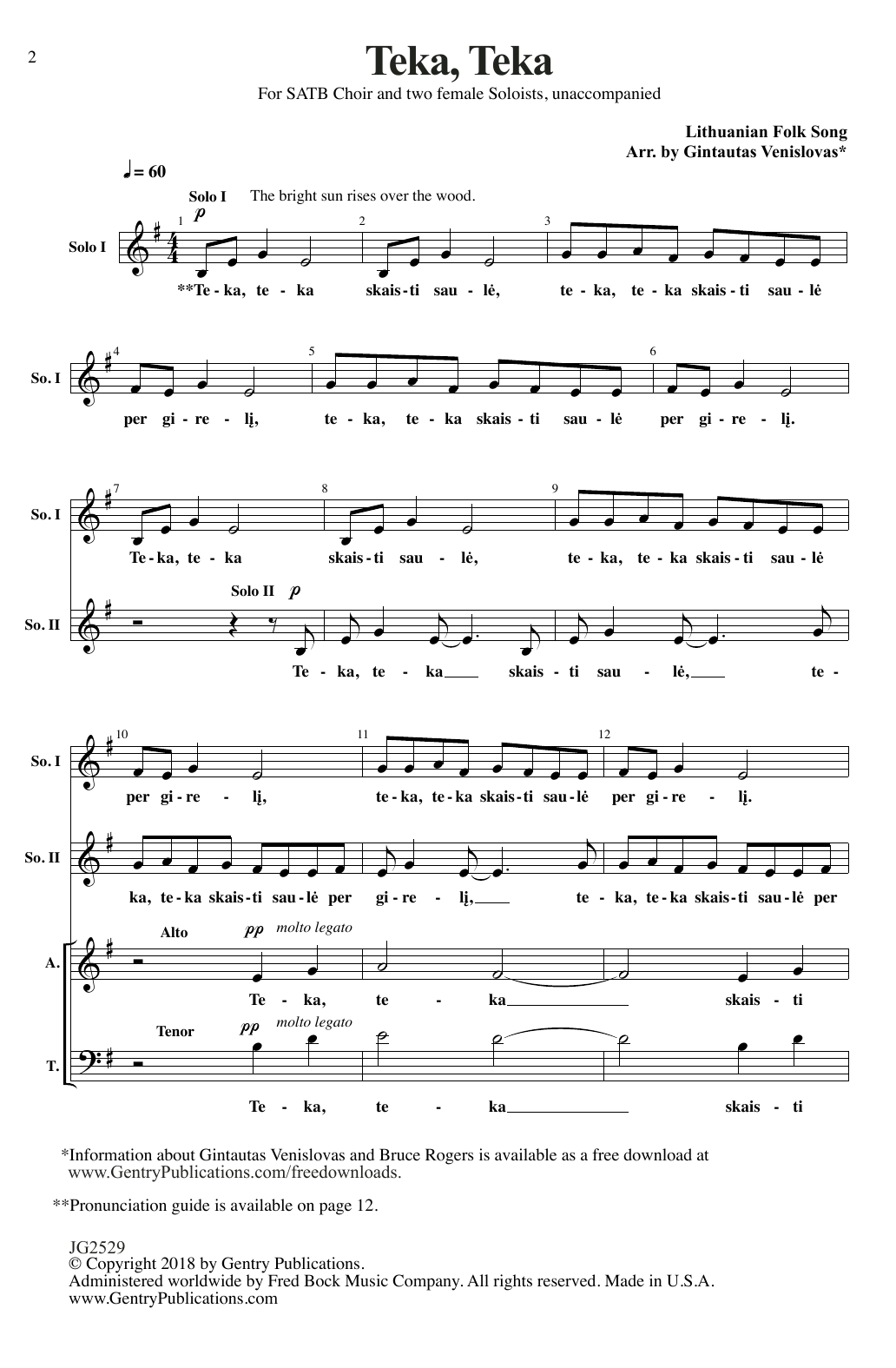
Teka, Teka (arr. Gintautas Venislovas) Sheet Music Preview

Teka, Teka (arr. Gintautas Venislovas): SATB Choral Octavo

Arranged by Gintautas Venislovas

Item: 35-DS00450720

Digital Download
$2.99
Description

Teka, Teka (arr. Gintautas Venislovas): SATB Choral Octavo isn't in MakeMusic Cloud just yet...but it could be. Let us know you'd like to see it, and you'll help shape what comes next. In the meantime, start a free trial and dive into thousands of interactive titles your students can play along with today.

Sample Audio
No sample audio found.
Sample Video
Additional Details
Publisher: Hal Leonard
Page Count: 11
SKU: 35-DS00450720

More about this title

About the Arranger: Gintautas Venislovas

Gintautas Venislovas is a Lithuanian composer and arranger whose work bridges traditional Baltic music with contemporary choral practice. His arrangements honor the source material while crafting textures that challenge and engage modern ensembles, making folk repertoire accessible without sacrificing cultural authenticity.

Why we love this

Venislovas's treatment brings genuine warmth to this traditional material without overshadowing its essential character. The four-part writing sits comfortably for singers at most levels, yet the harmonic choices reveal themselves over multiple rehearsals, rewarding directors who dig deeper.

What to expect

Intimate and grounded. The arrangement creates a sense of gathering, with voices weaving together in ways that feel both inevitable and gently surprising. There's a quiet dignity here, without pretense.

Who it's for

Intermediate to advanced SATB choirs looking to deepen their engagement with non-Western choral repertoire. This works equally well for concert programming, festival readings, and educational settings where cultural diversity matters.

How to get the most out of it

  • Shape the phrases as you would in a folk song; resist the urge to over-articulate. These melodies breathe naturally when singers treat them like speech, not classical art songs.
  • Balance soprano and alto lines carefully in sections where both carry melodic weight. A slight dynamic reduction in the upper voices often clarifies the harmonic movement underneath.
  • If a text translation is used, emphasize the rhythm of the language itself rather than imposing metric regularity. This lightens the music and lets the arrangement's understatement shine through.

How to use it

Pair this with other world music selections to create a thematically coherent set, or use it as a bridge piece between contrasting works that benefit from something reflective in between. Its modest scale and emotional clarity make it ideal for concert closings that need to feel genuine rather than grandiose.

Skills your students will build

  • Singing in a non-English language with natural phrasing
  • Blending four-part harmony with restrained, folk-inspired tone production
  • Recognizing and shaping modal or non-major/minor harmonic structures
  • Maintaining independent melodic lines while supporting ensemble blend

You May Also Like