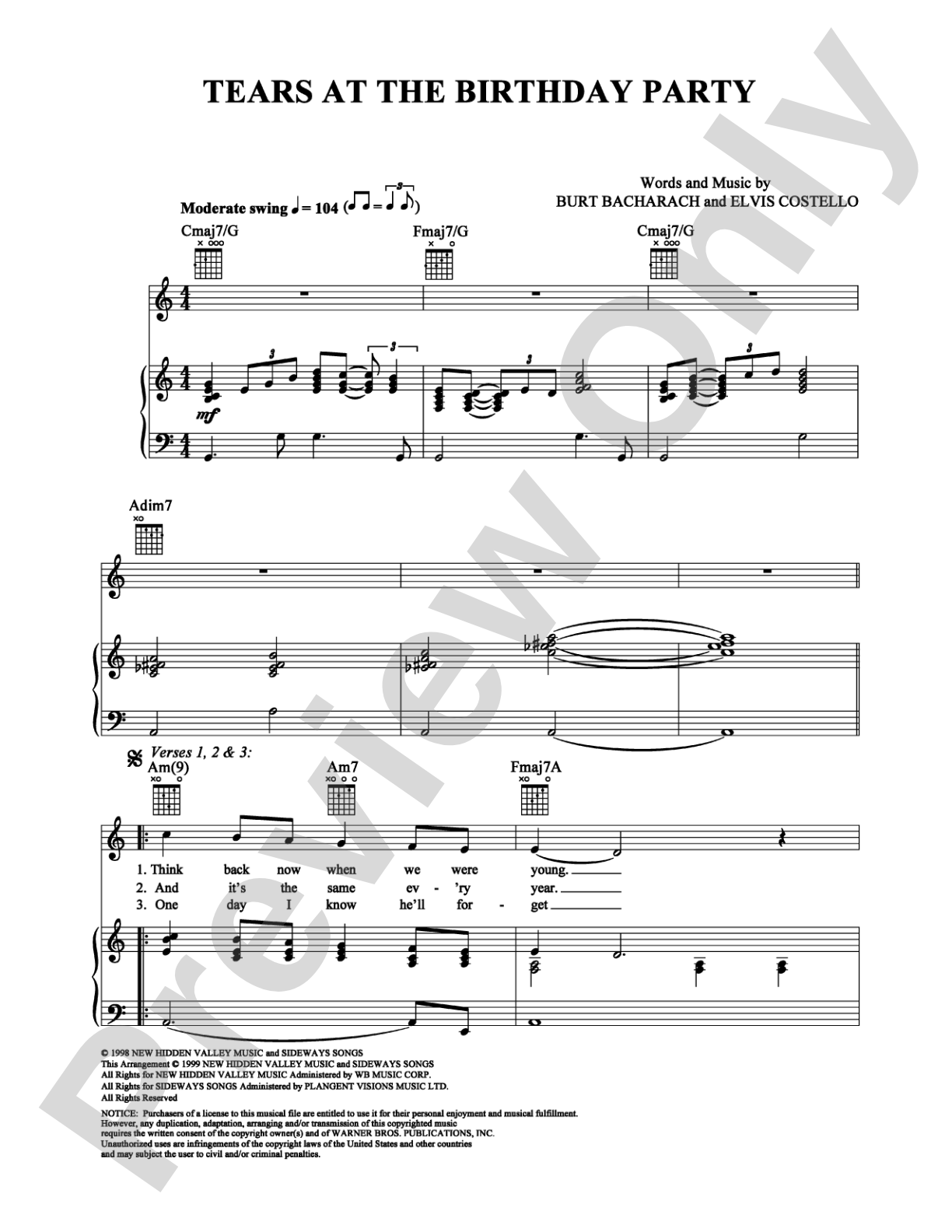
Tears At the Birthday Party: Piano/Vocal/Chords Digital Sheet Music

Tears At the Birthday Party: Piano/Vocal/Chords Digital Sheet Music

Burt Bacharach, Elvis Costello

Item: 00-PS-0001467

Digital Download
$2.95
Description

Tears At the Birthday Party: Piano/Vocal/Chords Digital Sheet Music isn't in MakeMusic Cloud just yet...but it could be. Let us know you'd like to see it, and you'll help shape what comes next. In the meantime, start a free trial and dive into thousands of interactive titles your students can play along with today.

Sample Audio
No sample audio found.
Sample Video
Additional Details
SKU: 00-PS-0001467

More about this title

About the Artist: Elvis Costello

Elvis Costello emerged as one of rock's sharpest songwriters in the late 1970s, known for his rhythmically inventive compositions and emotionally complex lyrics delivered with distinctive vocal intensity. His collaboration with Burt Bacharach on the 1998 album "Painted From Memory" showcased his ability to work within sophisticated pop arrangements while maintaining his distinctive artistic voice, earning Grammy recognition and introducing his work to adult contemporary audiences.

Costello's career spans decades of genre exploration, from punk and new wave to orchestral pop and country. His versatility as both composer and interpreter has made him a significant figure in contemporary music education, particularly for students studying songwriting craft and the relationship between lyrical content and harmonic sophistication.

Why we love this

This song pairs Costello's sophisticated lyrical sensibility with Bacharach's elegant harmonic language, creating a piece that rewards both careful vocal interpretation and thoughtful piano accompaniment. The piano/vocal/chords format captures a song that balances accessibility with musical depth, making it valuable for intermediate to advanced vocalists exploring contemporary pop standards.

What to expect

The song carries an underlying melancholy despite its social setting; the title itself suggests emotional undercurrents beneath a celebratory event. Musically, Bacharach's harmonic sophistication and Costello's restrained vocal delivery create intimacy even within a piano/vocal arrangement, inviting the listener into a personal moment rather than a public display.

Who it's for

This piece suits intermediate to advanced vocalists with experience in contemporary pop and jazz-influenced material, as well as pianists comfortable with jazz voicings and modern harmonic thinking. It works equally well for students developing their skill at interpreting adult contemporary repertoire and for singers exploring sophisticated songwriting from the pop tradition.

How to get the most out of it

  • Approach the vocal line with attention to Costello's characteristic phrasing; the melody often sits slightly behind the beat, creating rhythmic tension that should feel intentional rather than loose.
  • Use the chord symbols to understand the harmonic progression's logic, then let that understanding inform your comping choices rather than playing every chord literally.
  • Balance the piano part to support the vocal without overwhelming it; think of accompaniment as conversation rather than accompaniment.
  • Attend to the emotional shift suggested by the title and lyrical content; the piano can color the mood through dynamics and voice leading rather than relying on stylistic effects.

How to use it

This digital sheet music works well in a recital exploring contemporary songwriting standards or as part of a set highlighting the artistry of modern pop composers. It also serves as a valuable study piece for vocalists and pianists working to develop interpretation skills within the jazz-influenced pop tradition, offering harmonic and rhythmic complexity that rewards careful study.

Skills your students will build

  • Interpreting jazz-influenced pop harmony and understanding seventh chords and chromatic voice leading
  • Managing the relationship between vocal phrasing and accompaniment rhythm, particularly when the vocal line sits behind the beat
  • Reading and realizing chord symbols while maintaining stylistic consistency
  • Conveying emotional subtext through subtle musical choices in dynamics and tone color

You May Also Like