Teach Me the Measure Sheet Music Preview

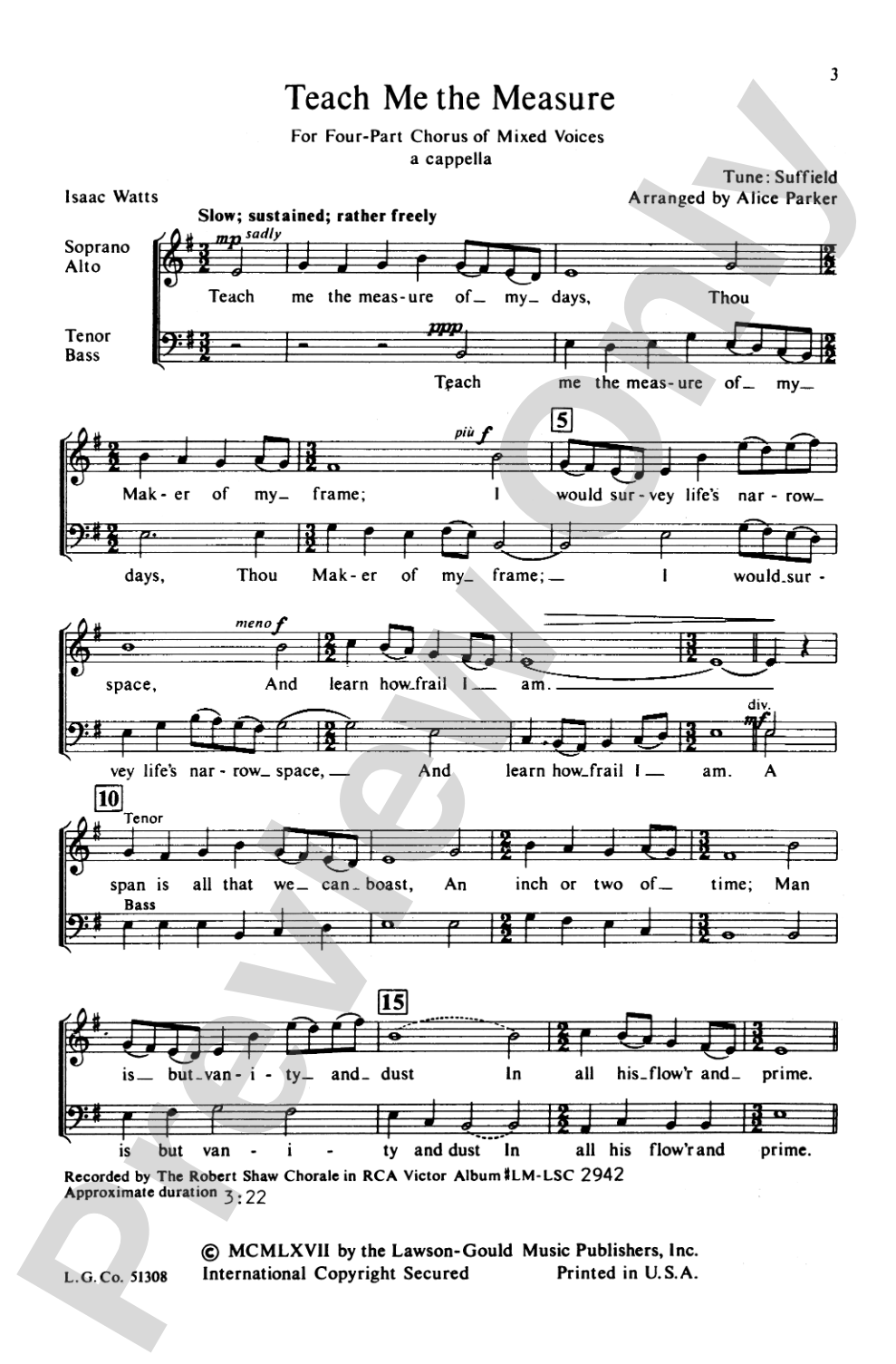
Teach Me the Measure: SATB Choral Octavo

Arr. Alice Parker

Item: 00-PO-0004989

Digital Download
$2.25

Minimum order quantity: 20 copies

Description

Teach Me the Measure: SATB Choral Octavo isn't in MakeMusic Cloud just yet...but it could be. Let us know you'd like to see it, and you'll help shape what comes next. In the meantime, start a free trial and dive into thousands of interactive titles your students can play along with today.

Sample Audio
No sample audio found.
Sample Video
Additional Details
Series: Alfred Archive Edition: Lawson-Gould Music Publishers
Publisher: Alfred Music
Page Count: 8
SKU: 00-PO-0004989

More about this title

About the Arranger: Alice Parker

Alice Parker

Alice Parker's career spans decades as a composer, conductor, and vocal music specialist with deep roots in American choral tradition. After studying at Smith College and Juilliard, she developed a legendary partnership with Robert Shaw that produced hundreds of settings of American folksongs, hymns, and spirituals now sung by choirs across the world. Her published catalog exceeds five hundred works, encompassing operas, cantatas, song cycles, and individual anthems that have shaped choral music in America.

Parker founded Melodious Accord, Inc. in 1985 to center her work on what she calls the heart of vocal music: the melody itself. She authored influential books on melodic style, choral improvisation, and church music, including The Melodious Accord Hymnal and her essays on song leading and congregational singing. Her honors include the Robert Shaw Award from the American Choral Directors Association, the Harvard Glee Club Foundation Medal, six honorary doctorates, and recognition as Distinguished Composer of the Year by the American Guild of Organists.

Why we love this

Parker's sacred arrangements sit at the intersection of accessibility and musical substance, making this octavo equally at home in a church service and a concert setting. Her melodic sensibility shines through here, creating a piece that sounds effortless to sing while carrying the spiritual weight that defines her work. Choirs consistently report that Parker's voicings feel natural to sing and reward careful attention to phrasing and line.

What to expect

The piece carries the warmth and intimate quality characteristic of Parker's sacred work, drawing listeners into a moment of genuine musical and spiritual reflection. Its melodic clarity and thoughtful harmonic language create a sense of both timelessness and immediacy, as if the song has been sung for generations yet speaks to the present moment.

Who it's for

This octavo suits experienced church choirs, college and university ensembles, and concert choruses seeking repertoire that combines spiritual depth with musical craftsmanship. Directors programming sacred music will find this work engaging for singers with a range of abilities who can sustain ensemble blend and attend to Parker's nuanced voicings.

How to get the most out of it

  • Emphasize the melodic line through dynamic shaping rather than volume alone; Parker's arrangements reveal their beauty when each voice's contribution to the overall phrase shape is clear.
  • Balance the parts so that the primary melodic strand emerges naturally without forcing it, allowing secondary voices to support the harmonic fabric.
  • Pay attention to Parker's text setting; her understanding of how words interact with melody means that clear diction and thoughtful word stress will enhance the piece's impact.
  • Allow space for breath in phrases and resist the urge to push the tempo; Parker's writing often works best when given room to breathe.

How to use it

Program this as part of a sacred choral concert or worship service where it can anchor a thematic set of spiritual or hymn-based works. Its eight-page length and moderate demands make it ideal for a service anthem or concert piece that doesn't require extensive rehearsal time but rewards careful preparation.

Skills your students will build

  • Part independence and ensemble blend in four-part writing
  • Singing melody-driven harmonic progressions with awareness of secondary voice functions
  • Shaping phrases using Parker's natural text setting and melodic contour
  • Sustaining legit vocal tone and diction in sacred music contexts

You May Also Like