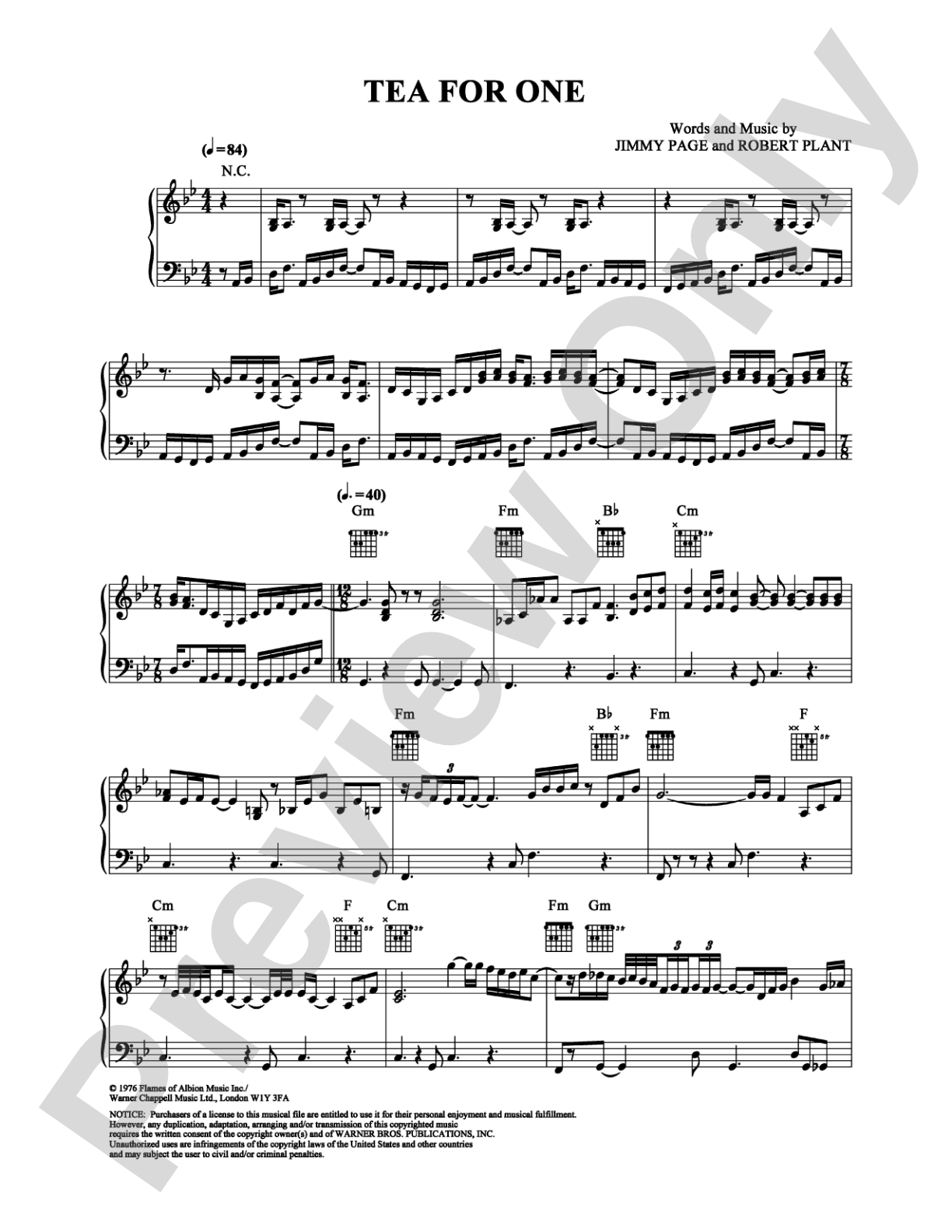
Tea For One: Piano/Vocal/Chords Digital Sheet Music

Tea For One: Piano/Vocal/Chords Digital Sheet Music

Led Zeppelin, Jimmy Page, Robert Plant

Item: 00-PS-0002868

Digital Download
$3.99
Description

Tea For One: Piano/Vocal/Chords Digital Sheet Music isn't in MakeMusic Cloud just yet...but it could be. Let us know you'd like to see it, and you'll help shape what comes next. In the meantime, start a free trial and dive into thousands of interactive titles your students can play along with today.

Sample Audio
No sample audio found.
Sample Video
Additional Details
SKU: 00-PS-0002868

More about this title

About the Artist: Led Zeppelin

Led Zeppelin stands among rock music's most influential acts, fundamentally shaping the sound of heavy metal and hard rock from their 1968 debut onward. The band's musical vocabulary drew from blues, folk, and world traditions, synthesizing these sources into something entirely new. Their work spans four decades of recorded music and remains central to understanding modern rock in educational contexts.

In the classroom and rehearsal room, Led Zeppelin's catalog serves as a bridge between popular music literacy and serious musical study. Their songs reward close harmonic and melodic analysis, feature sophisticated song structures, and demonstrate how rock arrangers approach voice leading and accompaniment.

Why we love this

Tea For One sits in a rare space within the Led Zeppelin catalog: introspective, blues-rooted, and genuinely singable without requiring instrumental virtuosity beyond reach. The piano arrangement opens this composition to vocalists and pianists who want to explore rock repertoire with real emotional depth rather than technical excess. Students gain meaningful experience with accompaniment textures that inform both classical song interpretation and contemporary music performance.

What to expect

Tea For One carries the reflective melancholy of the blues into an intimate space, almost conversational. The piano accompaniment provides steady harmonic grounding while leaving room for the vocal line to sing freely, creating a sense of introspection without heaviness. This is late-night music, the kind that invites listening as much as it invites performance.

Who it's for

Piano students exploring rock and popular music traditions will find an accessible yet sophisticated entry point here. Singers looking for repertoire that balances emotional authenticity with moderate technical demands will connect with this arrangement. It works equally well for soloists preparing a recital set that includes rock music or for duos building a mixed-genre program.

How to get the most out of it

  • Commit to the rubato. This song breathes; the piano part should follow the voice's phrasing rather than metronomic precision.
  • Layer the dynamics carefully. Begin almost introspectively and allow intensity to build across the song's arc rather than starting at full volume.
  • Pay attention to the vocal melody's placement against the harmonic rhythm; slight delays or anticipations create the bluesy character that defines this arrangement.
  • Use sustain strategically on the piano to create resonance, but lift before each new harmonic movement to keep the texture clear.

How to use it

This arrangement fits naturally into recital sets that blend rock, pop, and jazz standards with classical material. Consider pairing it with other introspective singer-pianist works from different genres to demonstrate how emotional storytelling transcends style boundaries. It also serves as an excellent choice for demonstrating to students how songs from popular music traditions can sustain sustained performance attention in concert settings.

Skills your students will build

  • Reading and performing chord symbols in a rock context
  • Interpreting rubato and vocal phrasing in piano accompaniment
  • Building dynamic shape across a song's full arc
  • Translating blues harmonic language into lyrical voice leading
  • Balancing notated notation with interpretive flexibility

You May Also Like