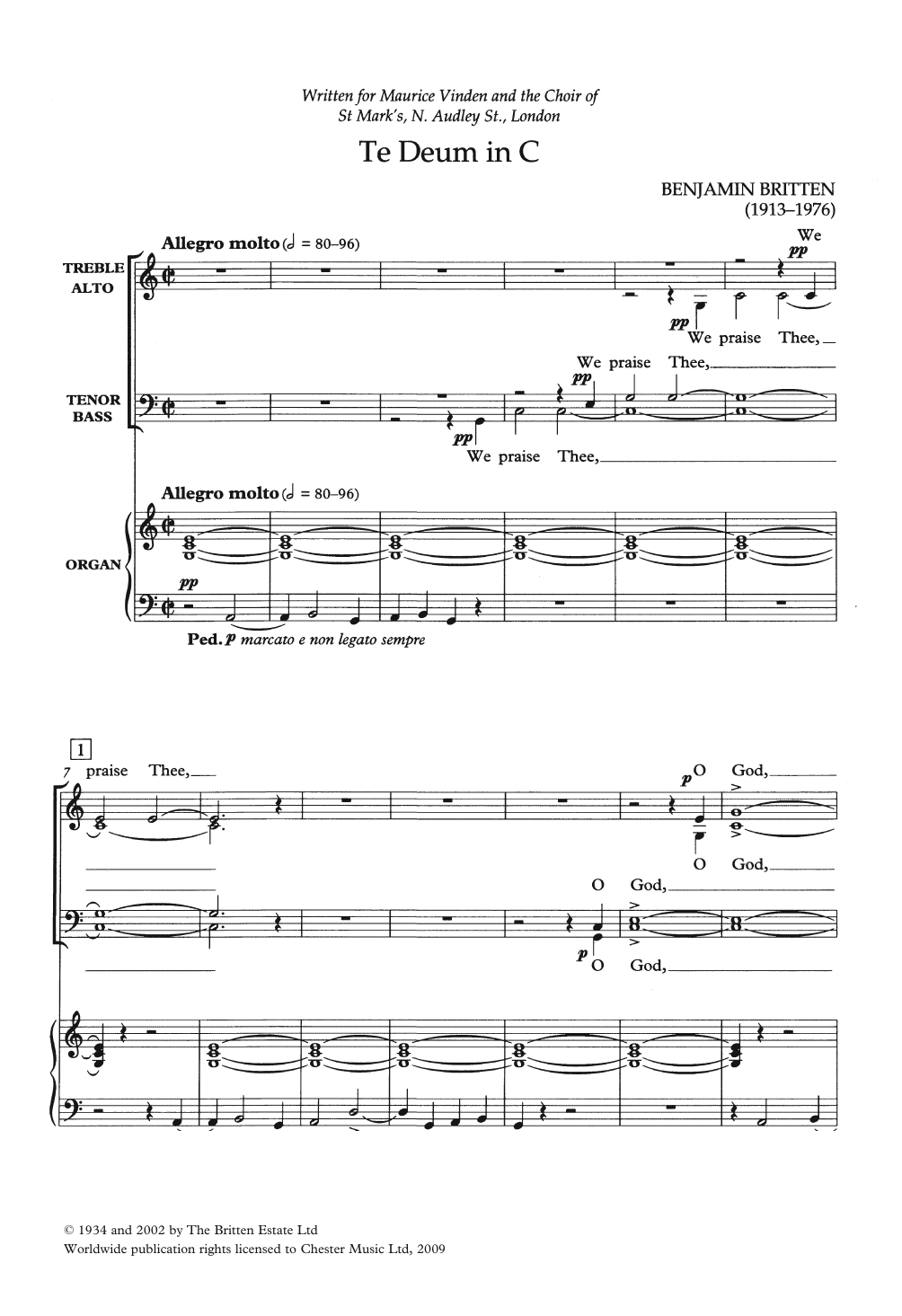
Te Deum In C Sheet Music Preview

Te Deum In C: Choral Octavo

By Benjamin Britten

Item: 35-DS00339767

Digital Download
$2.99
Description

Te Deum In C: Choral Octavo isn't in MakeMusic Cloud just yet...but it could be. Let us know you'd like to see it, and you'll help shape what comes next. In the meantime, start a free trial and dive into thousands of interactive titles your students can play along with today.

Sample Audio
No sample audio found.
Sample Video
Additional Details
Publisher: Hal Leonard
Page Count: 18
SKU: 35-DS00339767

More about this title

About the Composer: Benjamin Britten

Benjamin Britten (1913–1976) was one of the twentieth century's most versatile composers, equally comfortable writing symphonies, operas, song cycles, and choral works. His compositions for young musicians and amateur ensembles reveal a gift for clarity and accessibility without sacrificing musical substance; he understood how to write idiomatically for singers and players at all levels. Britten's choral works span sacred and secular texts, each one crafted with meticulous attention to text setting and vocal writing that brings poetry to life.

Why we love this

Britten's setting of the Te Deum brings liturgical grandeur within reach of skilled amateur choirs. The piece balances structural clarity with moments of genuine expressive depth, giving singers a real composition to sink their teeth into rather than a simplified arrangement. Programming this alerts your audience that your choir engages with twentieth century choral literature as seriously as you do with Renaissance masters.

What to expect

Britten's Te Deum radiates clarity and purpose, unfolding with the inevitability of a well-told story. The harmonic language feels modern yet grounded, creating moments of luminous beauty alongside passages of directness and vigor.

Who it's for

Conductors building a choral program that extends beyond standard repertoire will find this accessible without being diluted. It suits choirs with solid ensemble skills and singers ready to tackle twentieth century harmony and text setting.

How to get the most out of it

  • Pay attention to Britten's dynamics and articulation markings; they shape the text as much as the melody does. These aren't ornaments to add later.
  • Shape the longer vocal lines with a sense of forward motion, resisting the urge to slow down on held notes. Britten's harmonic language moves constantly.
  • Balance ensemble blend in the tutti sections by checking that no single voice part is dominating the texture. The interplay between parts matters as much as individual beauty.
  • Use this as an opportunity to refresh your singers' understanding of Latin pronunciation, especially for vowel consistency across the ensemble.

How to use it

Include this as a centerpiece on a concert exploring twentieth century sacred music, or pair it with Renaissance settings of the same text for a historical dialogue. It works equally well in a chamber concert context or as part of a larger liturgical celebration.

Skills your students will build

  • Reading twentieth century harmonic language and voice leading
  • Executing precise dynamic control and text-based articulation
  • Sustaining long vocal lines with forward momentum
  • Latin diction and text underlay in a modern compositional context
  • Part independence within homophonic and polyphonic textures

You May Also Like