
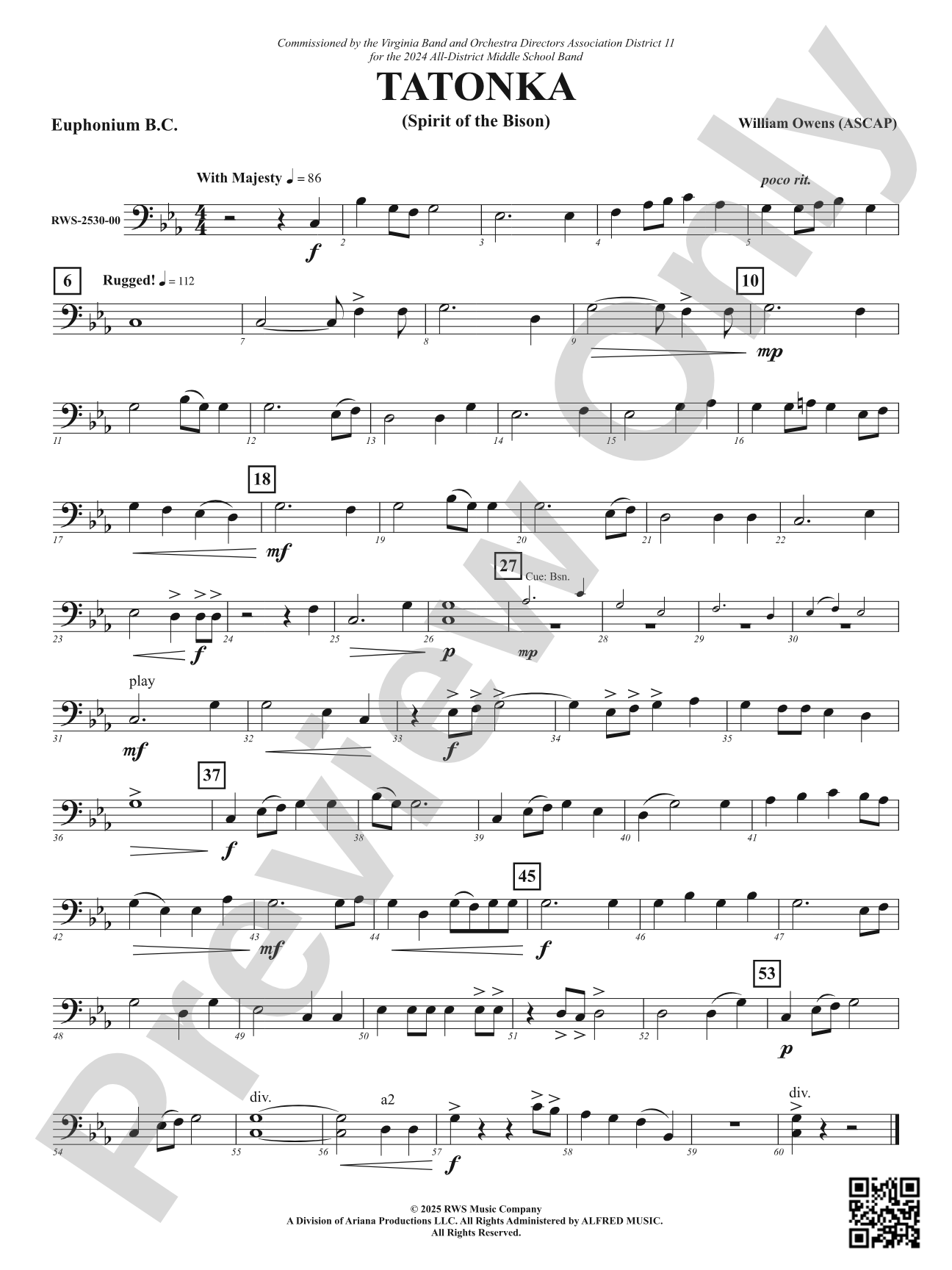

Tatonka (Spirit of the Bison): Euphonium B.C.
(Spirit of the Bison)
By William Owens
Grade: 2
Item: 98-PC-RWS2530_BBC1
$3.99
Pickup currently not available
Description
Tatonka is a musical depiction of North America's most formidable land mammal, the bison. The music is quite representative of the beast itself; it is a song of survival. Beginning with trumpet fanfare, the piece quickly settles into a steady "marching" beat. While brief moments of tenderness are heard, boldness and fortitude are at the heart of the piece


Tatonka (Spirit of the Bison): Euphonium B.C. isn't in MakeMusic Cloud just yet...but it could be. Let us know you'd like to see it, and you'll help shape what comes next. In the meantime, start a free trial and dive into thousands of interactive titles your students can play along with today.
Request This Title
Tell us you want it.
Start Your Free Trial
Explore everything that's ready to play right now.
Sample Audio
1
Audio File
--:--
0:00
0:00
Sample Video
Additional Details
Series:
RWS - Developing Band
Publisher:
RWS Music Company
SKU:
98-PC-RWS2530_BBC1
More about this title
About the Composer: William Owens

William Owens has composed over 300 works for concert band, string orchestra, and small ensemble since 1993, establishing himself as a trusted voice in music written for developing musicians. A native of Gary, Indiana, and 1985 graduate of VanderCook College of Music, Owens has spent decades as an educator, clinician, and conductor across North America, bringing a practical understanding of what young ensembles need to perform with confidence and musicality.
His compositions appear on required music lists nationally and internationally, with many analyzed in educational texts as benchmarks of the young band repertoire. Owens has received commissions from the South Plains College Department of Fine Arts, Phi Beta Mu International, and the American Bandmasters Association. He is an ASCAP member, a Distinguished Alumnus of VanderCook, and a recipient of the Texas Bandmasters Association's Meritorious Achievement Award. After 30 years as a band director in Texas, Owens retired in 2014 and now resides in Fort Worth with his wife, Georgia.
Why we love this
Owens captures the essence of programmatic writing at Grade 2 without oversimplifying the musical ideas. The opening trumpet fanfare immediately engages listeners and players alike, while the central marching pulse gives every section a clear role. The inclusion of brief lyrical moments prevents the piece from becoming one-dimensional, teaching young musicians that boldness and tenderness can coexist within a single narrative.
What to expect
Tatonka captures both the weight and the wild intelligence of its subject. The music charges forward with unstoppable momentum, grounded by that relentless marching pulse, yet it contains quiet moments of reflection that suggest survival born of both strength and wisdom. You hear the determination of a creature built for endurance, and the landscape it inhabits.
Who it's for
Grade 2 concert bands seeking a substantial programmatic work that combines accessibility with musical substance. Directors looking for a piece that appeals to audiences while giving developing musicians meaningful technical and expressive challenges will find Tatonka an ideal fit for festival play, concert programming, or contest preparation.
How to get the most out of it
- Lead the opening trumpet fanfare with clear articulation and confidence; this statement sets the entire character of the piece and establishes the bison's commanding presence from the downbeat.
- Shape the steady marching beat with slight dynamic breathing to avoid mechanical phrasing; find places where the ensemble can crescendo and recede naturally, much like a living creature moving through landscape.
- Balance the tender passages by asking lower voices to support without drowning the lyrical line; these moments require restraint from the full ensemble and should feel like a pause in the narrative rather than a breakdown.
How to use it
Position this piece as the centerpiece of a concert focused on American themes or programmatic storytelling. Its Grade 2 accessibility makes it suitable for early-season programming while its Contest/Festival designation ensures it holds up under adjudication. Pair it with contrasting lyrical works to showcase your ensemble's range, or program it as the closing statement of a set where its bold spirit leaves a lasting impression.
Skills your students will build
- Sustaining a steady march pulse across the full ensemble
- Balancing forte articulation with clear ensemble blend
- Contrasting dynamic character within a single piece (bold vs. tender passages)
- Following programmatic intent through musical storytelling
- Maintaining intensity in repetitive rhythmic figures without mechanical phrasing