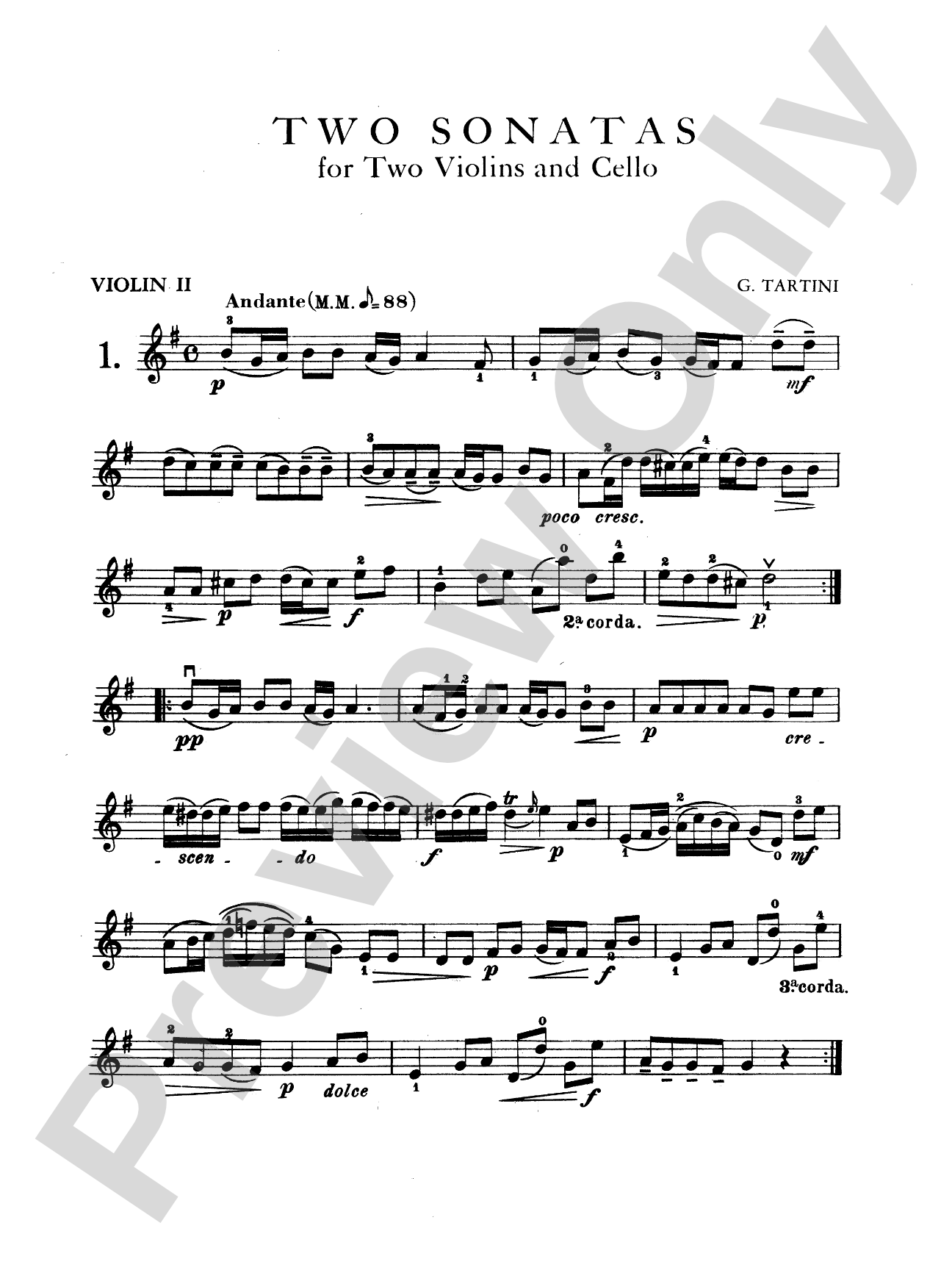
Tartini: Two Sonatas for String Trio (Score & Parts) Sheet Music Preview

Tartini: Two Sonatas for String Trio (Score & Parts)

By Giuseppe Tartini

Item: 00-PC-0009483

Digital Download
$0.99
Description

Don't just read it, hear it, play along with it, and watch your students grow with it. In MakeMusic Cloud, Tartini: Two Sonatas for String Trio (Score & Parts) comes alive with professional accompaniment, adjustable tempo, and built-in practice tools that turn solo practice into real progress.

Sample Audio
No sample audio found.
Sample Video
Additional Details
Series: Kalmus Edition
Publisher: Alfred Music
Page Count: 20
SKU: 00-PC-0009483

More about this title

About the Composer: Giuseppe Tartini

Giuseppe Tartini (1692-1770) was one of the Baroque era's most influential violinists and composers, known for establishing new standards of technique and expressivity on the instrument. Based primarily in Padua, Italy, he founded a prestigious violin school that attracted students from across Europe and developed innovations in bowing and intonation that shaped violin pedagogy for generations. His compositional output spans concertos, sonatas, and chamber works that remain central to string player development today.

Why we love this

These sonatas showcase Tartini's gift for writing idiomatic string music that sits naturally under the fingers while maintaining genuine compositional substance. The intimate three-voice texture demands precise ensemble balance and intonation, making them invaluable for developing chamber musicianship at the advanced level.

What to expect

Tartini's writing glows with the conversational warmth of Baroque chamber music, where three distinct voices engage in genuine dialogue rather than serve a single melody. The music balances structural clarity with expressive depth; movements unfold with architectural logic while allowing room for the stylistic ornamentation and phrasing detail that animated 18th-century performance.

Who it's for

Advanced string trio ensembles preparing for chamber music competitions, festivals, or recitals will find these sonatas both musically rewarding and technically appropriate. Students who have developed secure independent part-reading and sensitive ensemble listening are ready for the demands Tartini places on balance and intonation. Directors seeking substantial Baroque chamber works suitable for performance or final-round festival programs will appreciate the dramatic scope and genuine musical substance here.

How to get the most out of it

  • Establish a clear hierarchy of voices in rehearsal by identifying where the primary melodic line sits in each movement; often the first violin carries the main idea, but Tartini frequently gives significant material to the second violin and cello.
  • Shape each phrase with attention to Baroque rhetorical principles rather than 19th-century rubato; the music benefits from clear articulation and period-appropriate phrasing within a steady tempo.
  • Balance the texture so the cello is heard as an equal partner, not merely harmonic support; these sonatas give the cello genuine countermelodic responsibility.
  • Work the intonation of unisons and octaves between the two violins with particular care, as any wavering becomes immediately apparent in the transparent three-voice texture.

How to use it

These sonatas work beautifully as a complete program unit for a chamber music recital or as a centerpiece in a concert pairing Baroque and Classical string repertoire. Consider programming them alongside works by Vivaldi or Corelli to create a focused chamber music set that showcases the development of Italian string writing during this period.

Skills your students will build

  • Reading and executing Baroque ornamentation and articulation conventions
  • Balancing three independent lines of equal musical importance
  • Intonation precision in transparent textures with frequent unisons
  • Ensemble listening and response within a small ensemble setting
  • Interpreting figured bass implications and harmonic context from a chamber perspective
  • Stylistically appropriate phrasing and tempo flexibility within Baroque aesthetics

You May Also Like