Tarantella Viva! Sheet Music Preview

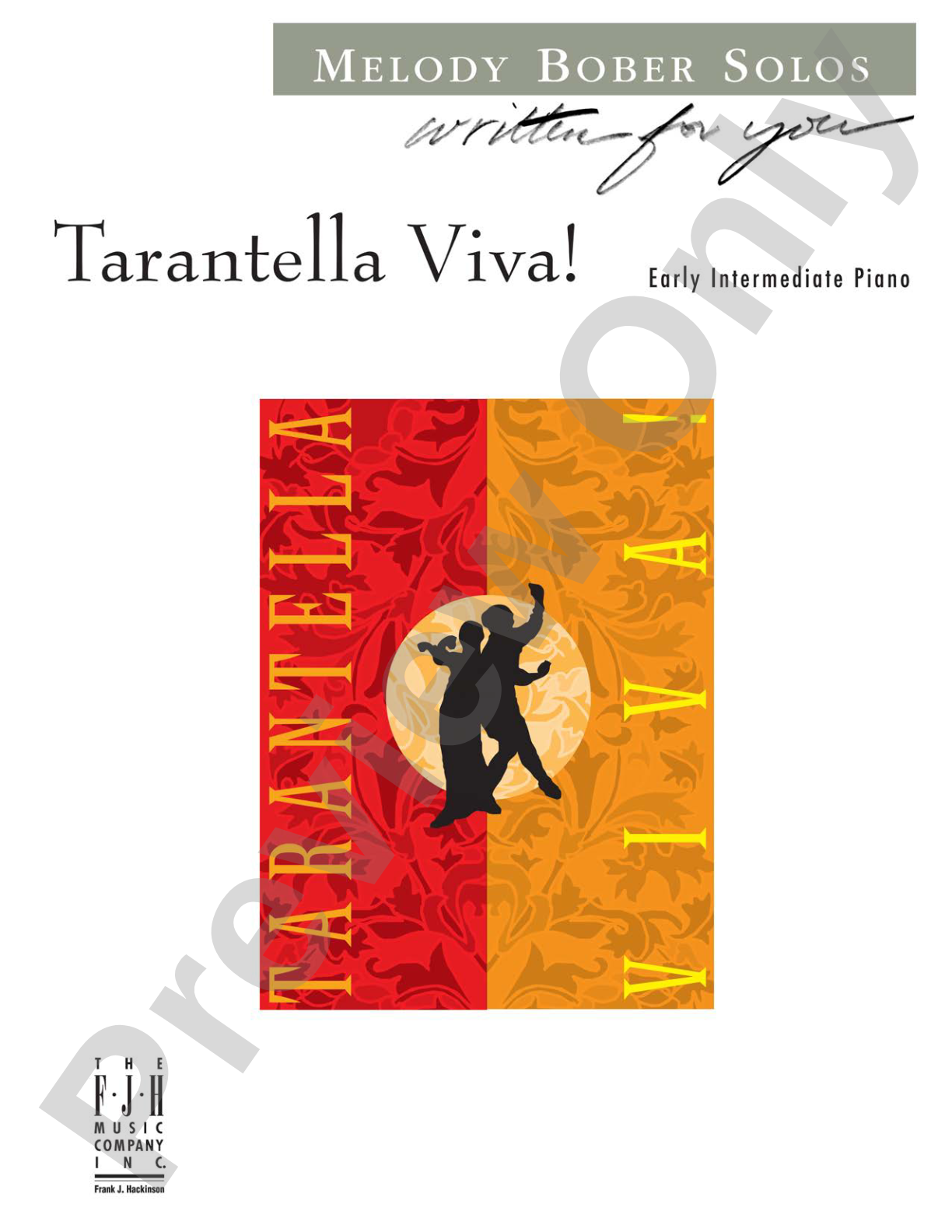
Tarantella Viva!: Piano

By Melody Bober

Item: 98-DW9238

Digital Download
$4.50
Description
A fast, exciting piece in 6/8 time with staff changes and hand crossovers, and the RH alternating between eighth notes and chords. This piece proclaims that the tarantella is indeed, alive! Another terrific piece from the creative mind of Melody Bober.

Tarantella Viva!: Piano isn't in MakeMusic Cloud just yet...but it could be. Let us know you'd like to see it, and you'll help shape what comes next. In the meantime, start a free trial and dive into thousands of interactive titles your students can play along with today.

Sample Audio
No sample audio found.
Sample Video
Additional Details
Series: Written For You
Publisher: The FJH Music Company, Inc.
SKU: 98-DW9238

More about this title

About the Composer: Melody Bober

Melody Bober

Melody Bober composes piano music grounded in her twenty years of classroom teaching and her graduate training in performance. After completing her bachelor's degree in music education at the University of Illinois, she earned a Master of Arts in piano performance from Minnesota State University, Moorhead, where she studied with acclaimed pianists including Joel Shapiro and Andrew Froelich. Her work as a church pianist, private studio instructor, and university faculty member has shaped her ability to write pieces that motivate students while respecting their developing technical abilities.

Bober is recognized across North America as both an innovative composer and a sought-after clinician at teacher conventions and workshops. Her influence extends from her mentors—among them jazz educator Tony Caramia and music education specialist Mary Hoffman—whose philosophies she carries into her own creative work. She continues to teach privately and compose from her home in Minnesota.

Why we love this

Bober captures the raw vitality of the tarantella without requiring technical virtuosity. The hand crossovers and rhythmic alternation between single notes and chords give intermediate pianists genuine engagement with texture and pattern, while the 6/8 meter provides a satisfying groove that students can feel immediately. The piece declares itself through sheer energy rather than complexity.

What to expect

Tarantella Viva! sparkles with the irrepressible energy of a folk dance that refuses to sit still. The constant motion between melody and accompaniment, combined with hand crossovers that demand physical presence at the keyboard, makes this piece feel alive in the truest sense. It is the sonic equivalent of movement captured in time.

Who it's for

Intermediate pianists who are comfortable with hand coordination and ready to explore rhythmic complexity in a new meter. Students drawn to pieces with character and momentum will find the tarantella's traditional spirit engaging, and the technical demands are manageable enough that they can focus on style and expression rather than survival.

How to get the most out of it

  • Establish the 6/8 pulse as a single unit per measure rather than counting six beats; this helps the piece feel propulsive rather than plodding.
  • Practice the hand crossovers slowly with separate hands first, then combine them at a tempo where the mechanical motion is comfortable before building speed.
  • Shape the right hand's alternation between eighth notes and chords so the chords land with slight emphasis, creating rhythmic clarity in the texture.
  • Maintain steady sixteenth-note patterns in the accompaniment even as the melody accelerates toward the finish; evenness here supports the soloist's freedom on top.

How to use it

This piece works beautifully in a recital focused on folk traditions or world music, especially paired with other dances or character pieces. Its duration and technical polish also make it suitable as a student concerto performance or as part of a "New Directions" program that highlights contemporary composers writing in traditional forms.

Skills your students will build

  • Reading and performing in 6/8 meter with secure pulse
  • Hand coordination across staff changes and hand crossovers
  • Rhythmic contrast between sustained chords and flowing eighth-note passages
  • Tempo control and consistent accompaniment patterns while managing technical demands
  • Stylistic interpretation of the tarantella idiom

You May Also Like