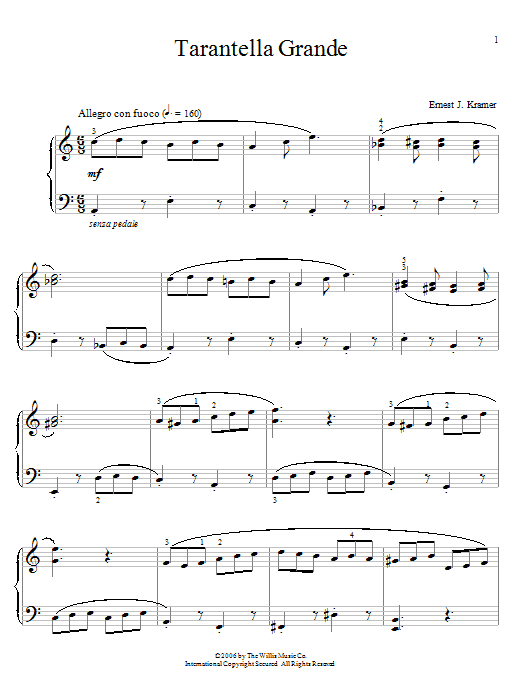
Ernest J. Kramer was an American composer and educator who specialized in accessible yet musically substantial arrangements and original works for piano students. His output bridged the gap between technical instruction and genuine musicality, creating pieces that challenged students without overwhelming them.
Why we love this
Kramer understood what intermediate pianists need: a piece with real character that doesn't require virtuosic technique to sound impressive. The tarantella form gives students a framework for understanding rhythmic vitality and sectional structure, while the educational arrangement respects their current abilities without patronizing them.
What to expect
Propulsive and dancing, with the relentless energy tarantella rhythms bring. There's joy in the forward momentum, balanced by moments where the melody can breathe and be heard distinctly.
Who it's for
Intermediate pianists (roughly grades 4-5) who are ready to move beyond simplified arrangements into authentic character pieces. This works well for students developing their interpretive skills and looking for accessible yet musically coherent repertoire.
How to get the most out of it
Anchor the rhythmic drive in the left hand accompaniment rather than forcing speed; a steady, energetic pulse matters more than breakneck tempo.
Shape the melody with deliberate phrase breathing rather than playing it straight through; this transforms the piece from exercise into performance.
Find the natural weight shifts between sections by experimenting with different dynamic levels; let the form guide your interpretation.
How to use it
Include this on a spring or end-of-year recital where you want to program something with genuine musical substance that intermediate students can play with confidence. It pairs well alongside other character pieces from the classical era.
Skills your students will build
Maintaining steady rhythmic drive across extended passages
Coordinating independent melodic and accompaniment lines at moderate tempo
Interpreting stylistic conventions of the tarantella form
Building structural awareness through sectional contrast
Developing finger independence and articulation control
You May Also Like
Scan to Complete Your Purchase
Use your phone's camera to scan the code below
You'll log in on your phone and the order will be added to your account