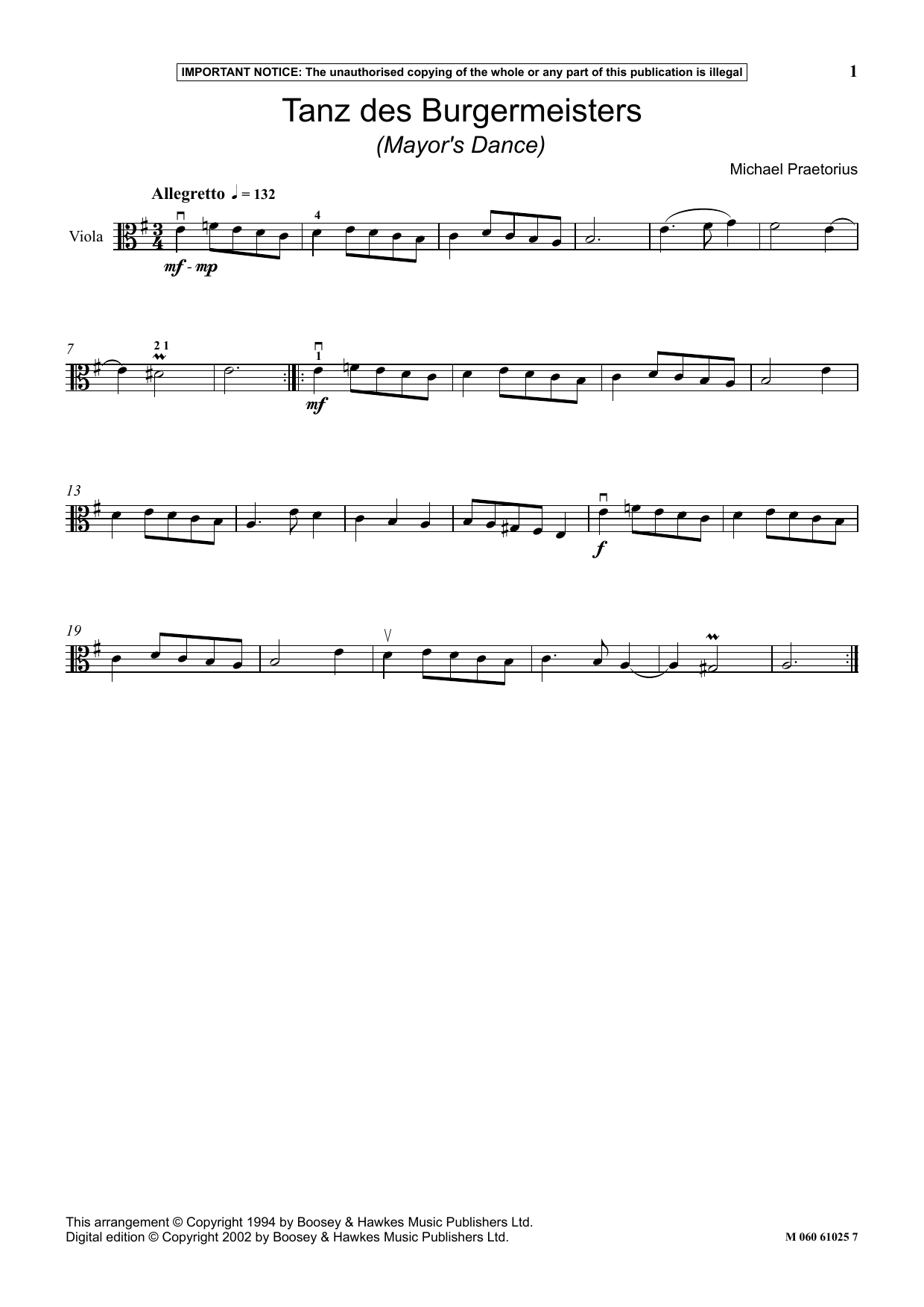
Tanz Des Burgermeisters (Mayor's Dance) Sheet Music Preview

Tanz Des Burgermeisters (Mayor's Dance): Instrumental Solo

As performed by Michael Praetorius

Item: 35-DS00239180

Digital Download
$3.99
One moment…
Description

Discover MakeMusic Cloud: thousands of interactive titles your students can play along with today.

Sample Audio
No sample audio found.
Sample Video
Additional Details
Publisher: Hal Leonard
Page Count: 2
SKU: 35-DS00239180

More about this title

About the Artist: Michael Praetorius

Michael Praetorius (1571-1621) was a German composer, organist, and theorist whose prolific output shaped early Baroque music across Germany. His works span sacred and secular genres, but he remains best known for his dance suites and hymn settings that bridge Renaissance and Baroque sensibilities. Praetorius held positions at several German courts and documented his compositional methods in his treatise Syntagma Musicum, making him both a practitioner and pedagogue of his era.

For music educators, Praetorius represents an invaluable bridge into early music. His dances are accessible without sacrificing historical authenticity, and they offer students direct exposure to dance forms that shaped instrumental writing for centuries. His music rewards careful attention to articulation, phrasing, and the interaction between independent lines.

Why we love this

Praetorius's dance music has an immediate charm that works equally well in concert settings and classroom demonstrations. This particular piece gives ensembles a two-page work that teaches ensemble balance and clear rhythmic coordination without demanding advanced technical facility, making it practical for mixed-ability groups while remaining musically sophisticated.

What to expect

A ceremonial procession with character and purpose. The Mayor's Dance carries both dignity and forward motion, with the kind of sturdy rhythmic foundation that makes you want to move without being aggressively energetic. It feels civic and celebratory, the kind of music that might accompany important people entering a hall.

Who it's for

This work suits intermediate ensembles exploring Renaissance and early Baroque repertoire, as well as any group looking for approachable music with genuine historical substance. It works for band, orchestra, or mixed instrument settings where flexibility in instrumentation is available.

How to get the most out of it

  • Let the pulse breathe rather than pressing forward; Renaissance dances sit comfortably when phrasing follows natural text rhythms and dance gestures
  • Articulation matters enormously here; crisp tonguing and clear note separation distinguish period style from modern legato habits
  • Balance inner voices so the piece doesn't collapse into melody and accompaniment; each line contributes to the harmonic and rhythmic texture

How to use it

Pair this with other Praetorius dances or Renaissance-era instrumental works to build a coherent historical unit within a concert. At two pages, it serves as an excellent shorter piece between larger works or as an opening number that establishes a stylistic context for the rest of your program.

Skills your students will build

  • Reading and executing period articulation conventions
  • Maintaining rhythmic clarity in dance forms
  • Balancing multiple independent lines without melody dominating
  • Understanding harmonic function in Renaissance and early Baroque contexts

You May Also Like