
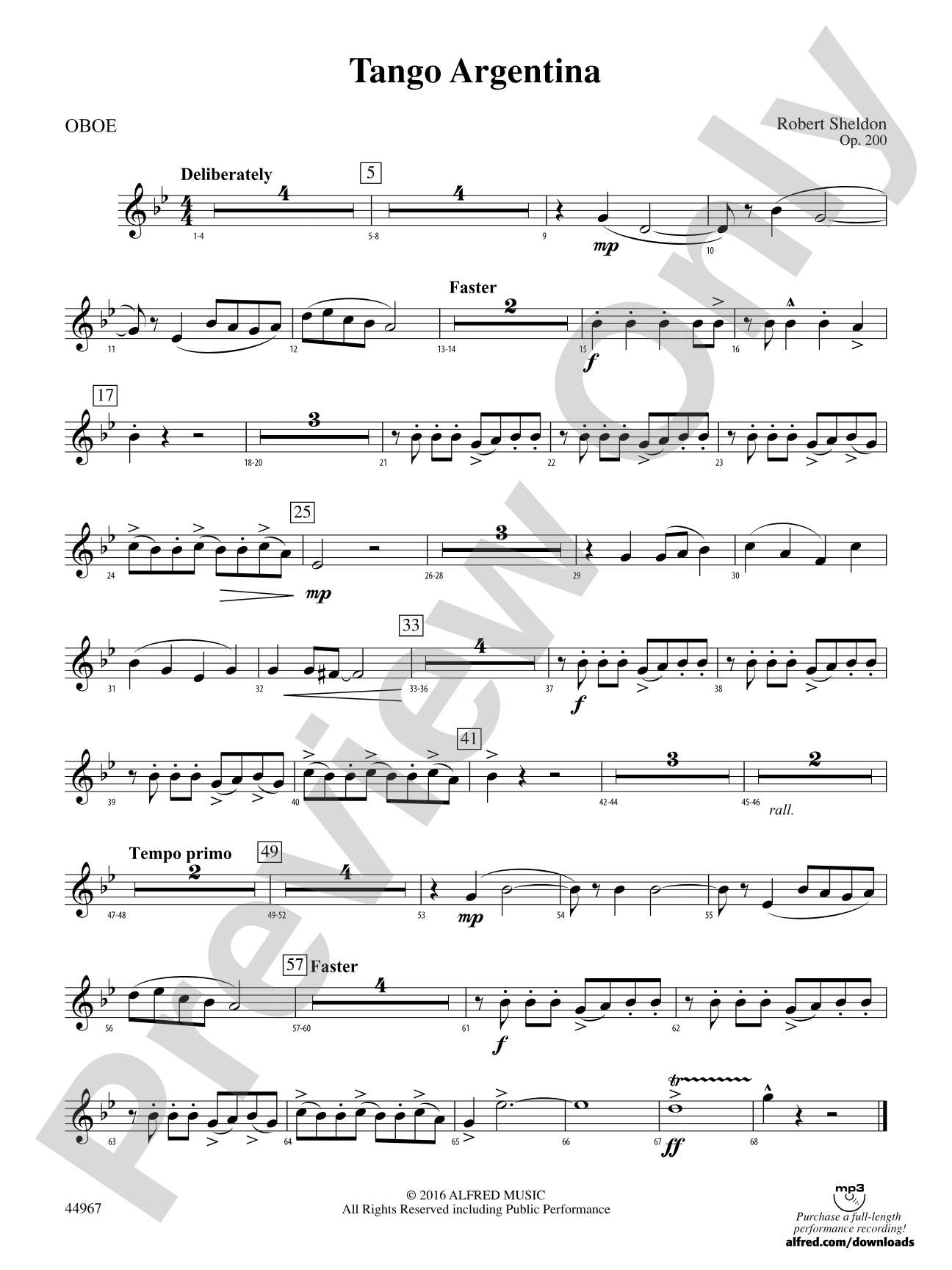

Tango Argentina: Oboe
By Robert Sheldon
Grade: 1.5 (Easy)
Item: 00-PC-0017432_O1
$3.00
Pickup currently not available
Description
The tango originated in late 19th century Buenos Aires, and has become popular around the world due to its driving rhythms, distinctive sound, and the passionate dance steps it inspires. This piece allows even young bands to experience the style and attitude of this wonderful musical genre. (2:45) Correlates with Sound Innovations for Concert Band, Book 2, Level 2.


Don't just read it, hear it, play along with it, and watch your students grow with it. In MakeMusic Cloud, Tango Argentina: Oboe comes alive with professional accompaniment, adjustable tempo, and built-in practice tools that turn solo practice into real progress.
Open in the Player
Jump straight in and assign it today.
Start Your Free Trial
Open this title and explore the full library in minutes.
Sample Audio
1
Audio File
--:--
0:00
0:00
Sample Video
Additional Details
Series:
Sound Innovations for Concert Band
Publisher:
Alfred Music
Page Count:
136
SKU:
00-PC-0017432_O1
More about this title
About the Composer: Robert Sheldon

Robert Sheldon stands among the most frequently performed composers for wind band. His work as lead author of Sound Innovations for Concert Band has shaped how thousands of young musicians develop their craft, and his output remains prolific, with new commissions and publications released annually. His honors span the American School Band Directors Association, Phi Beta Mu, and ASCAP, reflecting the respect his peers hold for compositions that balance musicality with pedagogical integrity.
Sheldon's reach extends beyond the page. He conducts All-State and Regional Honor Bands regularly, serves as a clinician at universities and state conferences across the country, and has led performances of his works at Carnegie Hall, Boston Symphony Hall, The Sydney Opera House, and the Kennedy Center. His conducting residencies have taken him through Japan, Canada, Italy, Germany, Australia, and China. In 2020, VanderCook College of Music awarded him an honorary doctorate in recognition of his sustained contributions to music education.
Why we love this
Sheldon understands the specific moment when young bands are ready to step beyond method books and into real repertoire, and this piece lands exactly there. The tango style gives students something visceral to grab onto, yet the orchestration never overwhelms inexperienced players; instead, it builds their confidence while teaching them authentic musicianship.
What to expect
Tango Argentina pulses with the energy of Buenos Aires nightlife, yet remains approachable for young players. The piece carries genuine passion and rhythmic swagger without demanding technical virtuosity, making it as enjoyable to perform as it is to hear.
Who it's for
Beginning to early intermediate concert bands ready to explore style beyond their method book studies. Students at the end of Book 2 in Sound Innovations will find this piece a natural extension of their training, while any ensemble at Grade 1.5 can access it immediately.
How to get the most out of it
- Keep the characteristic tango rhythm crisp and syncopated without letting it slip into swing feel. The distinction between this style and jazz lies in rhythmic precision and the relentless forward motion.
- Balance the melodic voices so the tango character speaks clearly. Because the piece works at Grade 1.5, resist the urge to over-blend; let the style shine through bright articulation and clear phrasing.
- Allow the tempo to settle naturally during the first rehearsals rather than forcing a click. Young musicians often find the pulse more intuitively when they feel the dance rhythm underneath.
How to use it
Program this early in a concert to set an energetic, stylistically diverse tone. It pairs well with more traditional band fare, serving as both a crowd-pleaser and a teaching moment about global musical traditions. At 2:45, it also fits neatly into pops concerts or community performances where variety matters.
Skills your students will build
- Reading and performing authentic Latin rhythmic patterns, particularly syncopation in tango style
- Balancing articulation clarity with stylistic expression in a non-march context
- Maintaining rhythmic integrity through varied textures and orchestrations
- Connecting musical character and mood to technical execution
- Ensemble cohesion when navigating syncopated melodic lines