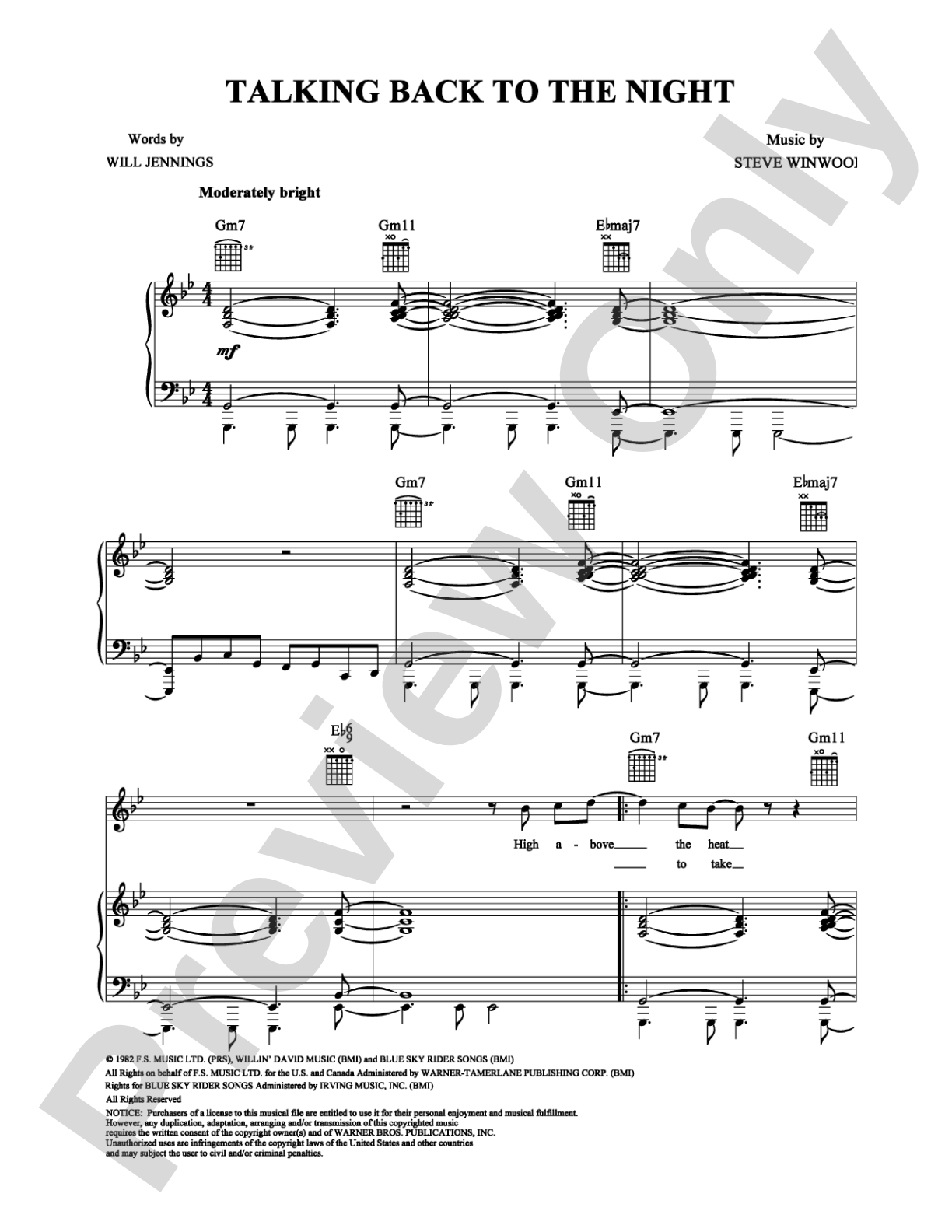
Talking Back to the Night: Piano/Vocal/Chords Digital Sheet Music

Talking Back to the Night: Piano/Vocal/Chords Digital Sheet Music

Steve Winwood

Item: 00-PS-0002300

Digital Download
$2.95
Description

Talking Back to the Night: Piano/Vocal/Chords Digital Sheet Music isn't in MakeMusic Cloud just yet...but it could be. Let us know you'd like to see it, and you'll help shape what comes next. In the meantime, start a free trial and dive into thousands of interactive titles your students can play along with today.

Sample Audio
No sample audio found.
Sample Video
Additional Details
SKU: 00-PS-0002300

More about this title

About the Artist: Steve Winwood

Steve Winwood has spent five decades at the forefront of rock and soul music, beginning his career as the keyboardist and vocalist for the British band Traffic in the late 1960s. His distinctive voice and virtuosic keyboard work became hallmarks of his solo career, which produced numerous hits and showcased his ability to blend rock, soul, and pop sensibilities into immediately memorable songs.

As both a performer and songwriter, Winwood's catalog offers rich material for singers and pianists seeking songs with genuine emotional depth and sophisticated harmonic content. His work demonstrates how accessibility and musical substance can coexist, making his compositions valuable studies in contemporary songwriting.

Why we love this

This song gives singers a chance to inhabit a contemporary pop-rock narrative with real emotional stakes. The piano/vocal/chords arrangement strips the production back to essentials, letting strong melodic writing and harmonic movement carry the piece. Students gain exposure to a songwriter who bridges seventies soul sensibility with modern production, broadening their understanding of what serious popular music can be.

What to expect

The piece carries an introspective, nighttime quality suggested by its title, balancing vulnerability with the steady presence of a thoughtful piano accompaniment. Winwood's melodic language draws the listener into a personal conversation, where the piano serves not as spectacle but as an attentive companion to the narrative unfolding in the lyrics. There's a quiet confidence in the writing, the sense of someone reflecting on something important without theatrical flourish.

Who it's for

Vocalists seeking contemporary pop-rock material with melodic and harmonic substance will find this song rewarding, particularly those comfortable with the emotional register of Winwood's writing. Pianists working in the singer-songwriter or jazz-influenced pop realm can use this arrangement as a study in accompaniment writing. This works equally well for advanced high school singers, college students, and adult learners preparing recital or audition material.

How to get the most out of it

  • Pay close attention to the lyrical phrasing and let it shape your breathing and phrasing at the piano; conversational moments benefit from shorter phrases rather than pushing every line to the bar line.
  • Balance the vocal line so it sits naturally over the chord voicings rather than fighting against them; Winwood's melodies often benefit from a conversational rather than soaring approach.
  • Explore the emotional arc of the song by varying your touch at the keyboard across different sections; dynamics in the accompaniment can shift the intimacy of the performance without overshadowing the vocal.
  • If accompanying a vocalist, listen for where they want space versus support in the arrangement, and adjust your voicing density accordingly.

How to use it

Include this in a solo recital program where you're building a narrative arc across multiple songs, or use it as a showcase piece in a cabaret-style concert pairing contemporary pop singers with acoustic accompaniment. It also serves well as a warm-up to exploring more of Winwood's catalog or as a bridge between standard repertoire and modern singer-songwriter material in a diverse concert setting.

Skills your students will build

  • Interpreting rhythmic flexibility within a steady harmonic accompaniment
  • Voicing jazz-influenced seventh and extended chords in a pop-rock context
  • Balancing melody and accompaniment when the piano part carries harmonic weight
  • Reading and performing from a lead sheet with intentionality about chord voicing choices

You May Also Like