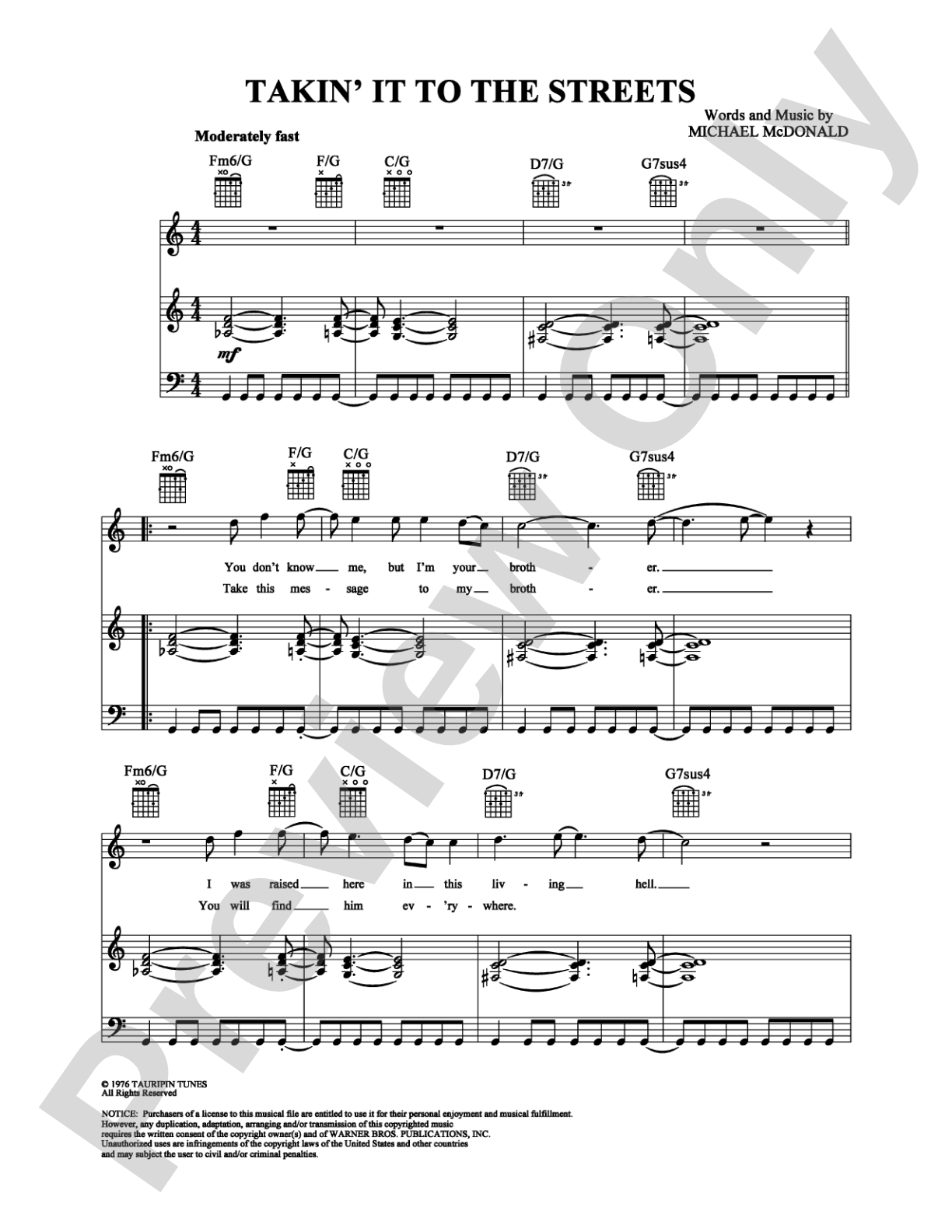
Takin' It To The Streets: Piano/Vocal/Chords Digital Sheet Music

Takin' It To The Streets: Piano/Vocal/Chords Digital Sheet Music

Doobie Brothers, Michael Mcdonald

Item: 00-PS-0006854

Digital Download
$2.95
Description

Takin' It To The Streets: Piano/Vocal/Chords Digital Sheet Music isn't in MakeMusic Cloud just yet...but it could be. Let us know you'd like to see it, and you'll help shape what comes next. In the meantime, start a free trial and dive into thousands of interactive titles your students can play along with today.

Sample Audio
No sample audio found.
Sample Video
Additional Details
SKU: 00-PS-0006854

More about this title

About the Artist: Doobie Brothers

The Doobie Brothers emerged from San Jose in the early 1970s to become one of rock music's most successful and enduring ensembles. Built on a foundation of tight vocal harmonies, inventive guitar work, and infectious grooves, the band created a catalog that bridged rock, soul, and pop sensibilities. Their signature blend of layered vocals and rhythmic sophistication made them influential interpreters of the singer-songwriter tradition adapted for ensemble performance.

The group's impact on contemporary music education stems from their sophisticated approach to harmony and arrangement. Songs like "Takin' It To The Streets" showcase how accessible melodies can coexist with complex harmonic progressions and nuanced rhythm section work, making them valuable models for students learning to balance commercial appeal with musical substance.

Why we love this

This track gives students a genuine pop-rock standard that demands real musicianship from both vocalist and pianist. The song's deceptive simplicity masks sophisticated chord movement and rhythmic sensibility, rewarding careful preparation and revealing new details with each run-through.

What to expect

Warm and conversational, with the kind of casual confidence that comes from knowing exactly what you're doing. The groove breathes rather than pushes, inviting the listener into an intimate space where the vocal and piano can speak directly to each other.

Who it's for

Vocalists and pianists preparing songs for recitals, studio work, or performance ensembles who want to study how contemporary songwriting handles harmonic depth. Students developing facility with chord-based accompaniment will find the voice-leading patterns instructive and musically rewarding.

How to get the most out of it

  • Lock the rhythmic pocket between your left hand and the vocal line; the groove sits slightly behind the beat, so practice with a metronome at half-tempo first to internalize the laid-back feel.
  • Shape the vocal line with dynamic restraint rather than volume alone; let the lyrics drive interpretation and let silence do as much work as sound.
  • Voice the chords with attention to the original arrangement's texture; these voicings aren't arbitrary, and respecting them preserves the song's signature warmth.
  • Balance harmonic fullness in the piano with enough space for the vocal to breathe; resist the urge to fill every rest with comping.

How to use it

Feature this as a standalone recital piece for a vocalist-pianist duo, or use it to teach popular music arranging and interpretation in a jazz or contemporary music course. It pairs well with other 1970s singer-songwriter material and demonstrates how rock arrangements achieve sophistication through restraint.

Skills your students will build

  • Reading and performing chord symbols with stylistically appropriate voicings
  • Singing and accompanying simultaneously while maintaining rhythmic independence
  • Interpreting the space between a vocal melody and harmonic foundation
  • Grooming behind the beat in contemporary popular music contexts
  • Voice-leading across chord changes to maintain smooth harmonic motion

You May Also Like