
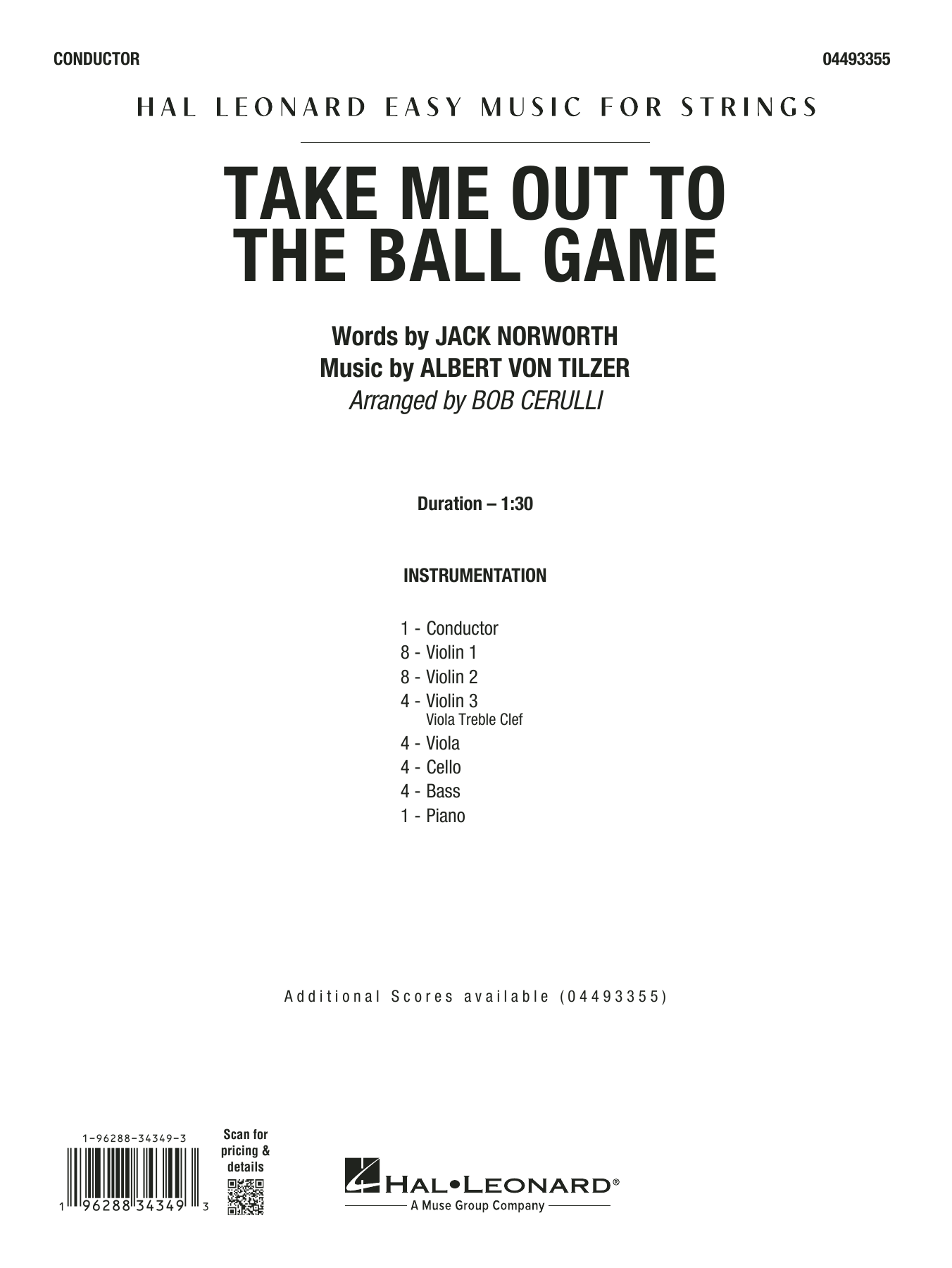

Take Me Out To The Ball Game: String Orchestra Conductor Score & Parts
Arranged by Bob Cerulli
Grade: 2
Item: 35-PK01677696
$45.00
Pickup currently not available
Buy Extra Parts (Digital PDF Download)
Parts Added to Cart!
Description
This classic song that is traditionally sung at baseball games during the 7th inning stretch is one of the most beloved in the American songbook. Perfect for reinforcing fingering patterns and 3/4 time. A great opportunity to include the audience in a sing-along.


Take Me Out To The Ball Game: String Orchestra Conductor Score & Parts isn't in MakeMusic Cloud just yet...but it could be. Let us know you'd like to see it, and you'll help shape what comes next. In the meantime, start a free trial and dive into thousands of interactive titles your students can play along with today.
Request This Title
Tell us you want it.
Start Your Free Trial
Explore everything that's ready to play right now.
Sample Audio
No sample audio found.
Sample Video
No sample videos found.
Additional Details
Publisher:
Hal Leonard
SKU:
35-PK01677696
More about this title
About the Arranger: Bob Cerulli

Bob Cerulli's music education spans three respected institutions: the Curtis Institute of Music, where he studied double bass with Roger Scott; the University of the Arts, where he earned a degree in music education; and the College of New Jersey, where he studied conducting. His performance resume includes principal bass positions with the Greater Trenton Symphony, The New Jersey Capital Philharmonic Orchestra, and Delaware Valley Philharmonic Orchestra, as well as membership in the Buffalo Philharmonic under Josef Kripps. He has freelanced extensively in Philadelphia and Atlantic City, performing with Broadway touring companies and recorded alongside artists ranging from Henry Mancini and Bill Conti to Luciano Pavarotti and Andrea Bocelli.
Cerulli's contributions to music education are equally substantial. He taught music in public schools for 29 years and currently serves as Senior Adjunct Professor at Rowan College at Burlington County. His compositions have been performed by major ensembles, including his work Celebration by The Philadelphia Orchestra and Romance in D Major, a cello and piano piece commissioned by Philadelphia Orchestra Principal Cellist William Stokking. He regularly conducts orchestral performances and reading sessions at regional music festivals.
Why we love this
Cerulli's arrangement captures everything that makes this tune enduring while keeping the technical demands entirely manageable for a Grade 2 ensemble. The 3/4 meter sits naturally for young string players learning metric variety beyond cut time and common time, and the straightforward fingering patterns reinforce core left-hand development without distraction. Best of all, the built-in singalong quality transforms a rehearsal into a shared cultural moment, reminding students why they're learning music in the first place.
What to expect
Nostalgic and unpretentious. The arrangement honors the melody's simplicity while giving each section a moment to shine, creating the feeling of a traditional ballpark sung by people who know the song by heart. It settles into a 3/4 groove that feels comfortable and familiar rather than challenging.
Who it's for
String orchestras in grades 2 and 3 who need accessible repertoire that still teaches something real about rhythmic and technical fundamentals. Directors looking for a morale-boosting piece that connects students to the broader American musical tradition, especially one that invites community participation.
How to get the most out of it
- Shape the melody through phrase length rather than dynamic changes. Young string players often respond better to thinking about breathing points and line continuity than to written hairpins, which can feel mechanical at this level.
- Establish a clear, walking 3/4 pulse before adding the ensemble arrangement. A single rehearsal devoted entirely to just the melody with a steady conductor beat will prevent rhythmic wavering later.
- Invite your audience to sing during the final statement if the setting allows it. The moment families and friends join in is the one they remember, and it justifies every scale exercise your students have practiced.
How to use it
Schedule this during an outdoor or community concert where the audience can join in on the final chorus. It works especially well as a palate cleanser between more technically demanding pieces, or as the closing number of a spring pops concert when engagement with the audience matters more than demonstrating advanced technique.
Skills your students will build
- Reading and playing in 3/4 time
- Reinforcing consistent fingering patterns across a complete solo line
- Maintaining rhythmic alignment in a homophonic ensemble texture
- Sustaining tone quality through longer melodic phrases
- Responding to audience connection and the role of music in community gatherings