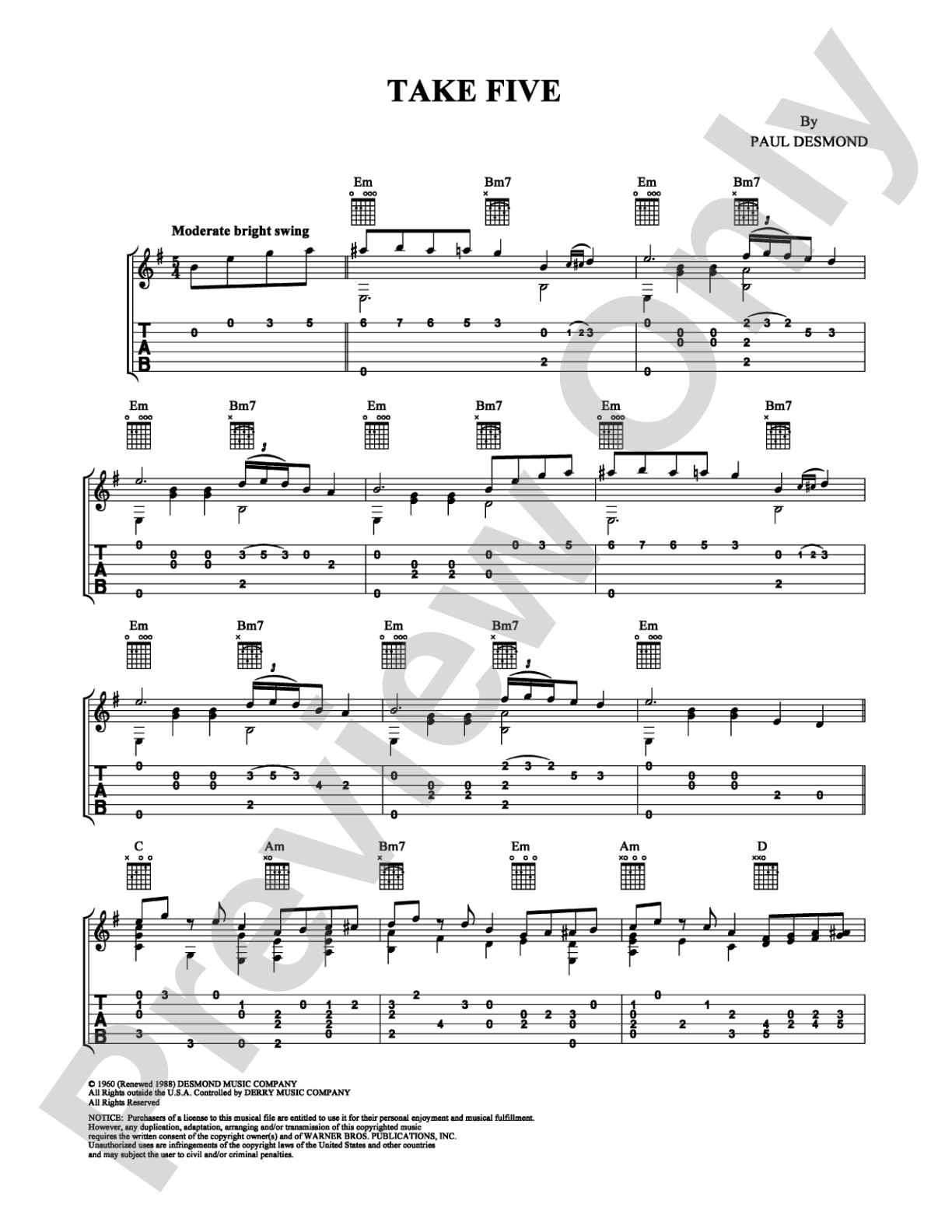
Take Five: Guitar TAB Digital Sheet Music

Take Five: Guitar TAB Digital Sheet Music

Paul Desmond, Dave Brubeck

Item: 00-PS-0000760

Digital Download
$2.99
Description

Take Five: Guitar TAB Digital Sheet Music isn't in MakeMusic Cloud just yet...but it could be. Let us know you'd like to see it, and you'll help shape what comes next. In the meantime, start a free trial and dive into thousands of interactive titles your students can play along with today.

Sample Audio
No sample audio found.
Sample Video
Additional Details
SKU: 00-PS-0000760

More about this title

About the Artist: Dave Brubeck

Dave Brubeck

Dave Brubeck was a jazz pianist and composer whose improvisational brilliance shaped modern jazz while his classical training informed sophisticated large-scale works. Beyond his legendary recordings, he composed choral pieces, orchestral works, chamber music, and solo repertoire that have been performed by ensembles ranging from the London Symphony Orchestra to cathedral choirs across multiple continents. His formal studies with Darius Milhaud at Mills College after World War II proved transformative, encouraging him to merge jazz language with classical structure in ways that felt both innovative and deeply musical.

Brubeck's cultural impact extended far beyond the concert hall. He broke racial barriers during the civil rights era and received recognition from presidents, governments, and institutions including a Grammy Lifetime Achievement Award, the Presidential Medal of the Arts, and induction into the American Classical Music Hall of Fame in 2003. "Take Five" and the album "Time Out" became historic landmarks: the latter was the first jazz album to achieve over one million copies sold, cementing Brubeck's role in bringing jazz to mainstream audiences worldwide.

Why we love this

This digital TAB transcription of Brubeck's most iconic composition gives guitarists direct access to a piece that defined cool jazz sophistication. The unconventional 5/4 meter makes it engaging for students learning to navigate unusual time signatures while the melody itself remains immediately memorable and singable. Programming this alongside other jazz standards or as a concert feature practically guarantees connection with your audience.

What to expect

Relaxed and hypnotic. The melody sits in a comfortable range and moves with unhurried grace while the underlying 5/4 pulse creates gentle forward motion without urgency. There's an almost meditative quality to playing this tune, as if the notes are unfolding at their own pace.

Who it's for

Guitarists with solid jazz fundamentals who want to learn one of the most recognizable jazz tunes ever written. This works equally well for intermediate to advanced players looking to deepen their understanding of jazz phrasing, rhythmic interpretation, and the 5/4 time signature in a musical context.

How to get the most out of it

  • Study the original recording carefully to absorb the rhythmic pocket and phrasing. This tune's power comes from its laid-back swing feel, not from racing through the changes.
  • Pay close attention to the relationship between your rhythm section and the melody line. The interaction between bass, drums, and guitar is what makes "Take Five" breathe.
  • Approach the 5/4 meter as natural rather than complicated. Count it as a phrase rather than individual beats to maintain the piece's effortless groove.
  • If improvising over the changes, respect the simplicity of the harmonic framework. The genius is in what you do with restraint, not complexity.

How to use it

Feature this as a solo guitar piece in a jazz concert or mixed recital to showcase your soloist's phrasing and rhythmic maturity. It also pairs beautifully with other Brubeck compositions or serves as a bridge between classical and contemporary music programming, introducing audiences to how jazz standards can anchor a concert theme.

Skills your students will build

  • Reading and performing in 5/4 meter
  • Jazz phrasing and rhythmic interpretation
  • Chord melody and improvisation over jazz changes
  • Balancing melody with accompaniment in jazz contexts
  • Understanding swing feel and groove

You May Also Like