
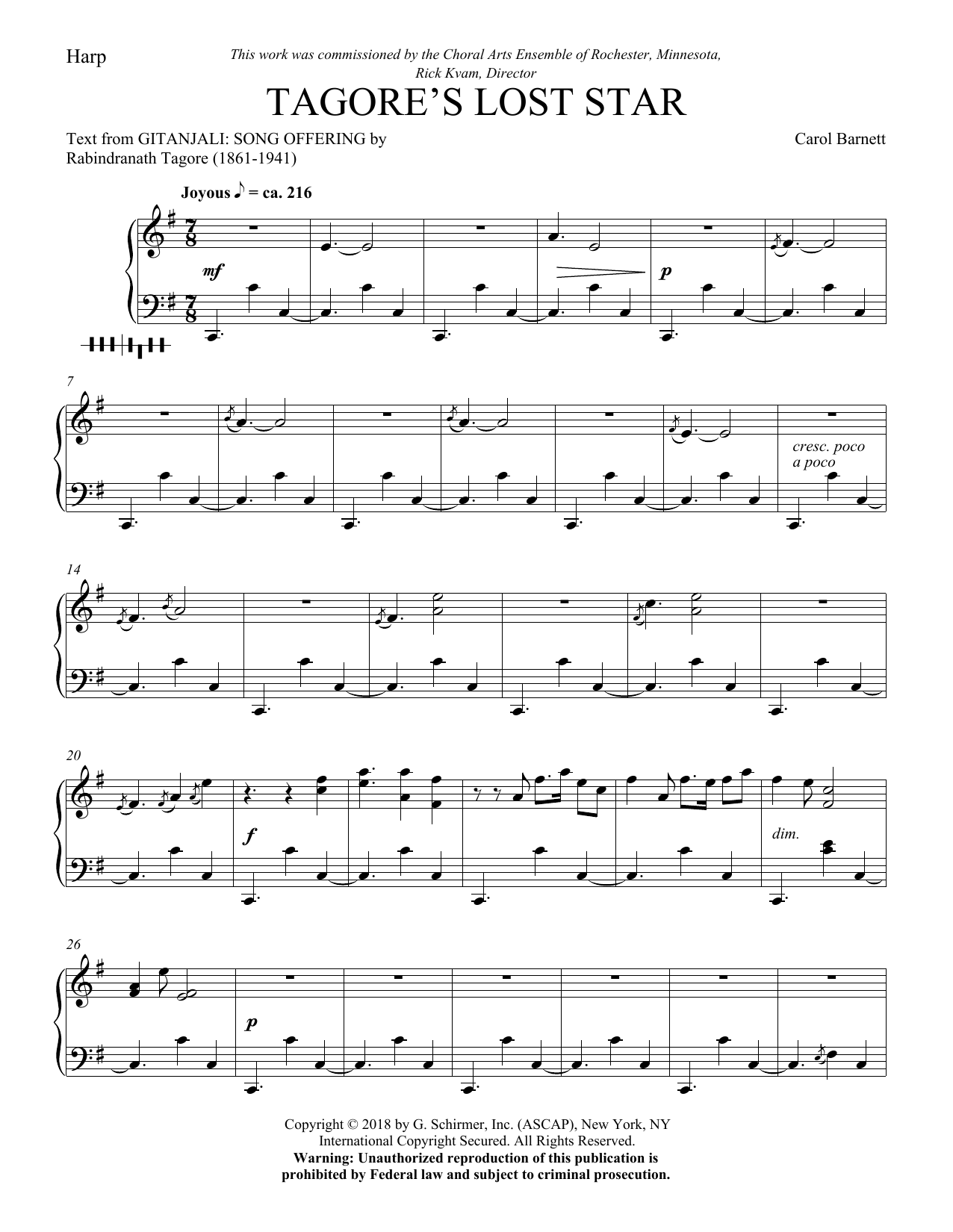

Tagore's Lost Star: Choral Instrumental Pak
By Rabindranath Tagore
Item: 35-PK00421175
$5.00
Pickup currently not available
Buy Extra Parts (Digital PDF Download)
| Product | Price | Quantity |
|---|---|---|
| Tagore's Lost Star - Harp: Choral Instrumental Pak | $7.00 |
Parts Added to Cart!
Description
Exploring the sound world of Northern India while setting the words of Bengali poet Tagore, here is a stylistic new work suitable for any community choir. The English translation is the poet's own and the musical characteristics are a combination of Eastern scales combined with Western harmonies.


Tagore's Lost Star: Choral Instrumental Pak isn't in MakeMusic Cloud just yet...but it could be. Let us know you'd like to see it, and you'll help shape what comes next. In the meantime, start a free trial and dive into thousands of interactive titles your students can play along with today.
Request This Title
Tell us you want it.
Start Your Free Trial
Explore everything that's ready to play right now.
Sample Audio
No sample audio found.
Sample Video
No sample videos found.
Additional Details
Publisher:
Hal Leonard
SKU:
35-PK00421175
More about this title
About the Author: Rabindranath Tagore
Rabindranath Tagore (1861–1941) was a Bengali polymath whose influence extended across literature, music, visual arts, and philosophy. As a composer, he created over 2,000 songs that blended Indian classical traditions with Western musical forms, establishing a distinctly modern voice within South Asian music. His work in education emphasized the integration of arts across disciplines, and his approach to setting his own poetry to music demonstrates how text and sound can reinforce each other without sacrificing either art form.
Tagore's musical compositions remain central to Bengali cultural identity and Indian classical music pedagogy. For Western choral programs, his work offers a bridge between traditions, allowing singers to engage with non-Western scales and harmonic thinking while performing in their native language through his own English translations.
Why we love this
This piece gives your ensemble access to authentic cross-cultural writing without the pitfalls of surface-level exoticism. Tagore's dual mastery of poetry and music means the text lands with intention, and the fusion of Indian melodic thinking with Western harmonic language creates something genuinely fresh rather than gimmicky. Your singers get to inhabit a musical world that challenges their typical assumptions about what scales and chord structures can do together.
What to expect
Meditative and spacious, with an undercurrent of philosophical searching. The blend of Northern Indian melodic contours with Western harmonic language creates a sound both familiar and unsettling in the best way, inviting listeners into a musical space where different traditions meet as equals rather than tourist attractions.
Who it's for
Community choirs with singers ready to expand their musical vocabulary and conductors seeking repertoire that honors non-Western traditions authentically. This work suits ensembles comfortable with modal melody and interested in programming that reflects global musical perspectives without separating "world music" into a novelty category.
How to get the most out of it
- Study the scalar language alongside your warm-ups. Indian classical modes will feel unfamiliar to many singers; isolate these passages and build facility before integrating them into full phrases.
- Balance the instrumental palette carefully. The text's philosophical weight demands that no instrument overwhelm the choir, even during moments of fuller texture.
- Attend to Tagore's own English translation as a guide to phrasing and emphasis. The translation reflects how he heard these words sung, offering clues about where to breathe and where to sustain.
- If your ensemble includes singers familiar with Indian vocal traditions, leverage that knowledge in rehearsal. Their instincts about ornamentation and microtonal nuance will inform how others approach the melodic material.
How to use it
Pair this with other works that explore cross-cultural dialogue, or program it as a centerpiece for a concert themed around poetry and song. Its contemplative nature works especially well as a second-half opener, resetting the energy after lighter opening selections and creating space for whatever follows.
Skills your students will build
- Reading and singing non-Western scalar patterns while maintaining accurate intonation
- Balancing modal melody with tertian harmony in ensemble context
- Interpreting English text that carries poetic weight beyond surface meaning
- Adapting vocal technique to accommodate microtonal inflection in melody
- Understanding how instrumental accompaniment supports rather than dominates choral lines