
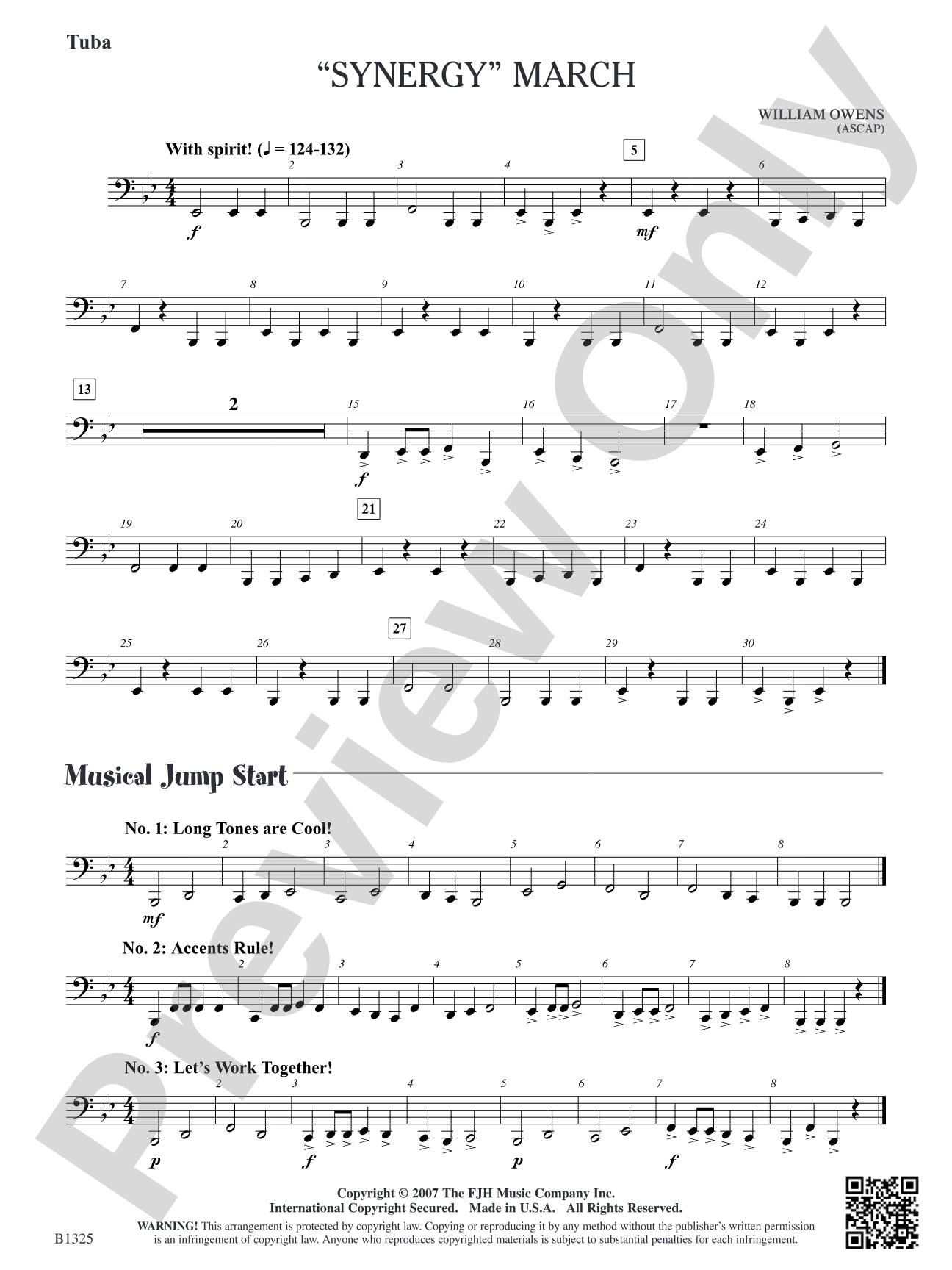

Synergy March: Tuba
By William Owens
Level:.5
Item: 98-PC-DB1325_TB1
$7.00
Pickup currently not available
Description
This spirited concert march begins with a crisp melody and bold accompaniment. As it moves into the middle section, brass and woodwinds are featured separately, with percussion serving as a link between the two. Finally, the three groups combine to drive forward to an energetic, synergistic finish. Excellent for teaching march style with only 6 notes!


Don't just read it, hear it, play along with it, and watch your students grow with it. In MakeMusic Cloud, Synergy March: Tuba comes alive with professional accompaniment, adjustable tempo, and built-in practice tools that turn solo practice into real progress.
Open in the Player
Jump straight in and assign it today.
Start Your Free Trial
Open this title and explore the full library in minutes.
Sample Audio
1
Audio File
--:--
0:00
0:00
Sample Video
No sample videos found.
Additional Details
Series:
FJH Starter Series
Publisher:
The FJH Music Company, Inc.
SKU:
98-PC-DB1325_TB1
More about this title
About the Composer: William Owens
William Owens has composed over 300 works for young ensembles since 1993, establishing himself as a foundational voice in accessible band and orchestra literature. A VanderCook College of Music graduate (1985), he brings three decades of classroom experience to every score, combining musical substance with genuine pedagogical insight. His compositions appear on honor lists and required repertoire lists across North America and have become teaching staples in young band programs.
Owens's approach to composition prioritizes clarity and purpose. He has received commissions from the South Plains College Department of Fine Arts, Phi Beta Mu International, and the American Bandmasters Association, and holds membership in ASCAP, TMEA, and Phi Beta Mu. Recognized as a Distinguished Alumnus by VanderCook and a recipient of the Texas Bandmasters Association's Meritorious Achievement Award, he retired from directing in Texas after 30 years to focus on composition and clinician work.
Why we love this
Owens understands what young conductors need to teach march style effectively, and this piece does it without overwhelming players. The orchestration deliberately separates brass and woodwinds before bringing them together, making sectional rehearsal logical and giving students a clear structural frame. At only 6 notes, this march removes technical barriers and lets the ensemble focus on what matters: style, balance, and energy.
What to expect
Synergy March captures the propulsive spirit of a traditional concert march without pretense. The crisp, confident opening establishes forward momentum immediately, while the sectional middle section feels like a conversation between instrumental families. When brass, woodwinds, and percussion merge for the finish, the ensemble experiences genuine musical synergy—the sense that combining forces creates something none could achieve alone.
Who it's for
Conductors building foundation-level bands and ensembles ready to tackle march form. This score works especially well for first-year concert bands, middle school groups, or any ensemble that benefits from a limited note range and clear structural teaching points.
How to get the most out of it
- Shape the opening melody with clear phrase direction. The crisp character depends on rhythmic precision and attention to articulation rather than dynamic extremes.
- During the sectional features, ensure each group (brass, then woodwinds) maintains the march tempo and character as if leading the full ensemble. This builds confidence and clarifies the form.
- Lock the percussion and bass line during transitions between sections. Their continuity holds the structure steady while different instrumental groups come into focus.
- The final combination of all three groups needs clean, unified attacks. Rehearse that moment with eyes on the podium so the energy builds as one sound, not three separate layers.
How to use it
Program this early in a concert to establish style and energy for the audience. Its straightforward structure and accessible difficulty make it ideal as a teaching vehicle in rehearsal, where students can absorb march conventions while playing something that feels genuinely musical. It also pairs well with slightly more complex concert pieces later in the program, showing the ensemble's range.
Skills your students will build
- March style and characteristic rhythmic articulation
- Following sectional leadership and cues from the podium
- Balance and blend between instrumental sections
- Maintaining tempo and character through sectional transitions
- Reading and executing a three-part ensemble form (opening, sectional features, combined finish)