Syncopated Shuffle: Piano Digital Sheet Music

Syncopated Shuffle: Piano Digital Sheet Music

Duke Ellington

Item: 00-PS-0008204

Digital Download
$3.99
Description

Syncopated Shuffle: Piano Digital Sheet Music isn't in MakeMusic Cloud just yet...but it could be. Let us know you'd like to see it, and you'll help shape what comes next. In the meantime, start a free trial and dive into thousands of interactive titles your students can play along with today.

Sample Audio
No sample audio found.
Sample Video
Additional Details
SKU: 00-PS-0008204

More about this title

About the Artist: Duke Ellington

Duke Ellington (1899-1974) fundamentally changed what jazz could be. A pianist, composer, and bandleader, he elevated jazz from dance music to concert art while maintaining its swing and accessibility. His innovations in harmony, orchestration, and form influenced generations of musicians across genres, and his prolific output—over a thousand compositions—remains central to American music education and performance.

Ellington's piano playing was distinctive: harmonically adventurous, rhythmically sophisticated, and always in service of melody. His compositions for solo piano capture the wit, harmonic depth, and rhythmic subtlety that defined his larger works. Teaching and performing Ellington's piano music connects students directly to jazz history and compositional craftsmanship at the highest level.

Why we love this

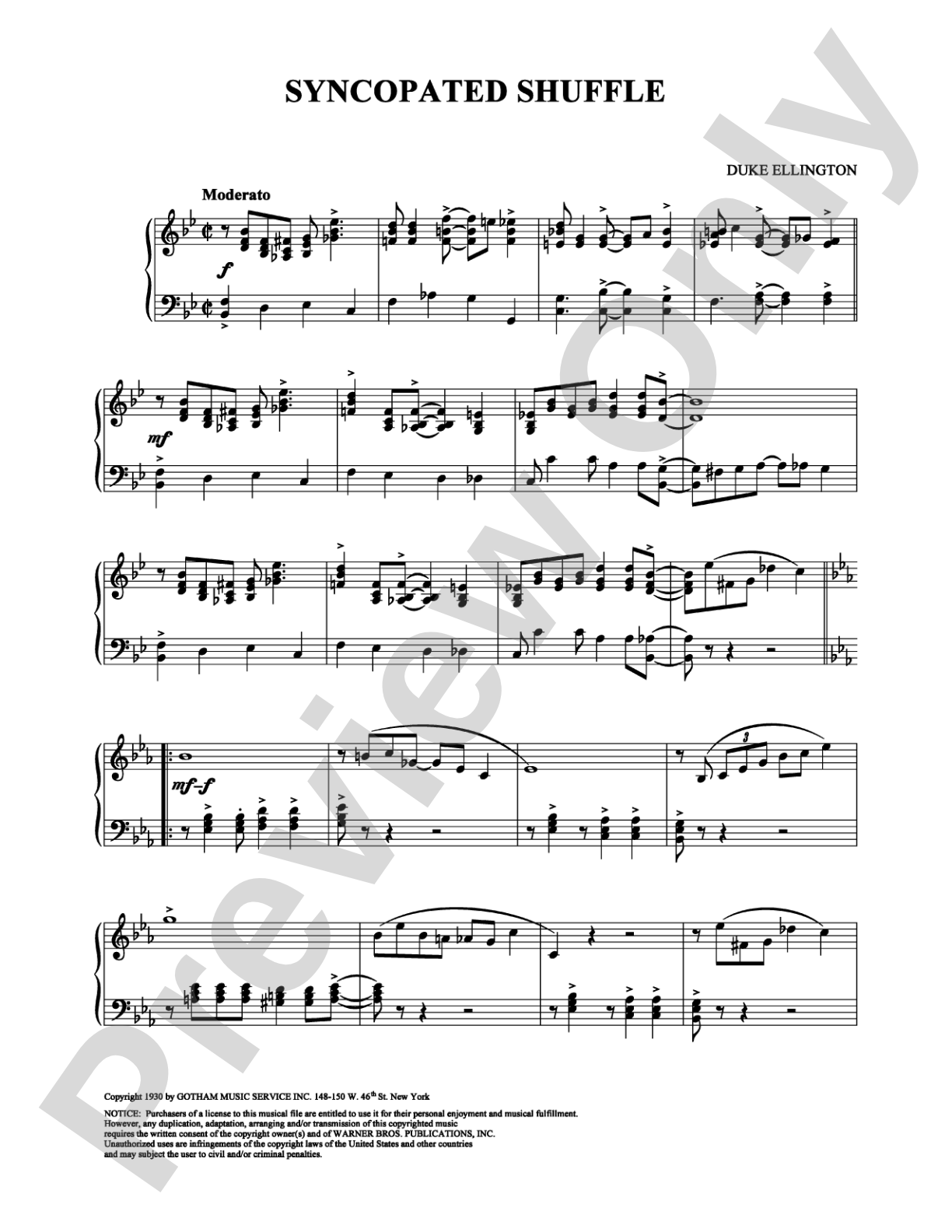
Ellington's piano writing rewards close listening and careful practice. Syncopated Shuffle showcases his characteristic blend of stride bass, unexpected harmonic turns, and linear melody—the kind of piece that sounds effortless when it's actually quite sophisticated. Students come away understanding how jazz pianists think differently about rhythm, harmony, and the relationship between hands.

What to expect

A conversation between stride and modernism. The piece swings with easy sophistication, its syncopations suggesting movement without urgency. There's wit in the harmony and a pianist's understanding of what the instrument can do—the kind of music that feels alive in your hands.

Who it's for

This is for pianists with solid technique and rhythm reading skills who are ready to engage with jazz language. Advanced intermediate and professional pianists will find it rewarding; it's sophisticated enough to challenge but not so dense that it overwhelms. Jazz students and performers looking to deepen their knowledge of Ellington's compositional voice will connect immediately.

How to get the most out of it

  • Establish a steady internal pulse before attacking the syncopation. The shuffle rhythm relies on a rock-solid foundation, so practice the left hand independently until it's automatic.
  • Shape phrases through touch rather than dynamic extremes. Ellington's sophistication comes from voice leading and articulation, not volume shifts.
  • Let the rhythm breathe. Resist the temptation to rush syncopated passages; the groove strengthens when you sit comfortably behind the beat.
  • Explore the recording of Ellington performing this piece if available. His touch and phrasing reveal interpretive choices that notation alone cannot capture.

How to use it

Place this in a jazz or American music concert where it can stand alongside other piano standards or Ellington orchestral arrangements. It works as a bridge between classical recital and jazz set, showing listeners that swing and sophistication are not opposing forces. In a teaching context, pair it with Ellington's larger works to help students trace his compositional thinking across different ensembles.

Skills your students will build

  • Reading and executing syncopated rhythms in a jazz context
  • Stride piano technique and left-hand independence
  • Harmonic analysis of jazz chord progressions
  • Interpreting swing feel and rhythmic placement
  • Translating lead sheet or melodic notation into full piano textures

You May Also Like