Symphony No. 9 (Fourth Movement): Flute Sheet Music Preview

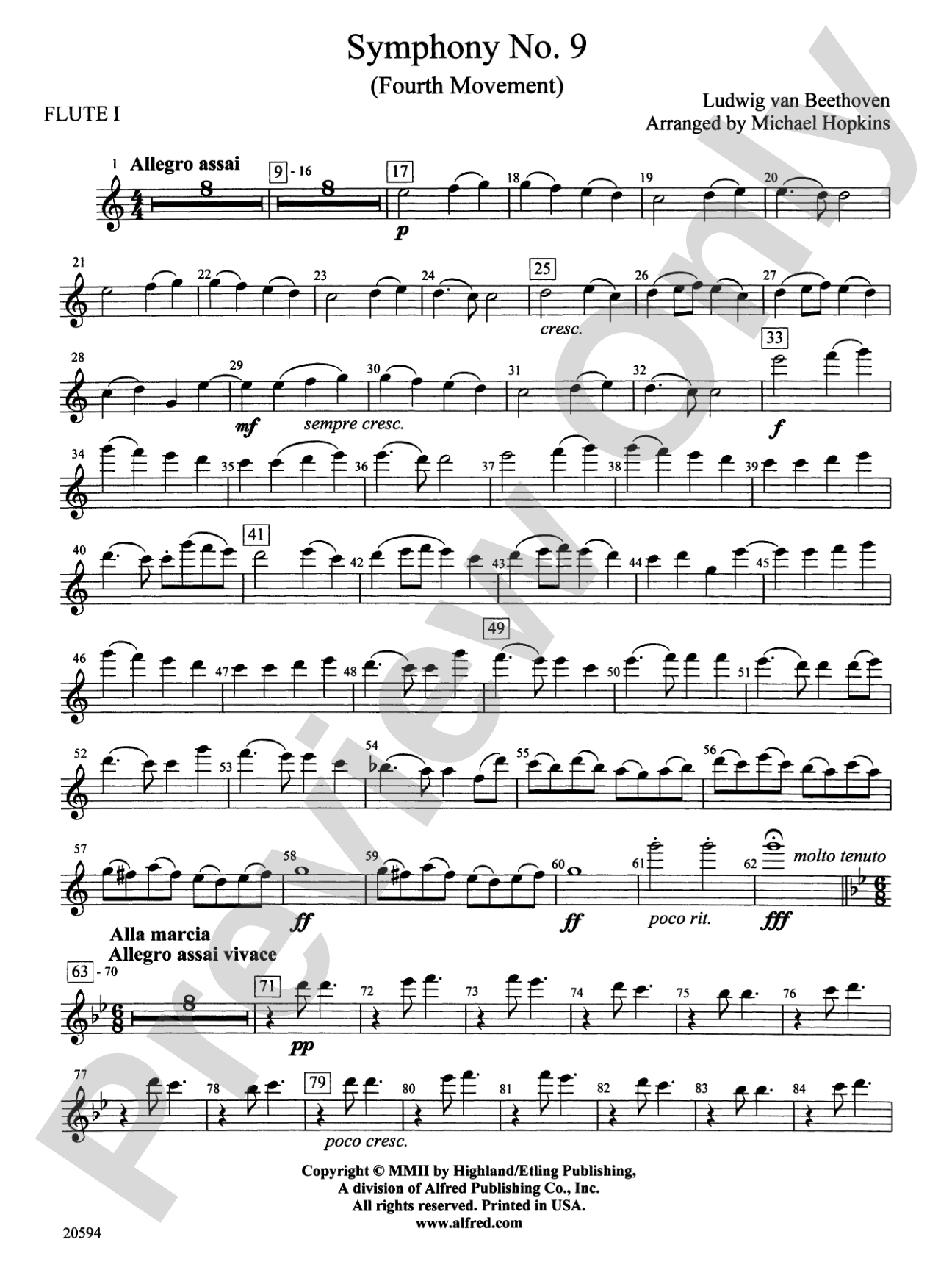
Symphony No. 9 (Fourth Movement): Flute

By Ludwig van Beethoven / arr. Michael Hopkins

Grade: 3

Item: 00-PC-0000420_F1

Digital Download
$3.00
Description
Now your full orchestra can perform Beethoven's Symphony No. 9! Almost everyone can hum the famous "Ode to Joy," but now students can play it in the context of the heroic and beautiful fourth movement, which has been skillfully adapted by Michael Hopkins.

Don't just read it, hear it, play along with it, and watch your students grow with it. In MakeMusic Cloud, Symphony No. 9 (Fourth Movement): Flute comes alive with professional accompaniment, adjustable tempo, and built-in practice tools that turn solo practice into real progress.

Sample Audio
No sample audio found.
Sample Video
Additional Details
Series: Highland/Etling Full Orchestra
Publisher: Alfred Music
Page Count: 216
SKU: 00-PC-0000420_F1

More about this title

About the Composer: Ludwig van Beethoven

Ludwig van Beethoven (1770-1827) fundamentally transformed the symphony from a formal Classical structure into a vehicle for profound emotional and philosophical expression. His nine symphonies trace an arc from Classical clarity toward Romantic expansiveness, with the Ninth standing as his final and most ambitious orchestral statement. Beethoven's deafness during the composition of these late works makes their emotional intensity and structural innovation all the more remarkable.

Why we love this

Michael Hopkins' adaptation makes the Fourth Movement accessible to Grade 3 orchestras without sacrificing the movement's architectural grandeur or the unforgettable melody that students already know. The arrangement balances the famous "Ode to Joy" theme with the complex harmonic language and structural sophistication that define Beethoven's masterwork, giving young musicians genuine encounter with a canonical work rather than a simplification.

What to expect

Triumphant yet reflective, built on a melody so universally known it feels like rediscovering something familiar in a new light. The movement carries the weight of Beethoven's larger argument about joy and brotherhood while remaining singable and direct in its emotional appeal.

Who it's for

Grade 3 full orchestras with solid technical foundation and strong ensemble discipline. This arrangement suits schools and community orchestras seeking a recognizable masterwork that challenges students musically without requiring virtuosic technique.

How to get the most out of it

  • Shape the "Ode to Joy" melody with long phrase arcs rather than square articulation; this theme rewards singers' phrasing instincts even in instrumental form.
  • Establish a stable, singing tempo from the outset and maintain it throughout; Beethoven's structure depends on metric consistency rather than flexibility.
  • Balance the choral-style passages in violas and lower strings so the harmonic progression remains audible beneath the primary melodic line.
  • Ensure ensemble cohesion during rhythmic unison passages; precision here strengthens the heroic character Beethoven intended.

How to use it

Position this as a concert centerpiece rather than a filler; it anchors a program while remaining accessible to diverse audiences. The piece works equally well for festival performances or community concert contexts where the cultural recognition of the melody serves the occasion.

Skills your students will build

  • Sustaining long melodic phrases with consistent tone and intonation
  • Reading and balancing choral-style harmony writing across multiple staves
  • Maintaining metric precision in unison rhythmic passages
  • Responding to Classical-era phrasing conventions (symmetrical periods, clear cadential structures)
  • Coordinating ensemble texture shifts between homophonic and polyphonic writing

You May Also Like