
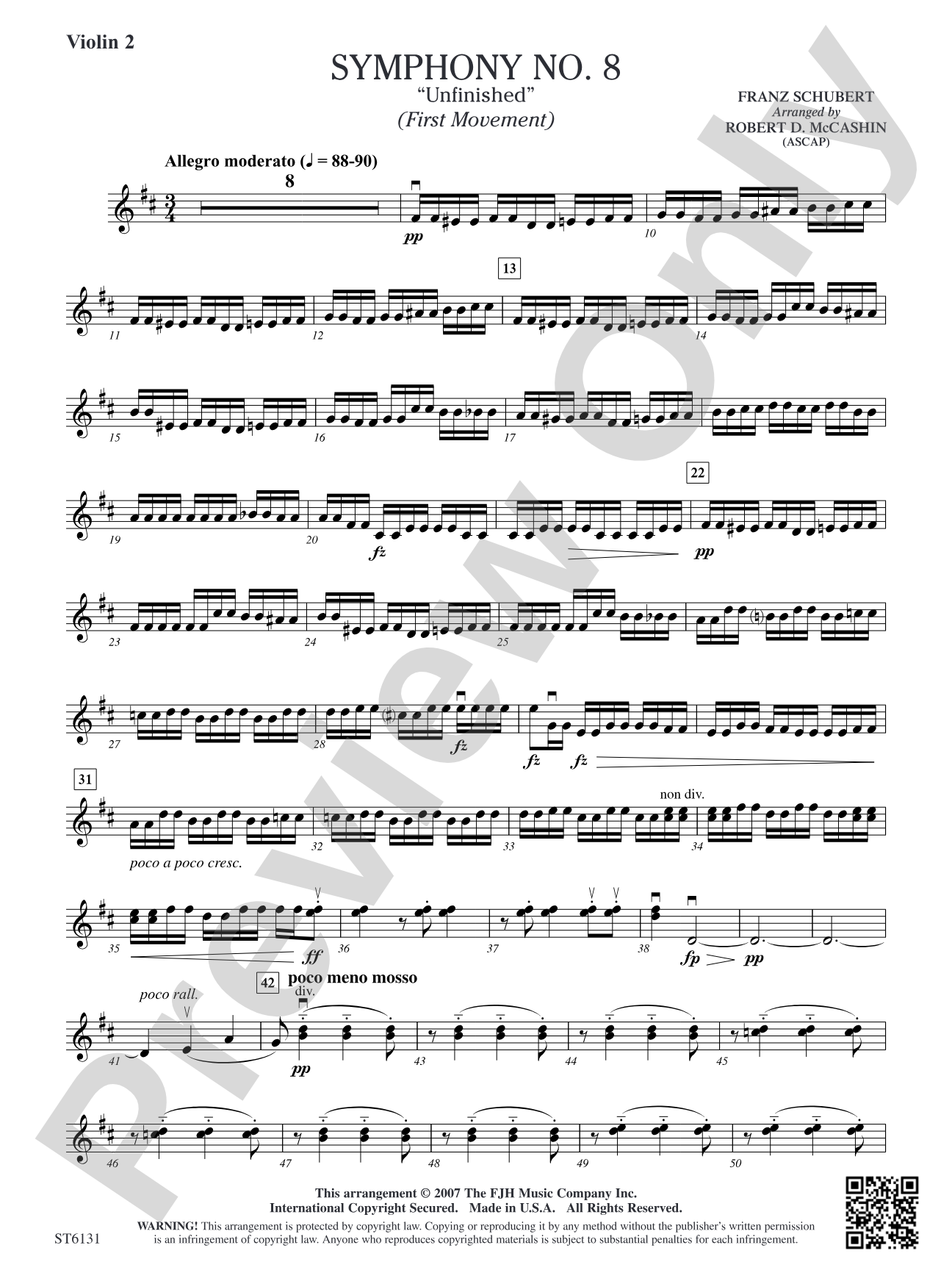

Symphony No. 8 "Unfinished" (First Movement): Violin 2
First Movement
By Franz Schubert / arr. Robert D. McCashin
Grade: 3.5
Item: 98-PC-DST6131_VN2
$7.00
Pickup currently not available
Description
Your students will enjoy performing this faithful arrangement of themes from the first movement of Franz Schubert's famous Symphony No. 8. As always, Robert D. McCashin has taken great care to maintain the integrity of the original while making it accessible to younger string musicians. A wonderful addition to any program, and a standard that all string students should know.


Symphony No. 8 "Unfinished" (First Movement): Violin 2 isn't in MakeMusic Cloud just yet...but it could be. Let us know you'd like to see it, and you'll help shape what comes next. In the meantime, start a free trial and dive into thousands of interactive titles your students can play along with today.
Request This Title
Tell us you want it.
Start Your Free Trial
Explore everything that's ready to play right now.
Sample Audio
1
Audio File
--:--
0:00
0:00
Sample Video
No sample videos found.
Additional Details
Series:
FJH String Orchestra
Publisher:
The FJH Music Company, Inc.
SKU:
98-PC-DST6131_VN2
More about this title
About the Composer: Franz Schubert
Franz Schubert (1797-1828) composed over 600 works during his brief life, establishing himself as a bridge between the Classical and Romantic eras. His gift for melody was unparalleled; even his most ambitious instrumental works are built on singable, memorable themes that have captivated audiences for nearly two centuries.
The "Unfinished" Symphony stands among his most performed works, famous for its haunting B minor opening and the lyrical second theme that dominates the first movement. Though Schubert sketched a third movement, he never completed the symphony, yet its two movements contain some of his most profound musical ideas. For string students, this work offers direct access to one of the pillars of the symphonic repertoire.
Why we love this
McCashin's arrangement preserves the essential character and emotional arc of Schubert's original while keeping the technical demands realistic for Grade 3.5 ensembles. Your students get to perform a genuine masterwork recognized worldwide, not a simplified knockoff, which builds confidence and musicianship. This is the kind of repertoire that reminds young musicians why they chose strings in the first place.
What to expect
The first movement unfolds with a sense of yearning and introspection. The opening trembles with quiet urgency, then yields to a warm, almost unbearably beautiful melody that feels both intimate and grand. You'll hear why Schubert's melodies have lived in the concert hall for nearly 200 years: they seem to emerge naturally from the very fabric of music itself.
Who it's for
This arrangement suits Grade 3.5 string orchestras ready to tackle serious repertoire with solid fundamentals in place. Directors seeking contest or festival material will find a work that challenges musicianship without requiring professional-level technique. Students should have secure shifting, vibrato control, and comfort sustaining lyrical passages.
How to get the most out of it
- Bring out the contrast between the restless, anxious opening theme and the singing second theme. The first idea works best with forward motion and slight intensity; the second needs space to breathe and genuine expression.
- Balance the accompaniment figures in the violas and lower voices so they support without overwhelming the melody. Schubert's orchestration relies on transparent layers, not thick texture.
- Shape longer phrases with subtle dynamic shaping rather than sudden changes. A gradual swell through four bars will feel more natural than abrupt dynamics that interrupt the vocal quality of the string writing.
- Attend to intonation in the unison and octave doublings at key moments; they are structurally important and any wavering will be audible even to untrained ears.
How to use it
Program this as the centerpiece of a concert exploring Romantic orchestration or as a standalone festival entry; it stands equally well in either context. It also pairs effectively on a concert that includes later works influenced by Schubert's harmonic language, creating a through-line for the audience.
Skills your students will build
- Sustaining lyrical phrasing across long, multi-bar phrases without rhythmic wavering
- Balancing transparent orchestration and understanding voice leading across the string choir
- Navigating key modulations and harmonic rhythm typical of Romantic-era writing
- Responding to subtle dynamic and tempo shaping rather than relying on printed indications alone
- Recognizing and performing a canonical work that defines string orchestra literature