
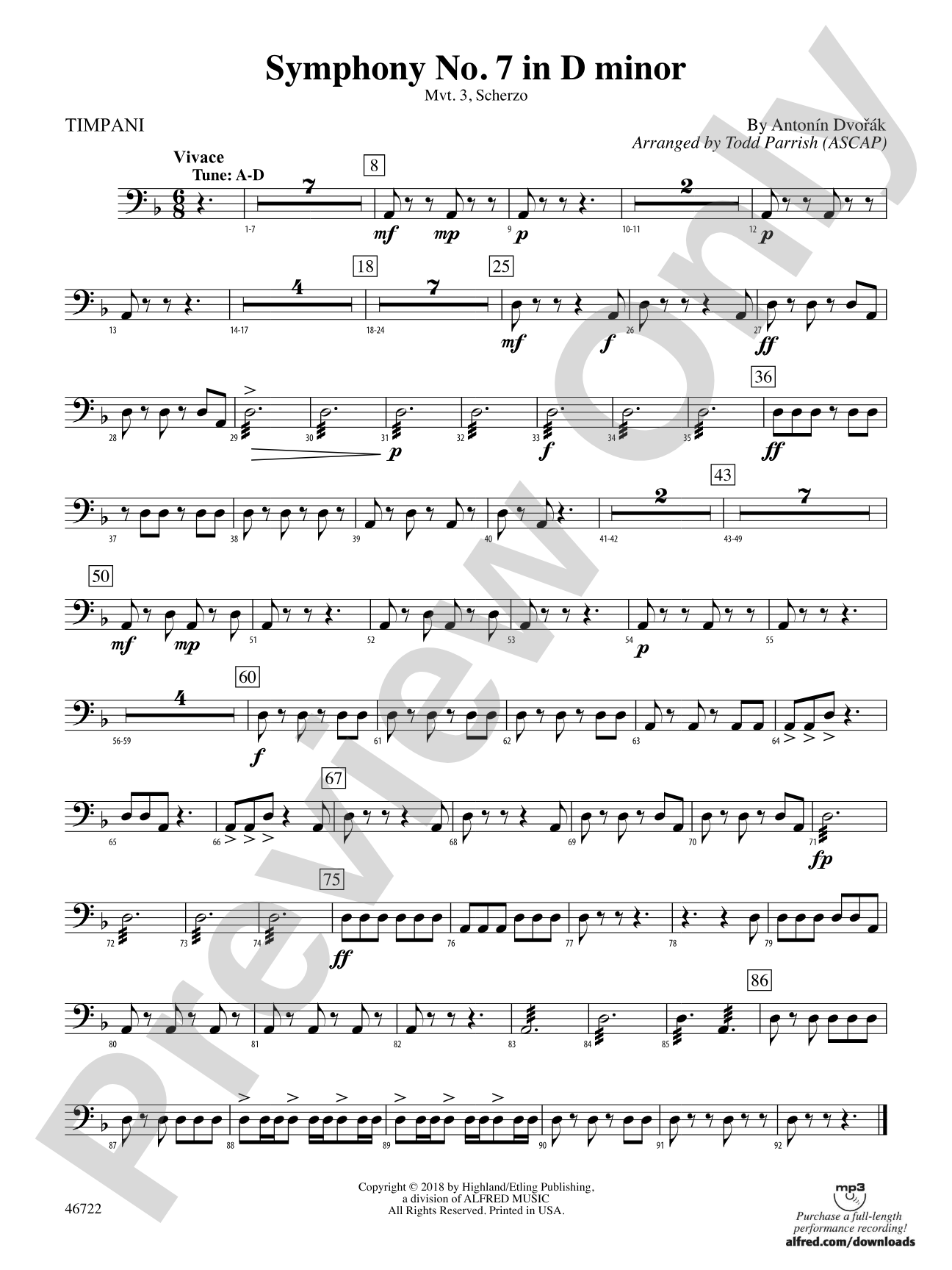

Symphony No. 7 in D Minor: Timpani
Mvt. 3, Scherzo
By Antonín Dvorák / arr. Todd Parrish
Grade: 3.5
Item: 00-PC-0017857_TMP
$5.99
Pickup currently not available
Description
Though not as popular as his famous 8th and 9th symphonies, Dvorák's Symphony No. 7 in D minor is a masterpiece worthy of serious study and performance. The scherzo movement has been abridged and simplified from 6/4 to 6/8 for playability, but the spirit of Dvorák comes through clearly. Full of the composer's trademark hemiola, this arrangement by Todd Parrish gives melody and countermelodies to all parts and ends with an exciting, powerful conclusion. The optional timpani part gives even more strength to your performance. This title is available in MakeMusic Cloud.


Don't just read it, hear it, play along with it, and watch your students grow with it. In MakeMusic Cloud, Symphony No. 7 in D Minor: Timpani comes alive with professional accompaniment, adjustable tempo, and built-in practice tools that turn solo practice into real progress.
Open in the Player
Jump straight in and assign it today.
Start Your Free Trial
Open this title and explore the full library in minutes.
Sample Audio
1
Audio File
--:--
0:00
0:00
Sample Video
Additional Details
Series:
Highland/Etling String Orchestra
Publisher:
Alfred Music
Page Count:
126
SKU:
00-PC-0017857_TMP
More about this title
About the Composer: Antonín Dvorák
Antonín Dvorák (1841–1904) stands among the most performed symphonists of the Romantic era, celebrated for melodies that seem to emerge from folk traditions while remaining entirely his own. A Czech composer who spent formative years in the United States, he brought nationalist spirit and harmonic innovation to every genre he touched, from chamber works to large orchestral forces.
His seven symphonies chronicle his stylistic evolution. While the Ninth ("From the New World") dominates concert programs, the Seventh represents Dvorák at full maturity: structurally ambitious, rhythmically inventive, and rich with the hemiola patterns that became his signature. For conductors and students, his symphonies remain essential windows into Romantic orchestration and the power of thematic development.
Why we love this
String orchestras rarely get access to genuine symphonic architecture at this grade level. This arrangement preserves Dvorák's structural integrity and harmonic language while making the scherzo playable (the original 6/4 meter becomes 6/8, a smart adaptation that keeps the rhythmic character intact). Todd Parrish's voicing ensures every section carries melodic responsibility, so your second violins and violas get moments that matter, not filler.
What to expect
Dvorák's lyricism flows through every phrase; even simplified, the arrangement sings with the warmth and directness his melodies are known for. The Romantic orchestration creates moments of genuine grandeur, building from intimate string textures to powerful unison statements that feel triumphant rather than strained.
Who it's for
Grade 3.5 string orchestras ready to tackle substantial four-movement architecture without the technical demands of the original Dvorák score. This works for festival-focused programs, honor orchestras, and ensembles building toward higher-level repertoire.
How to get the most out of it
- Balance the hemiolas by having your principal violins lead the main melodic line while lower strings lock into the underlying pulse; this clarity prevents the rhythmic motif from becoming muddy.
- Work the optional timpani part if your ensemble includes a capable percussionist; those moments add dramatic weight without overshadowing the strings.
- Shape the final movement's conclusion with a real dynamic arc rather than simply playing forte; build intensity through articulation and bow pressure to match the power indicated on the page.
- Rehearse the scherzo's 6/8 feeling in isolation from the rest of the symphony so your ensemble internalizes the meter shift before placing it in context.
How to use it
Program this as a festival selection or as the centerpiece of a concert celebrating Romantic repertoire. Its four-movement span and serious musical content make it ideal for a program that pairs lighter works on either side, allowing the symphony to command full attention without exhausting your ensemble.
Skills your students will build
- Reading and playing hemiola rhythms across multiple voices
- Sustaining lyrical phrasing across phrase boundaries in Romantic style
- Balancing inner voices and countermelodies with primary melodic lines
- Ensemble unity in rapid meter changes (adaptation from 6/4 to 6/8)
- Dynamic control and shaping in longer formal structures
- Coordination between tutti sections and sectional independence