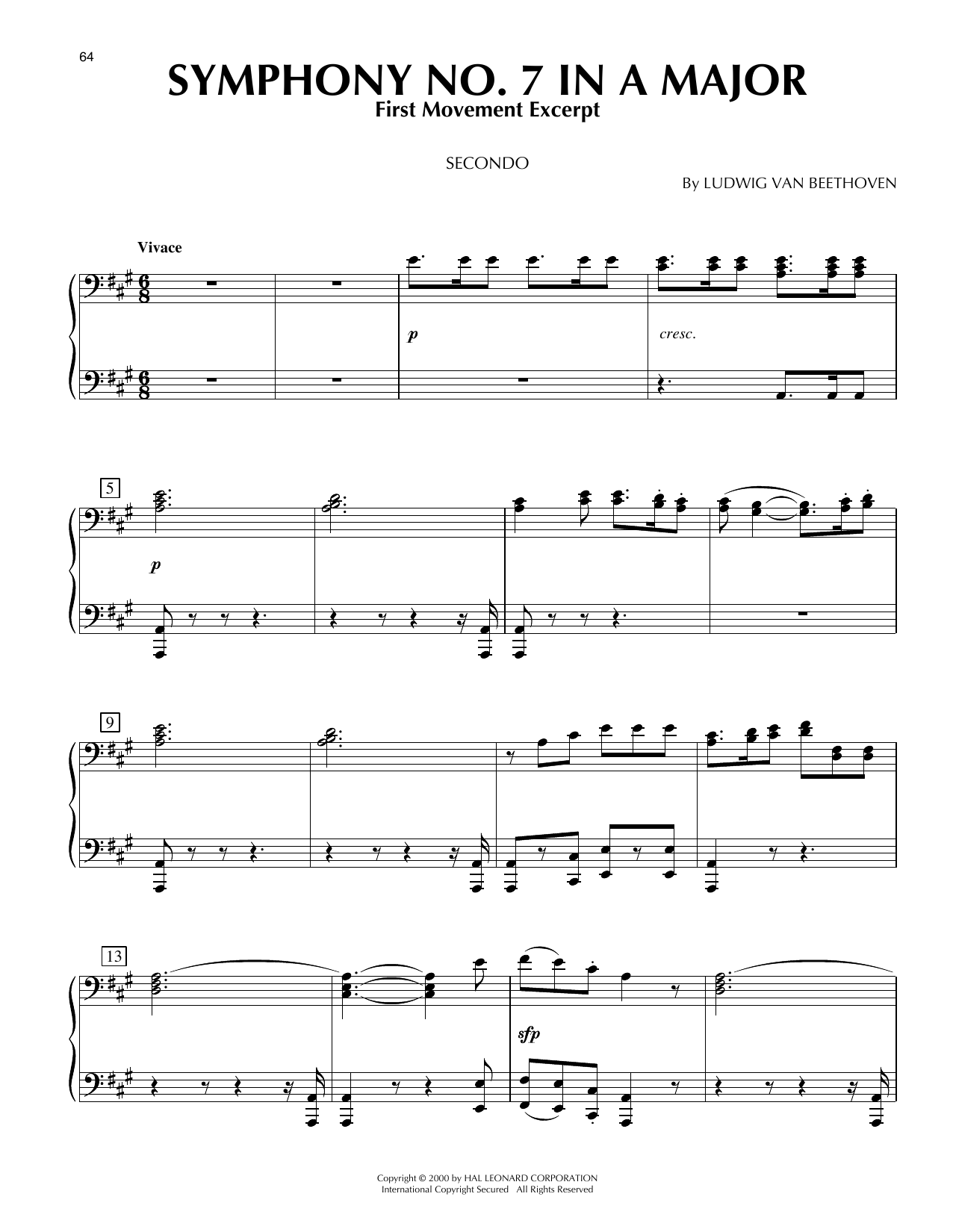
Beethoven's Seventh Symphony stands among his most rhythmically propulsive and harmonically adventurous works, composed during a period of creative maturity when he had fully embraced the possibilities of extending Classical form into Romantic territory. The first movement exemplifies his genius for building monumental structures from economical thematic material, using relentless rhythmic drive and strategic harmonic shifts to sustain listener engagement across a large span.
Why we love this
This excerpt captures the movement's infectious rhythmic propulsion and architectural brilliance without requiring a full orchestra. Pianists encounter genuine compositional challenges here: Beethoven's textures demand clarity and independence between hands, and the harmonic language rewards interpretive maturity. It's substantial enough to showcase real pianistic musicianship while remaining accessible for serious students.
What to expect
Urgency and vitality pulse through nearly every measure. The movement generates momentum through rhythmic insistence rather than lyrical warmth, creating an almost athletic quality that demands focused energy from the performer. Harmonic shifts feel purposeful and occasionally surprising, keeping the listener alert to structural developments unfolding across the eight pages.
Who it's for
Pianists at the intermediate advanced level who are ready to engage with Beethoven's symphonic language and want an excerpt that presents real interpretive and technical demands. This works equally well for students studying Beethoven's structural approach or for teachers building a Beethoven curriculum beyond the Moonlight Sonata and Für Elise.
How to get the most out of it
Establish a steady, energetic pulse from the opening; Beethoven's rhythmic drive is the lifeblood of this movement, and any rhythmic wavering will undermine the forward momentum.
Differentiate the textural layers carefully, especially where thematic material passes between registers. Voicing clarity prevents the excerpt from becoming muddy despite the dense harmonic activity.
Attend to Beethoven's dynamic markings with precision. The unexpected forte and piano contrasts are compositional decisions, not expressive whims, and executing them faithfully shapes the architectural logic.
How to use it
Position this within a unit on Classical symphonic structure and how composers adapted instrumental writing for keyboard, or pair it with Beethoven's later piano sonatas to trace his evolving approach to texture and form. It also serves as an excellent bridge repertoire between student exploration of earlier Classical works and Romantic period pianism.
Skills your students will build
Sustaining forward momentum through long phrases using rhythmic precision
Differentiating textural layers and voicing independence between hands
Interpreting Beethoven's dynamic markings as structural signposts rather than arbitrary expression
Harmonic analysis of modulations and chromatic voice leading in Classical works
Maintaining physical control during passages requiring hand crossing or dense figuration
You May Also Like
Scan to Complete Your Purchase
Use your phone's camera to scan the code below
You'll log in on your phone and the order will be added to your account