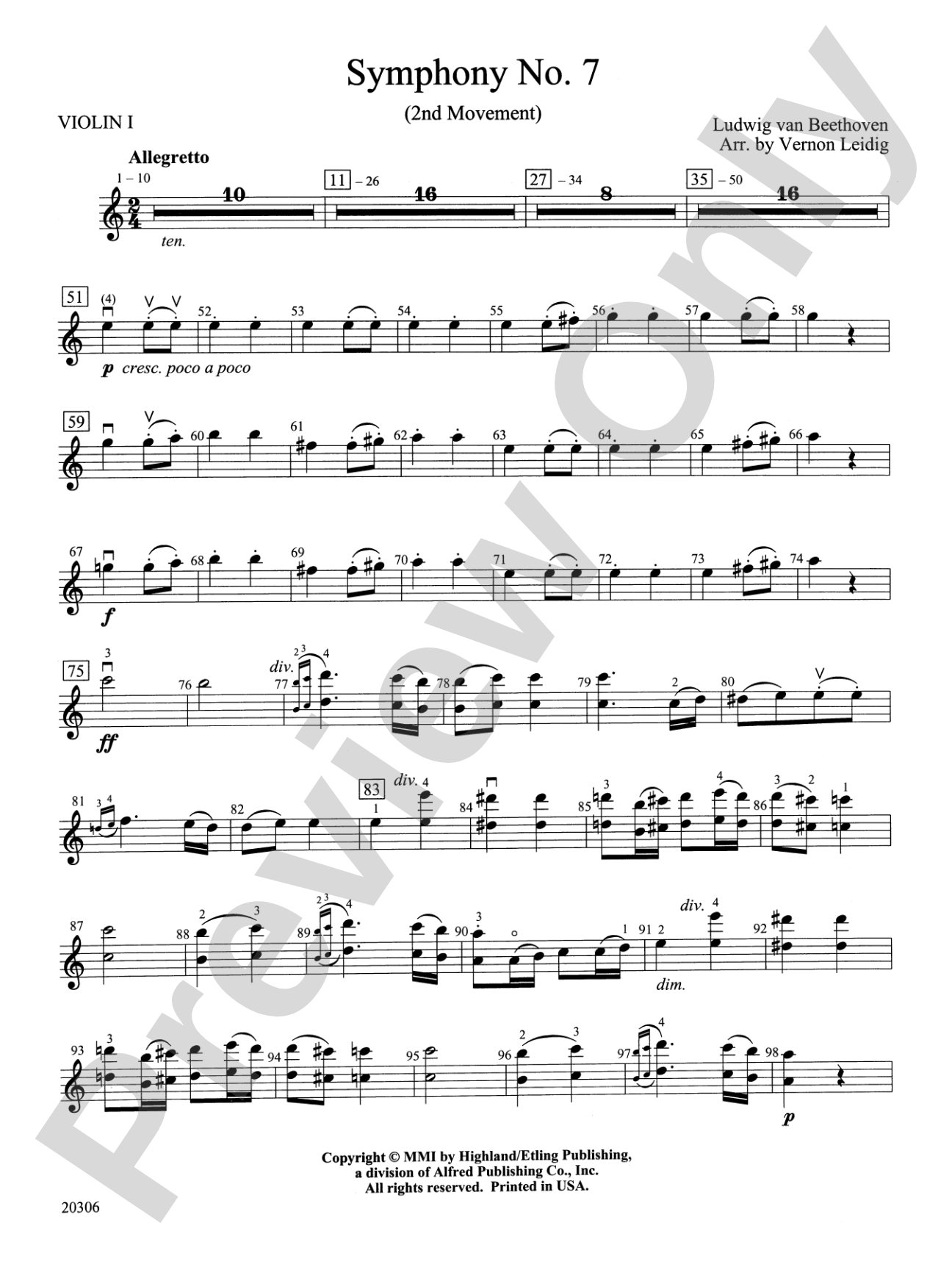
Symphony No. 7 (2nd Movement): 1st Violin Sheet Music Preview

Symphony No. 7 (2nd Movement): 1st Violin

(2nd Movement)

By Ludwig van Beethoven / arr. Vernon Leidig

Grade: 3

Item: 00-PC-0000386_VN1

Digital Download
$3.00
Description
This beautiful arrangement of the second movement from Beethoven's Symphony No. 7 should be in every orchestra's repertoire. With its serene and solemn dignity, it has been likened to a procession through the catacombs. Minor changes in instrumentation have been made here to make this treatment of Beethoven's masterpiece very accessible to the more advanced student orchestra, while still sounding very close to the original.

Don't just read it, hear it, play along with it, and watch your students grow with it. In MakeMusic Cloud, Symphony No. 7 (2nd Movement): 1st Violin comes alive with professional accompaniment, adjustable tempo, and built-in practice tools that turn solo practice into real progress.

Sample Audio
No sample audio found.
Sample Video
Additional Details
Series: Highland/Etling Full Orchestra
Publisher: Alfred Music
Page Count: 178
SKU: 00-PC-0000386_VN1

More about this title

About the Composer: Ludwig van Beethoven

Ludwig van Beethoven (1770-1827) fundamentally transformed what symphony could express. A student of Haydn and Mozart, he inherited the Classical form but pushed it toward profound emotional and philosophical territory. His nine symphonies remain cornerstones of orchestral literature, each one expanding the possibilities of the medium.

Beethoven's Second Symphony, composed in 1802-1803, marks a turning point in his style. Written during a period of personal struggle (his deafness was beginning), the work paradoxically radiates an almost hymn-like serenity, especially in the slow second movement. This movement has inspired conductors and arrangers for over two centuries because it distills Beethoven's ability to create monumental emotion through simple, dignified musical ideas.

Why we love this

Vernon Leidig's arrangement captures the essence of Beethoven's original conception while genuinely serving the capabilities of advanced student orchestras. The instrumentation adjustments preserve the work's architectural integrity and ceremonial character without requiring forces beyond what most school programs can field. Student musicians gain direct access to one of history's most consequential musical statements, not a watered-down substitute.

What to expect

Solemn yet serene, the movement unfolds like a processional through quiet, sacred space. The orchestration creates an almost hymn-like quality, with sustained harmonies and gentle rhythmic motion that invites reflection rather than excitement. There is nobility here, but expressed through restraint and dignified simplicity rather than grandeur.

Who it's for

Advanced student orchestras seeking repertoire with genuine artistic substance and historical weight. Directors programming concert or festival performances with orchestras capable of handling Grade 3 material and students ready for the interpretive demands of a Classical masterwork.

How to get the most out of it

  • Shape the opening melody with warm, singing tone from the first violins; Beethoven's 'serenity' demands genuine lyricism, not mechanical precision.
  • Balance the accompaniment figures (violas, cellos, basses) so they support rather than dominate the harmonic foundation; this movement lives in its sustained harmony.
  • Resist the urge to rush; the marked tempo (Allegretto) should feel unhurried and processional, allowing space between phrases for the architecture to emerge.
  • Use the conductor score to mark dynamic transitions clearly for all sections; even small crescendos and diminuendos shape the movement's emotional arc significantly.

How to use it

This movement stands alone effectively as a concert centerpiece or as the emotional anchor in a program of Classical and Romantic works. Its formal restraint and philosophical character pair well with smaller-scale contemporary pieces or lighter Classical fare, creating intelligent contrast. The 178 pages of score and parts make it substantial enough to merit its own rehearsal focus.

Skills your students will build

  • Balancing lyrical melodic lines with underlying harmonic support
  • Sustaining tone and focus across long phrases without dynamic movement
  • Reading and executing dynamic nuance within a narrow, refined range
  • Coordinating ensemble texture across multiple instrumental families
  • Interpreting Classical form and proportion as a conductor and section member

You May Also Like