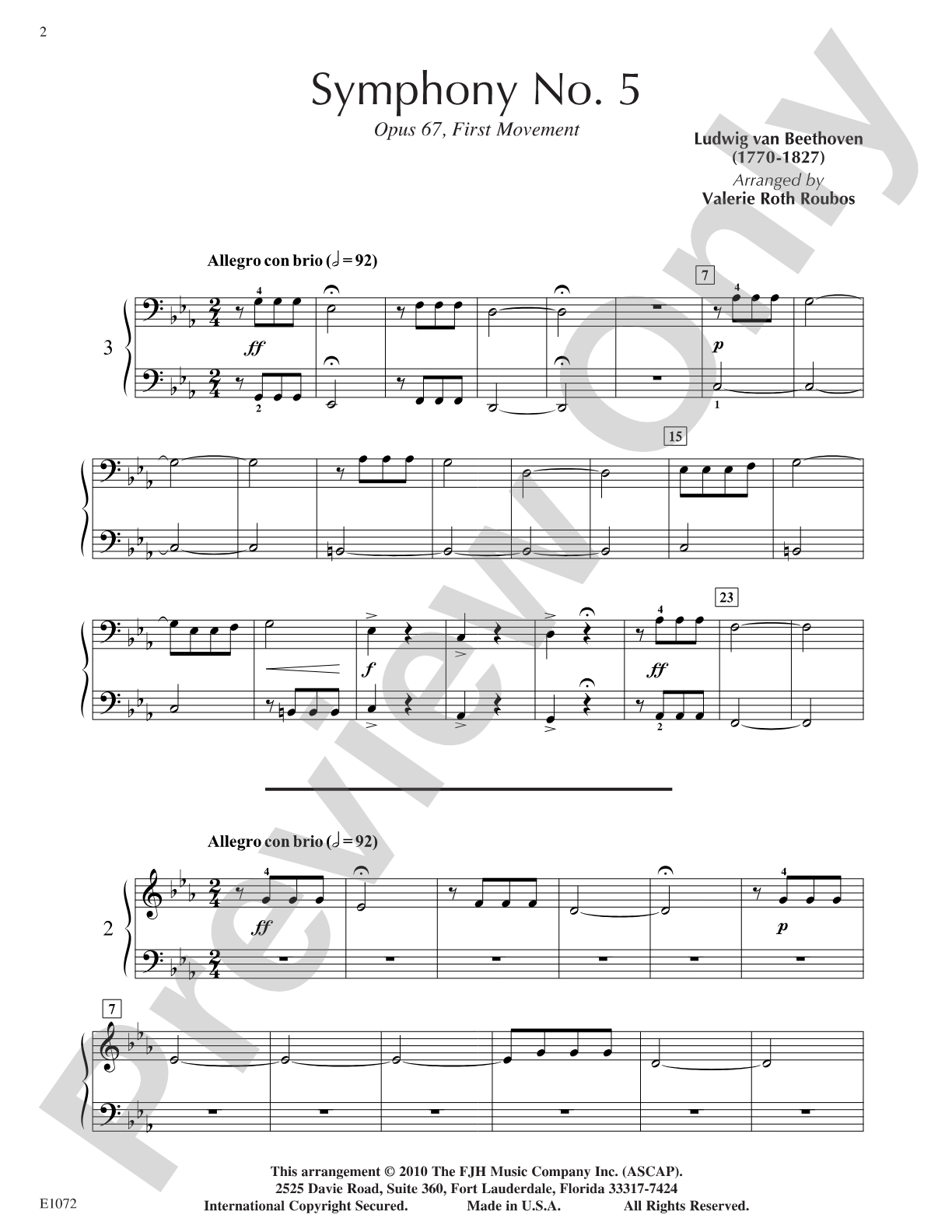
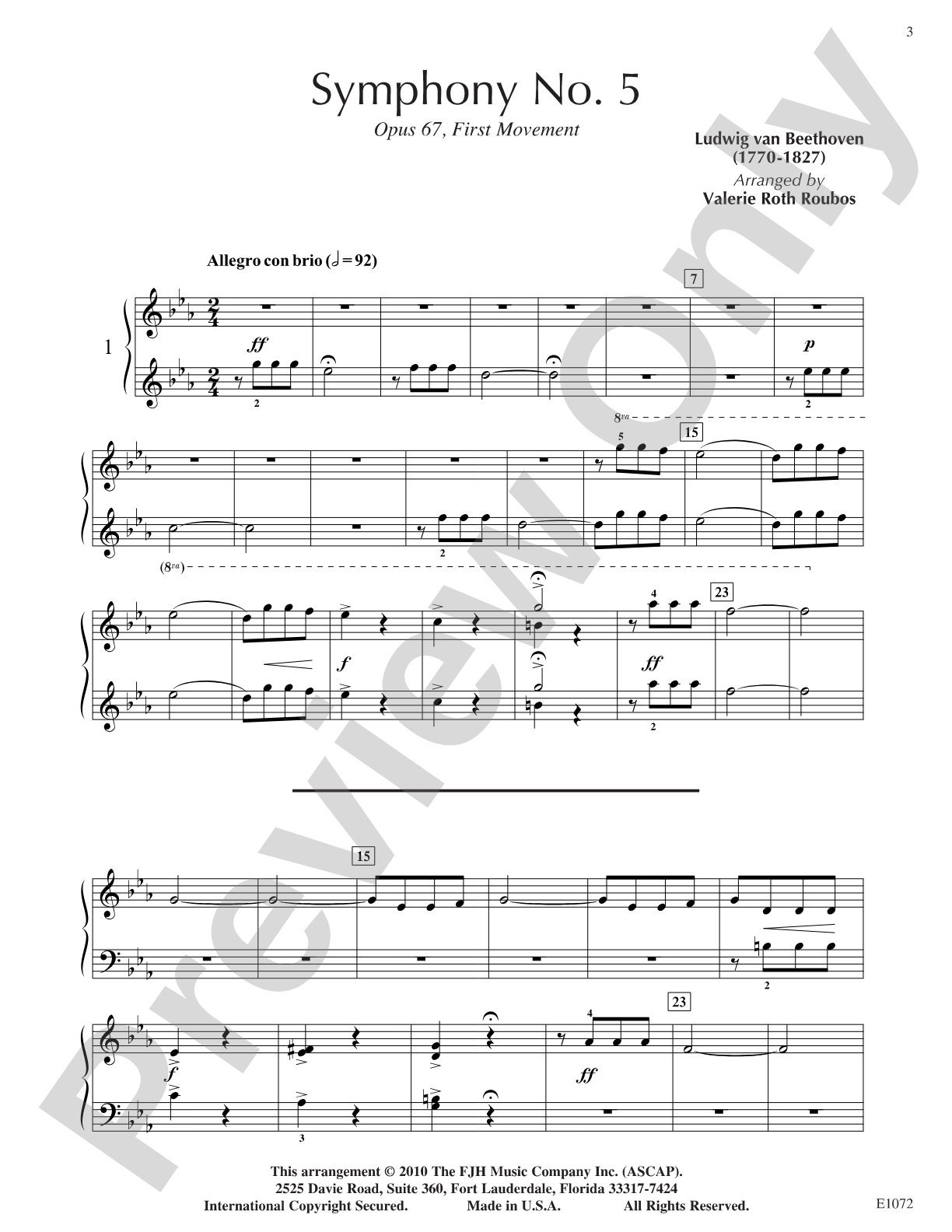
Symphony No. 5, Opus 67, First Movement Sheet Music Preview

Symphony No. 5, Opus 67, First Movement: Piano

By Ludwig van Beethoven / arr. Valerie Roth Roubos

Item: 98-DE1072

Digital Download
$10.95
Description
A true, timeless, classical theme recognized world wide, Beethoven's Symphony No. 5, First Movement will be a favorite ensemble piece for students. Especially exciting for recitals and other performance venues, audiences will undoubtedly enjoy listening to this exciting arrangement.

Symphony No. 5, Opus 67, First Movement: Piano isn't in MakeMusic Cloud just yet...but it could be. Let us know you'd like to see it, and you'll help shape what comes next. In the meantime, start a free trial and dive into thousands of interactive titles your students can play along with today.

Sample Audio
No sample audio found.
Sample Video
Additional Details
Series: The FJH Piano Ensemble Series
Publisher: The FJH Music Company, Inc.
SKU: 98-DE1072

More about this title

About the Composer: Ludwig van Beethoven

Ludwig van Beethoven (1770–1827) fundamentally transformed the symphonic form during his lifetime, expanding its emotional range and structural possibilities. His nine symphonies represent a bridge between Classical and Romantic idioms; the Fifth Symphony in particular stands as one of the most recognizable and structurally innovative works in the Western canon. Beethoven's relentless exploration of thematic development and harmonic boldness set the standard for generations of composers to follow.

For music educators, Beethoven's work offers students immediate engagement with profound compositional craftsmanship. The opening gesture of the Fifth Symphony—that iconic four-note motive—demonstrates how a small musical idea can sustain an entire movement through rigorous, purposeful development. Teaching his music builds student understanding of large-scale musical architecture and the power of compositional intention.

Why we love this

This arrangement captures the architectural brilliance of Beethoven's original while making it accessible at the intermediate level. The first movement's instantly recognizable opening gives students an immediate sense of accomplishment and confidence, and the familiar melody holds audience attention effortlessly at any performance venue.

What to expect

The movement thrums with purposeful energy, driven by that relentless four-note figure that becomes almost hypnotic in its persistence. Beethoven moves between moments of dramatic tension and surprising lightness, creating a sense of inevitability and forward momentum that never feels mechanical despite the repetition.

Who it's for

This piece suits intermediate pianists preparing for recitals or ensemble performances who want to tackle a work that sounds impressive and feels musically substantial. Students at this level have enough technical skill to handle moderate hand independence and faster passage work while building interpretive depth through engagement with a masterwork.

How to get the most out of it

  • Shape the iconic four-note opening motive with slight emphasis on the first note and gentle release on the following three, allowing the rhythmic profile to read clearly to the audience.
  • Balance the hand parts so that thematic material emerges distinctly; when the left hand carries supporting figures, keep them rhythmically propulsive but dynamically secondary.
  • Observe tempo markings carefully to maintain the forward momentum Beethoven intended; rushing through transitions can flatten the dramatic impact of the development section.
  • Pay attention to the key relationships and harmonic shifts throughout the movement; clear pedaling will enhance harmonic color without muddying the rapid figuration.

How to use it

This work serves naturally as a concert centerpiece or a standalone feature piece that needs no introduction; the melody is recognizable enough that audiences settle in immediately. It pairs well on a recital program with other Classical or early Romantic works, providing both a stylistic anchor and a technically satisfying challenge for intermediate students.

Skills your students will build

  • Left-hand accompaniment patterns and rhythmic independence
  • Thematic recognition and large-scale phrase architecture
  • Hand balance and dynamic control in parallel passage work
  • Pedaling for harmonic resonance at a moderate tempo
  • Interpretation of crescendos and dynamic shifts within a structured Classical form

You May Also Like