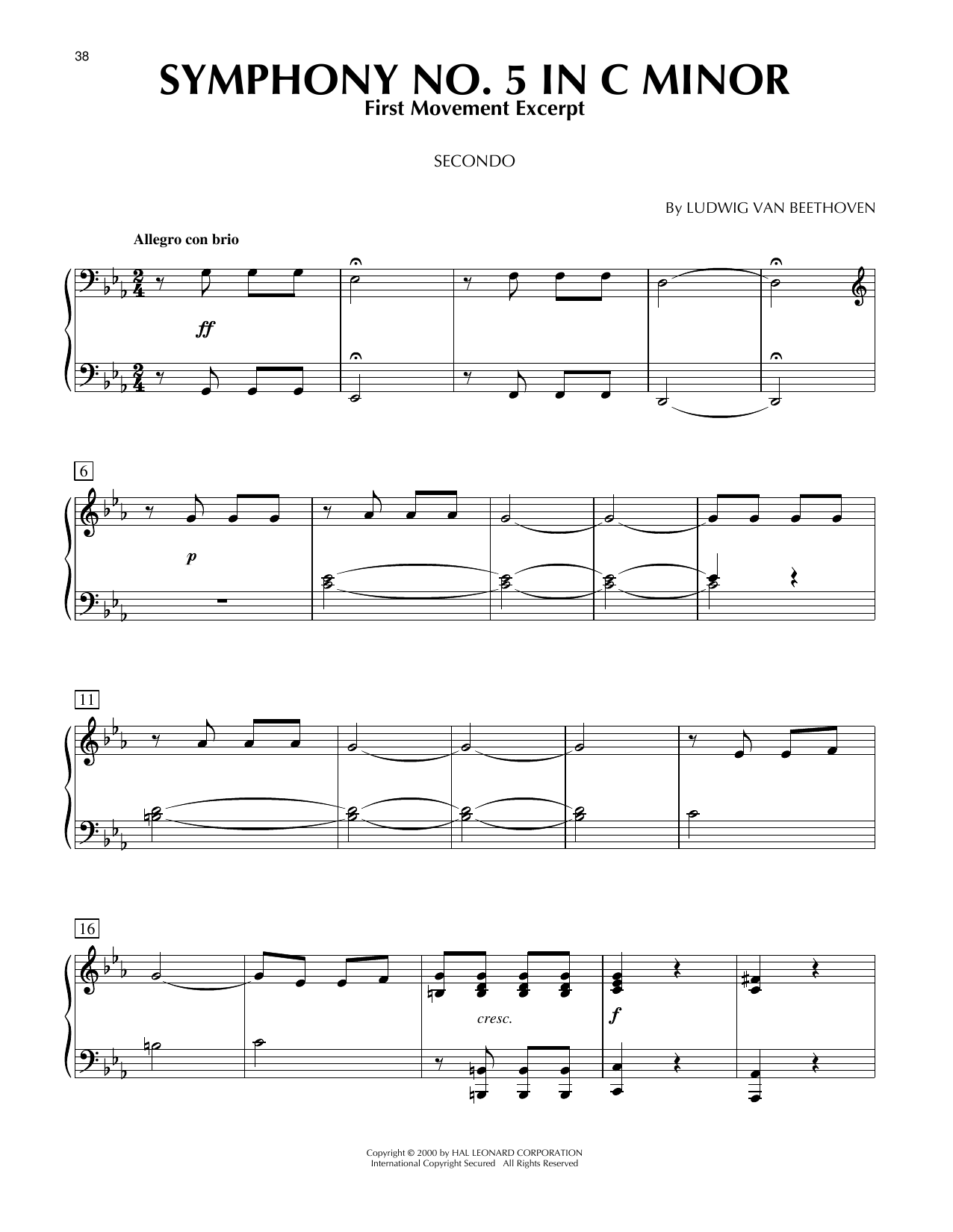
Ludwig van Beethoven (1770-1827) stands as one of history's most influential composers, bridging the Classical and Romantic eras with works that fundamentally expanded what instrumental music could express. Deaf for much of his creative life, Beethoven composed from an inner vision rather than external sound, resulting in symphonies of unprecedented dramatic scope and emotional depth. His Fifth Symphony in particular has become a cornerstone of the orchestral canon, and this first movement excerpt captures the work's most iconic gesture: four notes that have transcended classical music to become embedded in popular culture.
Why we love this
The famous opening gesture of Beethoven's Fifth needs no introduction, yet working with this excerpt offers something singular: students encounter one of music's most recognizable moments on the page, then discover how Beethoven constructs an entire movement from those four notes. The pedagogical gift here is watching students grasp motivic development in real time, seeing how a simple idea becomes architecture. Programming this gives young players direct access to a work that shaped everything that came after it.
What to expect
Urgent and propulsive, the movement grabs attention immediately and sustains it through sheer inevitability. There's a relentless quality to Beethoven's unfolding of this material: each repetition feels both familiar and slightly shifted, creating a sense that something unstoppable is in motion.
Who it's for
This excerpt works for high school orchestras, advanced middle school ensembles, and piano students seeking meaningful repertoire from the standard canon. It also serves pianists preparing for recitals or competitions who want to engage with a genuinely great work without the demands of a full sonata arrangement.
How to get the most out of it
Treat the opening four-note motive as a rhythmic statement before a melodic one; the weight lies on the first note and the sforzando marking, not on reaching any particular pitch.
Balance the dialogue between thematic statements and accompaniment figures throughout the excerpt, resisting the urge to let supporting voices collapse under the prominence of the main idea.
Shape each phrase with the harmonic tension in mind; Beethoven moves deliberately between keys, and performers should hear and communicate those shifts rather than play through them.
Maintain forward momentum during transitional passages, where the texture thickens and the motive fragments; this isn't a moment to slow down or lose direction.
How to use it
Open a concert with this excerpt to frame a discussion of how composers develop ideas, or pair it with a contemporary work that also builds from a single gesture, showing students that Beethoven's approach remains relevant. It also works beautifully as a gateway into studying the full symphony, giving students a concrete entry point before tackling the complete score.
Skills your students will build
Motivic analysis and recognition of how a single idea generates an entire musical argument
Understanding sforzando articulation and its rhythmic function within forte passages
Reading and responding to harmonic modulation and key change
Ensemble balance between primary thematic material and accompaniment textures
Phrasing across sustained harmonic tension and resolution
You May Also Like
Scan to Complete Your Purchase
Use your phone's camera to scan the code below
You'll log in on your phone and the order will be added to your account