Symphony No. 5 In C Minor, First Movement Excerpt Sheet Music Preview

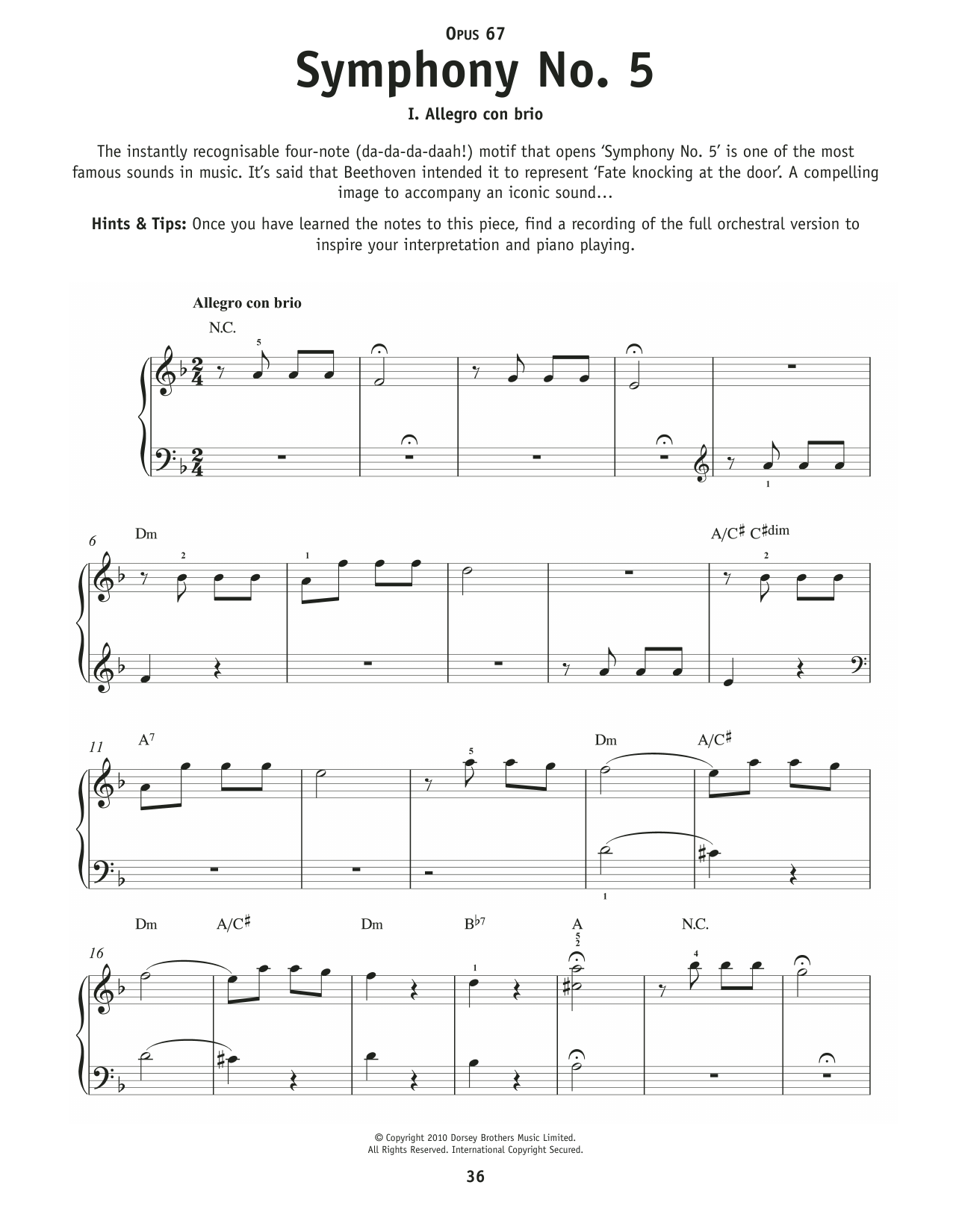
Symphony No. 5 In C Minor, First Movement Excerpt: Really Easy Piano

As performed by Ludwig Van Beethoven

Item: 35-DS01575197

Digital Download
$4.99
Description

Discover MakeMusic Cloud: thousands of interactive titles your students can play along with today.

Sample Audio
No sample audio found.
Sample Video
Additional Details
Publisher: Hal Leonard
Page Count: 2
SKU: 35-DS01575197

More about this title

About the Artist: Ludwig Van Beethoven

Beethoven's symphonies fundamentally reshaped what orchestral music could express and achieve. His deafness paradoxically sharpened his compositional voice; unable to hear his works performed, he composed with absolute clarity of intent, each gesture and transition meticulously architected. The Fifth Symphony stands as his most iconic work, a piece that bridges Classical form and Romantic intensity.

For music students, Beethoven represents the moment when a composer became a voice of human struggle and triumph. His willingness to disrupt convention (unexpected modulations, sudden dynamic shifts, structural surprises) gave permission to every composer who followed. Teaching his work means teaching students that rules exist to be understood, mastered, and then thoughtfully broken.

Why we love this

The opening of the Fifth is instantly recognizable yet remains endlessly teachable. That famous four-note motive contains every compositional principle your students need to understand: how small ideas generate large structures, how repetition with variation builds momentum, and how orchestration transforms a simple gesture into something monumental. This excerpt gives you access to one of music's most important moments without committing to a full symphony performance.

What to expect

Urgency and inevitability. The piece pulses with forward motion; there is no rest, only variation. Beethoven constructs tension through relentless repetition and unexpected harmonic turns, creating a sense that something significant must happen. The orchestration feels both intimate and overwhelming, depending on the moment.

Who it's for

Conductors building a program that needs a cornerstone work or teachers who want students to study one of music's most structurally clear examples. Advanced secondary ensembles and college orchestras will find this excerpt substantial enough for serious rehearsal and performance.

How to get the most out of it

  • Establish the rhythmic motive as the heartbeat of the section. Every player must hear the four-note gesture as a unified organism, not separate attacks.
  • Shape each appearance of the main theme with slight dynamic and agogic variation. Beethoven writes the same motive repeatedly, but rigidity drains its power; subtle color changes keep ears engaged.
  • Balance clarity in the lower strings with precision in the upper voices. The accompanimental figures matter as much as the melody for this excerpt to breathe properly.
  • Resist rushing through transitions. Beethoven's harmonic shifts can sound abrupt without careful attention to the space between phrases.

How to use it

Pair this with a lighter Classical work or a contemporary piece to show how Beethoven's approach to orchestral writing influenced everything after him. It also works as an educational concert centerpiece, where you can speak to your audience about motif and development before the performance begins.

Skills your students will build

  • Recognizing and developing a short motivic idea across multiple instrument groups
  • Understanding Classical sonata form structure through experiential learning
  • Balancing foreground melodic material with accompaniment figures
  • Playing with rhythmic precision while maintaining musical phrasing
  • Responding to conductor cues that shape harmonic transitions

You May Also Like