Symphony No. 5: E-flat Baritone Saxophone Sheet Music Preview

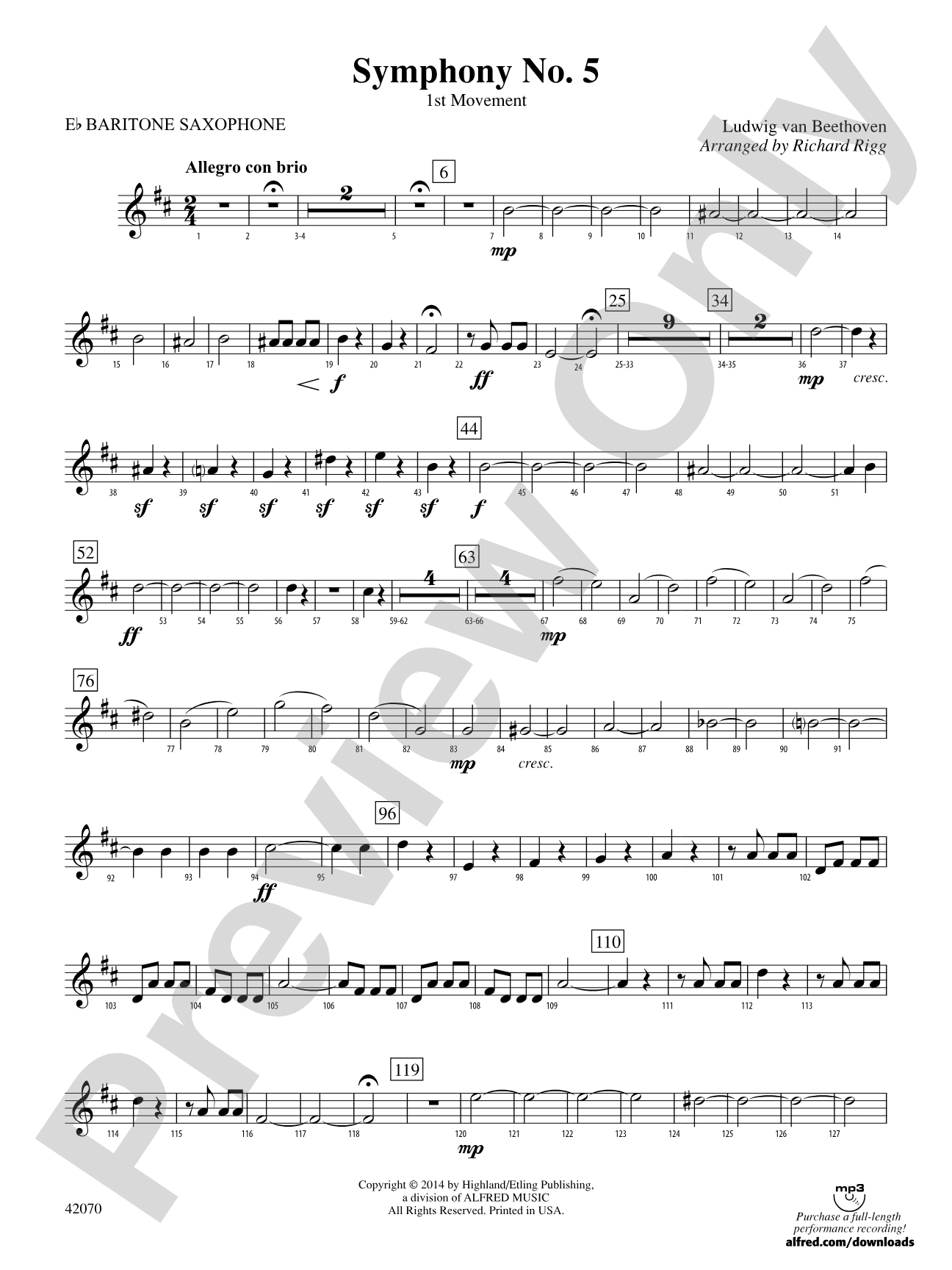
Symphony No. 5: E-flat Baritone Saxophone

1st Movement

By Ludwig van Beethoven / arr. Richard Rigg

Grade: 2.5

Item: 00-PC-0016462_BTX

Digital Download
$3.00
Description
In D minor, this arrangement is a very "approachable" version of this masterwork. Strings will use a variety of bowings, and some position work is required of first violins and cellos. Winds, brass, and percussion will enjoy this symphonic experience. Scored for either full or string orchestra, with optional percussion. (4:00) This title is available in MakeMusic Cloud.

Don't just read it, hear it, play along with it, and watch your students grow with it. In MakeMusic Cloud, Symphony No. 5: E-flat Baritone Saxophone comes alive with professional accompaniment, adjustable tempo, and built-in practice tools that turn solo practice into real progress.

Sample Audio
0:00
0:00
Sample Video
Additional Details
Series: Highland/Etling Full Orchestra
Publisher: Alfred Music
Page Count: 214
SKU: 00-PC-0016462_BTX

More about this title

About the Composer: Ludwig van Beethoven

Ludwig van Beethoven (1770-1827) fundamentally transformed the orchestra from a accompaniment ensemble into a vehicle for profound artistic statement. His nine symphonies, particularly the Fifth, represent a watershed moment in Western music history where orchestral writing became the primary medium for large-scale musical argument. For music educators, Beethoven's mastery of orchestration and structural clarity makes his work invaluable to student musicians learning how themes develop, how different instrumental families interact, and how musical tension builds toward resolution.

Why we love this

Richard Rigg's arrangement captures the visceral power of Beethoven's Fifth while making it genuinely playable for high school orchestras. The scoring preserves the symphony's architectural integrity and iconic themes without overwhelming developing players, and the flexibility to perform with or without full winds and brass means you can scale this to your ensemble's size and instrumentation.

What to expect

The opening obsessive four-note motif returns again and again, each time building greater momentum and intensity until the orchestra sounds unified and unstoppable. There is triumph in this piece, but also struggle; players will feel the progression from conflict toward hard-won resolution.

Who it's for

This arrangement is ideal for high school orchestras or community ensembles looking to program major repertoire without exceeding their players' current technical demands. Conductors will appreciate having a complete score that preserves Beethoven's orchestration while making bowings and fingerings accessible to intermediate musicians.

How to get the most out of it

  • Lock the famous four-note motive rhythmically across the entire ensemble from the opening; inconsistent articulation here will undermine the movement's propulsive energy.
  • Balance strings and winds carefully during the exposition to ensure melodic lines carry clearly even when multiple instrumental families have thematic material simultaneously.
  • Use the optional percussion selectively to enhance climactic moments rather than doubling them throughout; this keeps the texture transparent in passages where Beethoven relies on pure orchestral color.
  • Mark cues in both string and wind parts so that sections can lock onto each other's entrances, especially during transitions where the texture thins.

How to use it

Open a concert with this arrangement to establish serious artistic intent and give your orchestra a flagship work they can take pride in performing. The four-minute duration fits comfortably in a mixed program, and its familiarity to audiences makes it an excellent anchor for a concert centered on major works.

Skills your students will build

  • Rhythmic precision and ensemble unison in motif-driven writing
  • String bowing coordination and position work (first violins and cellos)
  • Balance and blend between string, wind, and brass sections
  • Phrasing and articulation control in thematic development
  • Reading complex full scores and tracking multiple instrumental lines simultaneously

You May Also Like