
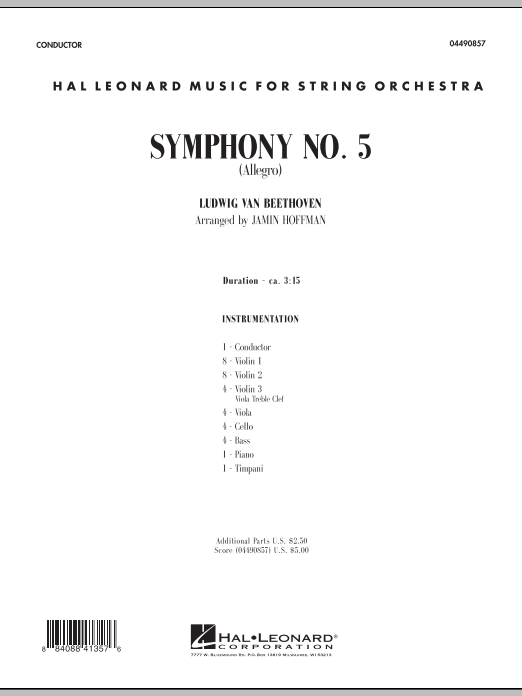

Symphony No. 5 (Allegro): String Orchestra Conductor Score & Parts
By Ludwig Van Beethoven / Arranged by Jamin Hoffman
Grade: 3-4
Item: 35-PK00135956
$55.00
Pickup currently not available
Buy Extra Parts (Digital PDF Download)
| Product | Price | Quantity |
|---|---|---|
| Symphony No. 5 (Allegro) - Full Score | $7.50 | |
| Symphony No. 5 (Allegro) - Violin 1 | $7.00 | |
| Symphony No. 5 (Allegro) - Violin 2 | $7.00 | |
| Symphony No. 5 (Allegro) - Violin 3 (Viola Treble Clef) | $7.00 | |
| Symphony No. 5 (Allegro) - Viola | $7.00 | |
| Symphony No. 5 (Allegro) - Cello | $7.00 | |
| Symphony No. 5 (Allegro) - Bass | $7.00 | |
| Symphony No. 5 (Allegro) - Piano | $7.00 | |
| Symphony No. 5 (Allegro) - Timpani | $7.00 |
Parts Added to Cart!
Description
Now available for string ensemble, this movement from Beethoven's fifth symphony has become the emblem of classical music and continues to be one of the most performed works in orchestral literature. The iconic opening motive is the essence of the entire symphony and is ingeniously developed in this opening movement. Jamin Hoffman's version is carefully crafted for strings, giving student players a great opportunity to perform this famous masterwork. Dur: 3:15


Symphony No. 5 (Allegro): String Orchestra Conductor Score & Parts isn't in MakeMusic Cloud just yet...but it could be. Let us know you'd like to see it, and you'll help shape what comes next. In the meantime, start a free trial and dive into thousands of interactive titles your students can play along with today.
Request This Title
Tell us you want it.
Start Your Free Trial
Explore everything that's ready to play right now.
Sample Audio
No sample audio found.
Sample Video
No sample videos found.
Additional Details
Publisher:
Hal Leonard
SKU:
35-PK00135956
More about this title
About the Composer: Ludwig Van Beethoven
Beethoven fundamentally reshaped what symphonic music could be. Writing during a period of profound personal challenge, including progressive hearing loss, he expanded the symphony from a elegant formal entertainment into a vehicle for urgent human expression. His relentless development of tiny musical ideas into vast architectures influenced every composer who followed.
For music educators, Beethoven's output represents the bridge between Classical clarity and Romantic intensity. His works teach students how motifs can be transformed, how harmonic tension builds drama, and how formal structures can contain genuine emotional weight.
Why we love this
This is the Beethoven piece your students already know, which means you can skip the "listen, this will be familiar" preamble and jump straight to teaching the architecture underneath that iconic opening. Hoffman's string arrangement preserves the original's driving force while remaining genuinely playable for Grade 3-4 orchestras; too many versions of this work either oversimplify the music or demand virtuosity your students don't yet possess.
What to expect
Purposeful and propulsive from the downbeat. The famous opening motive creates forward momentum that the arrangement sustains throughout, building in intensity as material develops and recombines. You'll sense the architecture of the larger symphony contained in this single movement, even at a smaller scale.
Who it's for
String orchestras at the intermediate level looking to tackle genuine masterworks without requiring advanced technical facility. This arrangement works equally well for school orchestras building their classical repertoire and community ensembles seeking to program recognizable music with substance.
How to get the most out of it
- Establish the opening motive's character in sectional rehearsals before bringing the full orchestra together. The rhythm must land with precision, not aggression; think of it as purposeful rather than heavy.
- Pay close attention to the dynamic shape between major statements and transitional passages. The contrast between the forte opening and the piano sections that follow creates the movement's momentum.
- Balance the viola and cello lines during the developmental sections. These inner voices carry harmonic weight that transforms the familiar opening into something new, and they'll be lost if the violins dominate.
How to use it
This works exceptionally well as an anchor for a Classical music concert, either opening the program or closing the first half. Pair it with another Beethoven arrangement or period-appropriate works to create a thematic program. It's also effective as a showpiece performance for beginning orchestras aiming to demonstrate what students can accomplish at the Grade 3-4 level.
Skills your students will build
- Motivic development and transformation across multiple sections
- Ensemble precision in rhythmic unison and staggered entrances
- Balancing dynamic contrast between foreground and background material
- Sustaining focus across a longer single-movement form
- Coordinating articulation and phrasing within a fast tempo