
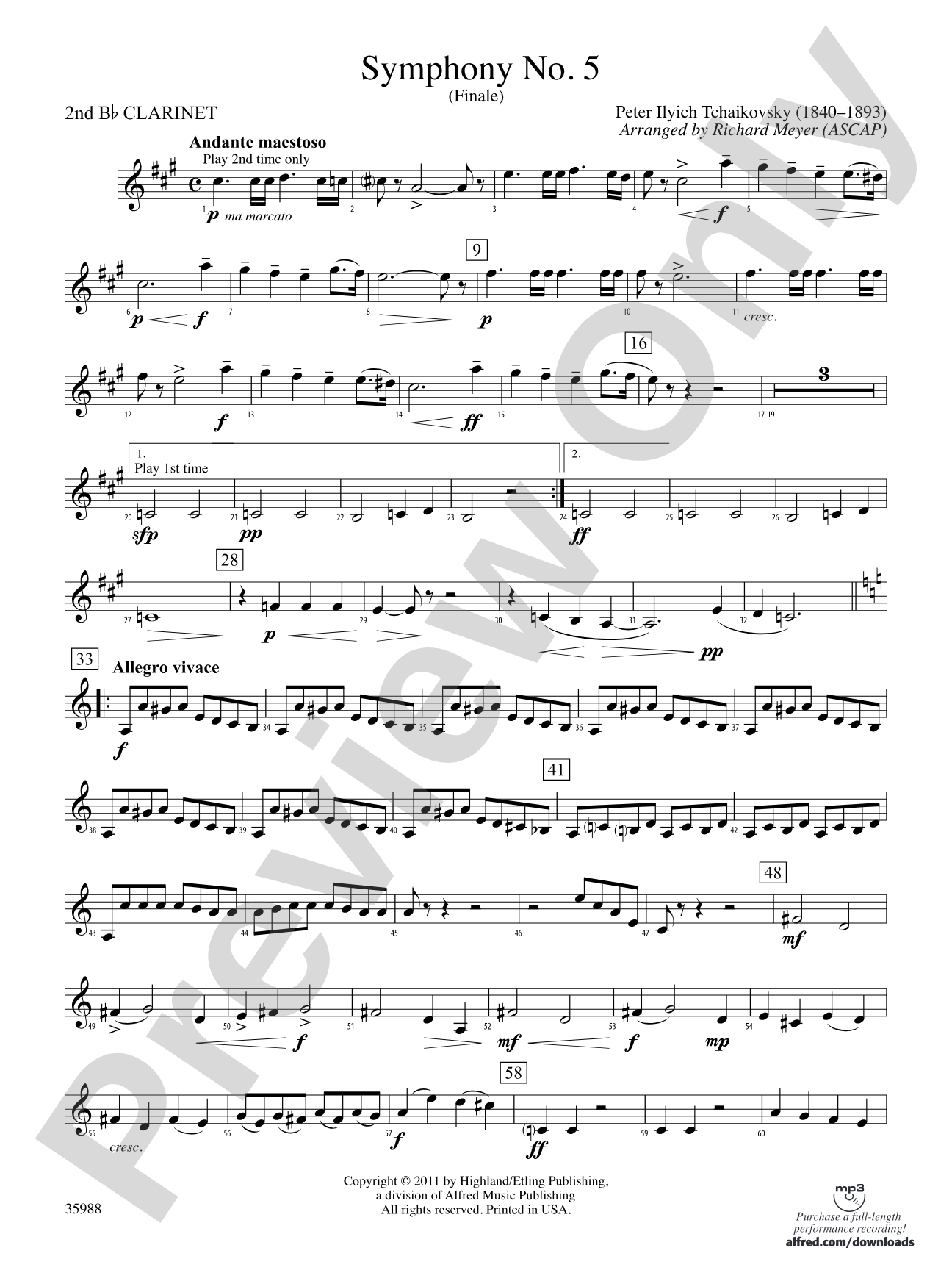

Symphony No. 5: 2nd B-flat Clarinet
Finale
By Piotr Ilyich Tchaikovsky / arr. Richard Meyer
Grade: 2.5
Item: 00-PC-0015063_C2
$3.00
Pickup currently not available
Description
All of the colors and moods of the original are retained in this exciting arrangement that is sure to challenge every section of your orchestra. This is a great way to introduce all of your student musicians to a masterwork of the symphonic literature, and a perfect closer to any concert! This title is available in MakeMusic Cloud.


Don't just read it, hear it, play along with it, and watch your students grow with it. In MakeMusic Cloud, Symphony No. 5: 2nd B-flat Clarinet comes alive with professional accompaniment, adjustable tempo, and built-in practice tools that turn solo practice into real progress.
Open in the Player
Jump straight in and assign it today.
Start Your Free Trial
Open this title and explore the full library in minutes.
Sample Audio
1
Audio File
--:--
0:00
0:00
Sample Video
Additional Details
Series:
Highland/Etling First Philharmonic
Publisher:
Alfred Music
Page Count:
204
SKU:
00-PC-0015063_C2
Instrumentation:
full (timp, snare, bass drum, crash cymbals, vln3)
More about this title
About the Composer: Peter Ilyich Tchaikovsky
Peter Ilyich Tchaikovsky (1840-1893) stands as one of the most performed composers in the orchestral repertoire, celebrated for his gift for melody and his ability to write directly for the strengths and limitations of each orchestral instrument. His five symphonies form the cornerstone of his legacy, each one a distinct exploration of form, orchestration, and emotional expression that continues to captivate audiences and challenge student musicians alike.
Tchaikovsky's work bridged the Romantic era's passion and the Classical tradition's structural discipline. His orchestrations are models of clarity and color; every section of the orchestra has something meaningful to play, which is precisely why his music translates so effectively to student ensembles when arranged with care.
Why we love this
Richard Meyer's arrangement strips away nothing essential while making this iconic symphony accessible to orchestras still building their technical foundation. Your brass section gets satisfying material that sits comfortably in the staff, the strings carry the melodic weight without requiring virtuosity, and every player in the ensemble feels like they're playing a real masterwork, not a simplified sketch of one.
What to expect
The opening emerges quietly and mysteriously, drawing you in with an unforgettable theme that threads through the entire work. Energy builds and releases in waves, moving from introspection to triumph, giving every student musician a moment to feel the scale and drama of a genuine symphonic experience.
Who it's for
Orchestras at the Grade 2.5 level with mixed instrumentation and at least one year of experience reading standard orchestral scores. This arrangement works for groups that have solid fundamentals in rhythm and intonation but may still be developing independence in their upper parts and section balance.
How to get the most out of it
- Balance the lower strings and woodwinds carefully in the opening; the foundation of this piece depends on them being heard as a unified sonority, not as accompaniment.
- Conduct the dramatic peaks with clear, generous gestures so the orchestra understands when to build intensity versus when to step back; Tchaikovsky's contrasts between soft and loud are essential to the piece's architecture.
- Give the timpani player confidence in those crucial rhythmic figures that punctuate the main themes; they anchor the ensemble through some of the busier harmonic passages.
- Shape the phrasing in longer melodic lines even at slower tempos; student orchestras can flatten long notes without intentional breathing points marked by the conductor.
How to use it
Close a concert with this piece; it reads as substantial and polished without exhausting the ensemble, and audiences recognize the melody immediately, creating that satisfying moment of shared musical literacy. It also works well as a festival selection for groups wanting to program something recognizable that showcases their entire section strength.
Skills your students will build
- Reading and executing dynamic contrast in a multi-movement context
- Balancing independent melodic lines across the orchestra while maintaining unified phrasing
- Managing tempo stability through varied harmonic density and rhythmic activity
- Responding to conducting cues that shape large-scale structural arcs
- Playing sustained tones with intention and color across multiple sections simultaneously