
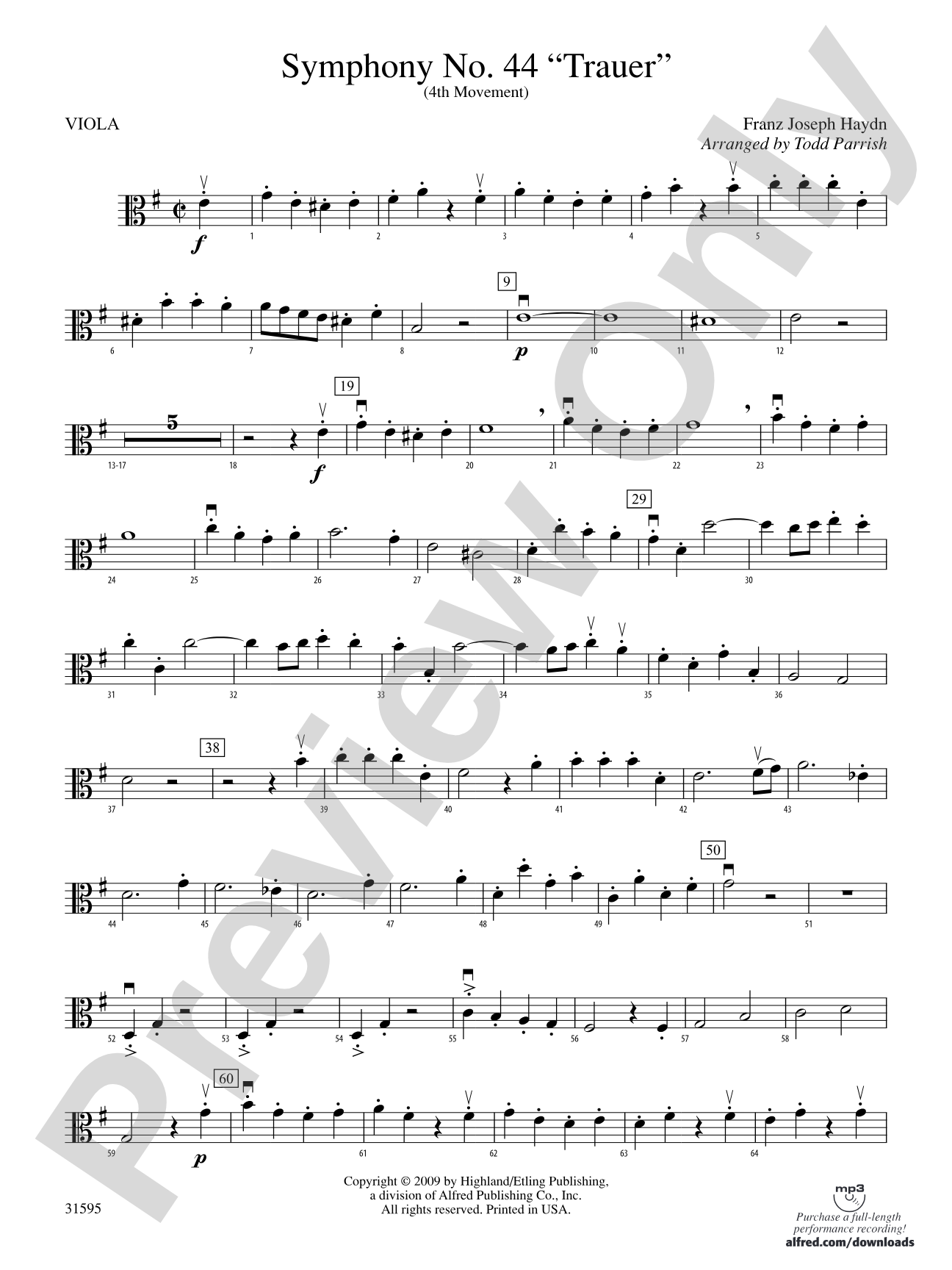

Symphony No. 44 "Trauer" (4th Movement): Viola
By Franz Joseph Haydn / arr. Todd Parrish
Grade: 4
Item: 00-PC-0001761_VA1
$5.99
Pickup currently not available
Description
Celebrate Haydn's 200th anniversary with this outstanding symphony! This exciting and energetic work is a rare example of Haydn's use of the minor tonality in symphonic writing, which is aptly subtitled "Trauer," translated "Mourning." The string parts are very close to the original with changes made only to accommodate the important lines of the original oboe and horn parts. Students will thoroughly enjoy the contrapuntal style allowing simultaneous independent melodies. Some shifting is required through third position for violins and fourth position for cellos and basses. This title is available in MakeMusic Cloud.


Don't just read it, hear it, play along with it, and watch your students grow with it. In MakeMusic Cloud, Symphony No. 44 "Trauer" (4th Movement): Viola comes alive with professional accompaniment, adjustable tempo, and built-in practice tools that turn solo practice into real progress.
Open in the Player
Jump straight in and assign it today.
Start Your Free Trial
Open this title and explore the full library in minutes.
Sample Audio
1
Audio File
--:--
0:00
0:00
Sample Video
No sample videos found.
Additional Details
Series:
Highland/Etling String Orchestra
Publisher:
Alfred Music
Page Count:
124
SKU:
00-PC-0001761_VA1
More about this title
About the Composer: Franz Joseph Haydn
Franz Joseph Haydn (1732-1809) shaped the symphony as we know it, developing the form from a brief orchestral introduction into a sophisticated multi-movement work. His prolific output of 104 symphonies spans decades of evolving compositional technique, and his influence on Mozart, Beethoven, and generations of composers that followed cannot be overstated.
Haydn spent much of his career in the service of the Esterházy family in Hungary, where he led orchestras, composed constantly, and experimented fearlessly with orchestral color and structure. His willingness to explore emotional depth through minor keys and contrapuntal complexity, evident in works like Symphony No. 44, reveals a composer far more adventurous than his "Papa Haydn" nickname might suggest.
Why we love this
This fourth movement captures something genuinely rare in Haydn's symphonic catalog: the full emotional weight of minor key writing combined with driving contrapuntal energy that keeps every string player engaged and essential. Todd Parrish's arrangement honors the original orchestration while making the inner voices breathe on student instruments, giving young orchestras a chance to tackle authentic Classical architecture without oversimplification.
What to expect
The fourth movement unfolds with urgency and architectural clarity, its minor key lending an intensity that contrasts sharply with typical Classical brightness. Multiple voices interweave in patterns that feel both inevitable and surprising, creating a sense of propulsive momentum wrapped in restless, contemplative color.
Who it's for
String orchestras at the Grade 4 level that have developed solid intonation and basic position technique and are ready for music that demands both technical growth and genuine interpretive maturity. This work suits ensembles preparing for festival competition or a concert program centered on Classical masterworks.
How to get the most out of it
- Balance the independent melodic lines carefully; each section should hear itself as a soloist in the contrapuntal texture rather than as accompaniment.
- Secure the position shifts (third position for violins, fourth position for cellos and basses) in sectional rehearsals before full run-throughs so technical demands don't interfere with interpretive control.
- Let the minor tonality and its harmonic language guide your phrasing; the Trauer subtitle reflects genuine gravity, not theatrical darkness.
- Shape the articulation consistently across the strings so rhythmic figures remain crisp and clear through the texture without sounding choppy or disconnected.
How to use it
Program this as a centerpiece in a Classical or chamber orchestra concert, pairing it with lighter fare to show Haydn's full range. Its substantial length and emotional weight also make it a strong festival selection where judges reward orchestral maturity and control of contrapuntal texture.
Skills your students will build
- Reading and executing position shifts (third position for violins; fourth position for cellos and basses)
- Balancing and listening to independent melodic lines within a contrapuntal texture
- Sustaining ensemble intonation and rhythmic precision in fast-moving harmonic environments
- Interpreting minor key character and phrasing with appropriate weight and direction
- Coordinating articulation across string sections to maintain clarity in complex textures