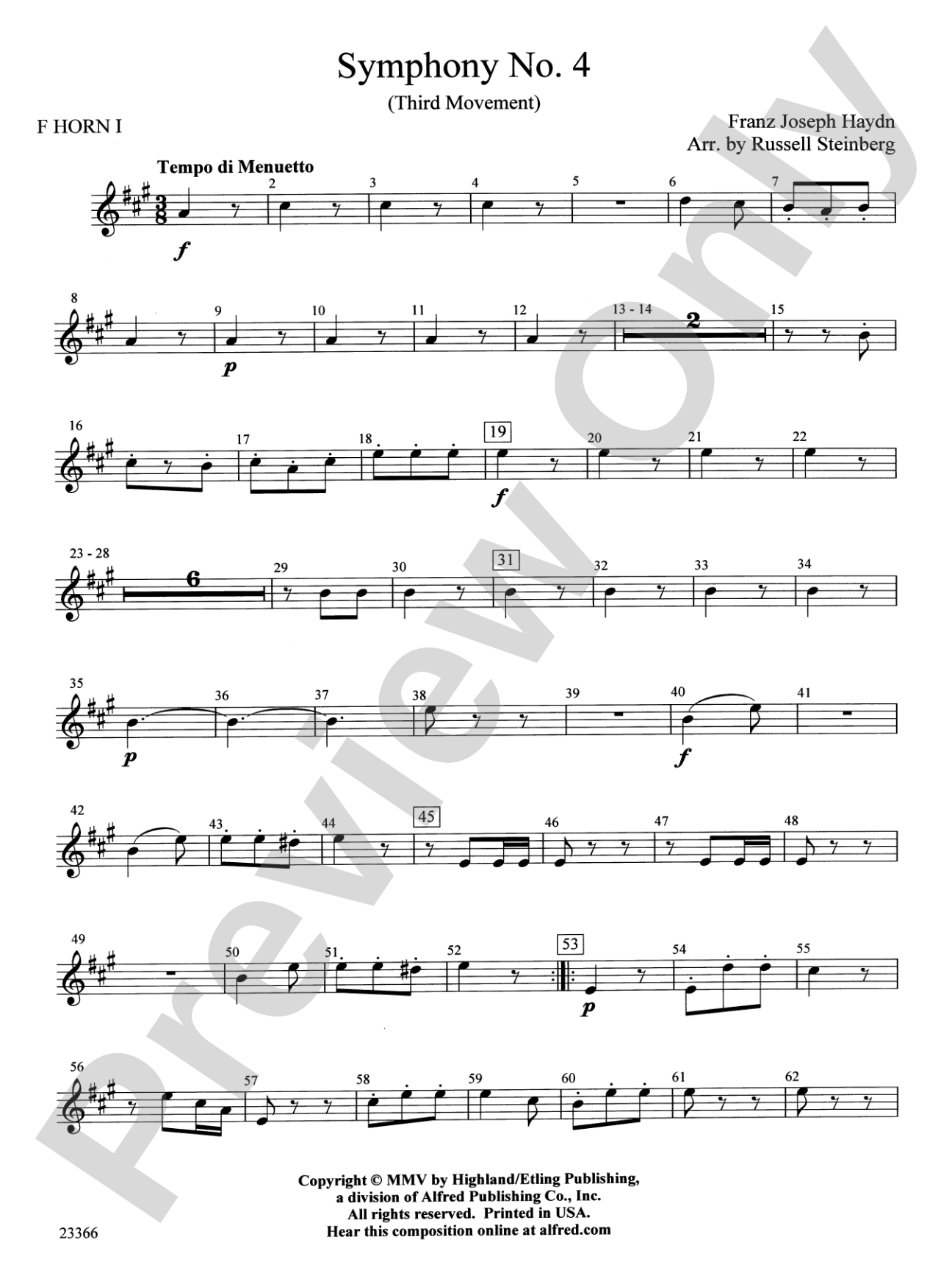
Symphony No. 4 (Third Movement): 1st F Horn Sheet Music Preview

Symphony No. 4 (Third Movement): 1st F Horn

(Third Movement)

By Franz Joseph Haydn / arr. Russell Steinberg

Item: 00-PC-0000710_H1

Digital Download
$3.00
Description
The piece is most effectively played with one beat per measure to give the music its necessary lightness and energy. The playing style should be detached and joyful. Dynamics should be as dramatic and sudden as possible, without crescendi or decrescendi. The tempo should be constant, without accelerandi or ritards.

Don't just read it, hear it, play along with it, and watch your students grow with it. In MakeMusic Cloud, Symphony No. 4 (Third Movement): 1st F Horn comes alive with professional accompaniment, adjustable tempo, and built-in practice tools that turn solo practice into real progress.

Sample Audio
No sample audio found.
Sample Video
Additional Details
Series: Highland/Etling Full Orchestra
Publisher: Alfred Music
SKU: 00-PC-0000710_H1

More about this title

About the Composer: Franz Joseph Haydn

Franz Joseph Haydn (1732-1809) shaped the Classical symphony into its definitive form. Working first as court composer for the Esterházy family in Hungary, he created over 100 symphonies across five decades, developing the structural and orchestral innovations that Beethoven and Brahms inherited.

Haydn's symphonies move far beyond formal templates. His rhythmic wit, unexpected harmonies, and theatrical sense of orchestration make each work a conversation between composer and listener. Teachers turn to Haydn because his music rewards close attention: students discover how much personality and craft can exist within elegant, balanced structures.

Why we love this

This third movement captures Haydn at his most direct and playful. The scoring is transparent enough to let young orchestras hear individual lines clearly, yet the writing remains sophisticated enough to hold professional players' interest. Russell Steinberg's arrangement preserves the original's character while making it accessible for full orchestra reading at the secondary or early collegiate level.

What to expect

Bright and buoyant, with a minuet's courtly grace mixed with mischievous humor. The orchestration sparkles; instrumental lines weave in and out of focus, catching light like facets of a jewel. There is joy in precision here, and the directness of Haydn's wit comes through in unexpected harmonic turns and the sharp clarity of orchestral texture.

Who it's for

Conductors leading full orchestras at the secondary or early college level who want to teach Haydn's symphonic mastery without overwhelming players with extreme technical demands. This movement works equally well for orchestras preparing concert programs that need elegance and clarity alongside more contemporary works.

How to get the most out of it

  • Conduct in one beat per measure to preserve the minuet-like articulation and prevent the tempo from dragging. This single-beat pulse gives the music its characteristic lightness.
  • Shape dynamics as sudden shifts rather than gradual transitions. Haydn wrote surprise and wit into the orchestration; let the abrupt dynamic changes land clearly without smoothing them into crescendi.
  • Keep the tempo absolutely steady. Resist the urge to breathe or ease into phrases. The energy comes from consistent rhythm and rhythmic precision, not expressive tempo flexibility.
  • Emphasize the detached, joyful character through articulation. Short note values should feel snappy; staccatos should be clean and energetic, never muddy.

How to use it

Program this as a palate-cleanser between weightier works, or pair it with other Classical era symphonic movements to demonstrate how Haydn shaped the form. It also works as an excellent teaching concert piece, allowing audiences to hear the orchestra's precision and clarity on a work they may know by name but have never encountered.

Skills your students will build

  • Conducting in a single beat per measure while maintaining ensemble precision
  • Reading transparent Classical orchestration and balancing lines across the ensemble
  • Playing with consistent tempo and steady pulse without expressive tempo manipulation
  • Executing sudden dynamic shifts accurately without crescendi or diminuendo
  • Producing detached, articulate phrasing that conveys rhythmic energy and clarity

You May Also Like