
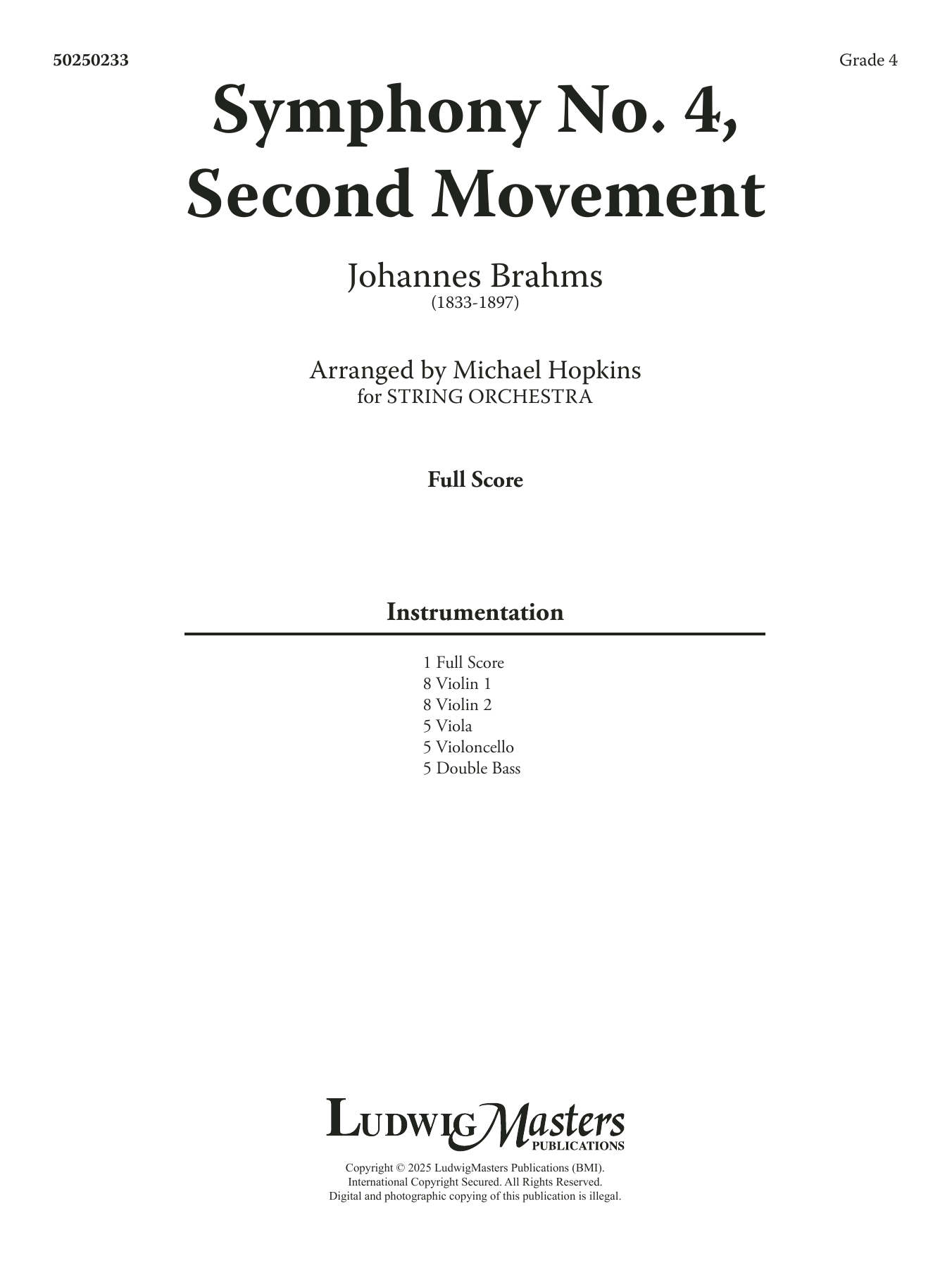

Symphony No. 4, Second Movement (arr. Michael Hopkins): String Orchestra Conductor Score & Parts
By Johannes Brahms / Arranged by Michael Hopkins
Grade: 4
Item: 35-PK01699141
$65.00
Pickup currently not available
Buy Extra Parts (Digital PDF Download)
Parts Added to Cart!
Description
Johannes Brahms (1833 - 1897) composed his Symphony No. 4 in E minor, Op. 98 in 1884. The symphony's premiere was in October 1885. This arrangement of the second movement is designed to make Brahms' masterpiece accessible for an intermediate level string orchestra. The introduction, principal and secondary themes, a portion of the development section and recapitulation, and the coda are included in this abridged arrangement. The time signature has been modified from a slow 6/8 to 3/4, and the key has been changed from E major to D major. The arrangement features sections for solo quartet contrasting with the tutti and captures the rich textures, rhythmic vitality, and Romanticism of Brahms original work. Your students will enjoy performing this beautiful work by one of history's greatest composers.


Symphony No. 4, Second Movement (arr. Michael Hopkins): String Orchestra Conductor Score & Parts isn't in MakeMusic Cloud just yet...but it could be. Let us know you'd like to see it, and you'll help shape what comes next. In the meantime, start a free trial and dive into thousands of interactive titles your students can play along with today.
Request This Title
Tell us you want it.
Start Your Free Trial
Explore everything that's ready to play right now.
Sample Audio
No sample audio found.
Sample Video
No sample videos found.
Additional Details
Publisher:
Hal Leonard
SKU:
35-PK01699141
More about this title
About the Composer: Johannes Brahms
Johannes Brahms (1833–1897) stands as one of the Romantic era's most rigorous and consequential symphonists. His four symphonies, composed across three decades, synthesize Classical form with Romantic expression, and the Fourth Symphony represents the culmination of his symphonic thinking. Brahms' meticulous approach to orchestration and his gift for memorable melodic material made his works staples of the concert repertoire almost immediately upon their premiere.
Why we love this
This arrangement preserves the movement's lyrical warmth and structural elegance while removing the technical barriers that make the original challenging for intermediate ensembles. Hopkins' thoughtful rescoring keeps the solo quartet passages intimate and expressive, giving your best players moments to shine while the tutti sections remain accessible and rewarding for everyone.
What to expect
Serene and introspective, with moments of gentle lyricism punctuated by richer harmonic color when the full ensemble plays. The Brahmsian warmth comes through in the lyrical themes and flowing accompaniment figuration, creating a performance that feels both intimate and substantial.
Who it's for
Intermediate string orchestras ready for substantial Romantic repertoire but without the performance hours to tackle the full movement. This arrangement works well for orchestras with solid fundamental technique, capable solo players, and directors who want their students to experience a major composer at a manageable level.
How to get the most out of it
- Shape the opening theme with gentle dynamic swells rather than static long tones; Brahms wrote for singing lines, and even in an abridged version, the melody benefits from subtle contour.
- Balance the solo quartet sections carefully so they project over the accompanying strings without pulling away from the ensemble sound.
- Approach the recapitulation with slightly warmer tone than the exposition to reflect the journey the material has taken through the development section.
- Let the coda breathe; resist rushing the final cadential gestures so the movement closes with the same poise and gentleness it began.
How to use it
Program this as a centerpiece of a Classical-Romantic concert, pairing it with a lighter contemporary work or a shorter Classical movement to balance the program's emotional arc. It also serves as an excellent vehicle for demonstrating growth mid-year, when your ensemble has developed both technical security and interpretive sophistication.
Skills your students will build
- Executing transparent, songlike phrasing in a slow-moving harmonic context
- Balancing solo quartet passages with accompanying string textures
- Translating time signature modification (6/8 to 3/4) without losing Brahms' original rhythmic character
- Managing ensemble intonation across extended, relatively static harmonic passages
- Responding to sectional contrasts between lyrical exposition and richer, more complex developmental material