
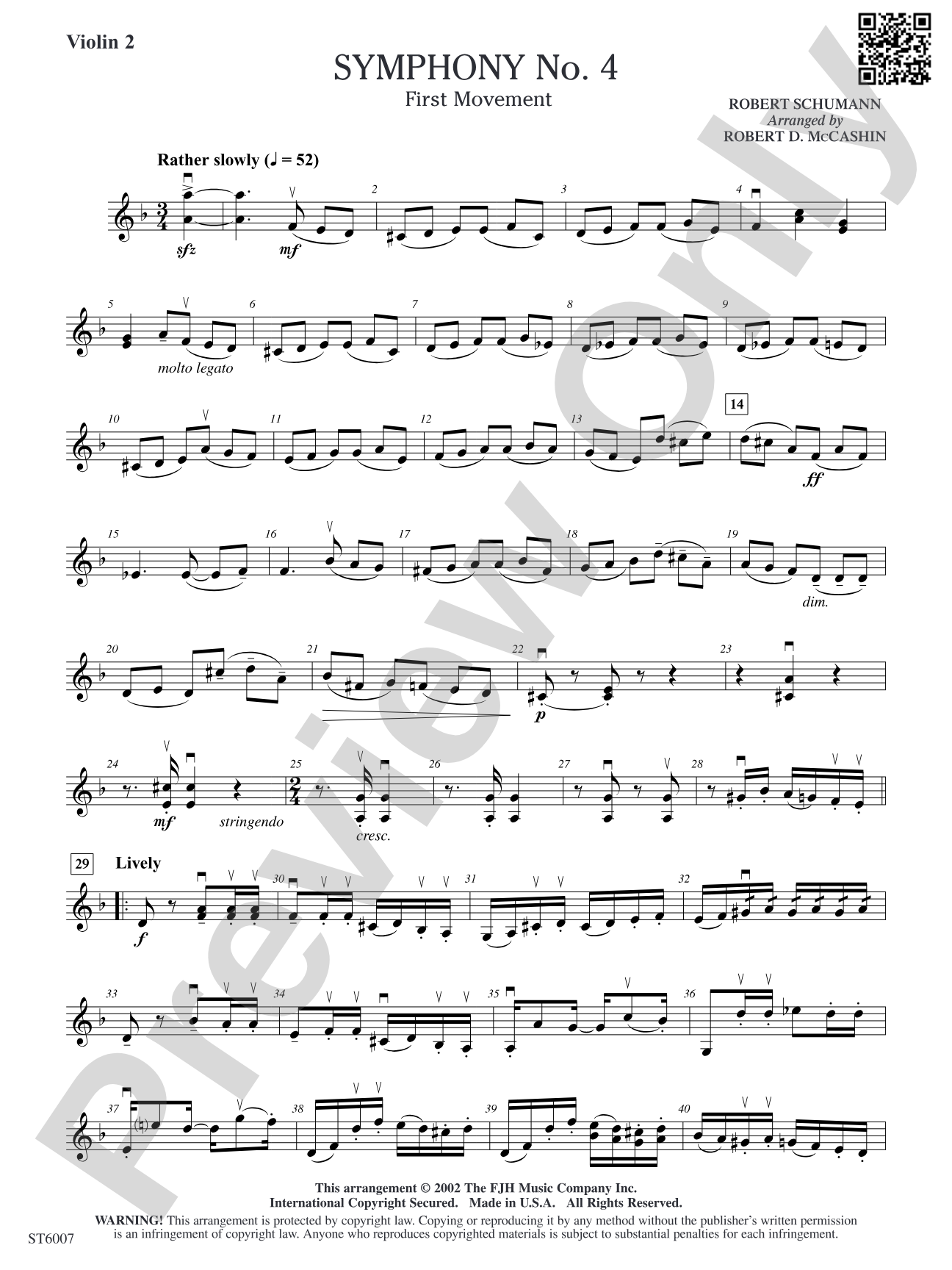

Symphony No. 4 (First Movement): Violin 2
First Movement
By Robert Schumann / arr. Robert D. McCashin
Grade: 5
Item: 98-PC-DST6007_VN2
$7.00
Pickup currently not available
Description
FJH is proud to offer this wonderful arrangement of the first movement of Robert Schumann's Symphony No. 4. This slightly shorter version works extremely well for string orchestra and is ideal for contests and festivals. Robert D. McCashin has used his own extensive experience as a university orchestra director to carefully bow and articulate each part with musical and pedagogical needs in mind.


Symphony No. 4 (First Movement): Violin 2 isn't in MakeMusic Cloud just yet...but it could be. Let us know you'd like to see it, and you'll help shape what comes next. In the meantime, start a free trial and dive into thousands of interactive titles your students can play along with today.
Request This Title
Tell us you want it.
Start Your Free Trial
Explore everything that's ready to play right now.
Sample Audio
1
Audio File
--:--
0:00
0:00
Sample Video
No sample videos found.
Additional Details
Series:
FJH String Orchestra
Publisher:
The FJH Music Company, Inc.
SKU:
98-PC-DST6007_VN2
More about this title
About the Composer: Robert Schumann
Robert Schumann (1810-1856) was a Romantic composer whose symphonies occupy a central place in the orchestral canon. His four symphonies showcase his gift for lyrical melody and structural innovation, combining the classical forms he admired with the emotional depth and harmonic adventurousness of the nineteenth century. Schumann's orchestration often benefits from reworking and arrangement, a practice he himself engaged in throughout his compositional life.
Schumann's music presents both interpretive and technical challenges that make studying his scores invaluable for developing musicians. His demands on string players—sustained singing lines, intricate rhythmic coordination, and careful balance of inner voices—teach orchestral thinking at its finest. For student orchestras, his works remain among the most rewarding investments in musical maturity.
Why we love this
McCashin's arrangement strips away the original's substantial woodwind and brass writing to let the string writing shine, which is precisely where Schumann's lyrical gift lives most vividly. At Grade 5, this version preserves the emotional arc and structural integrity of the first movement while remaining attainable for strong high school and pre-college orchestras. The careful bowing and articulation marks reflect genuine orchestral practice rather than generic editorial choices, which means your students learn professional habits from the start.
What to expect
The first movement unfolds with intimate lyricism tempered by Romantic passion. Lyrical themes emerge from transparent textures and gradually build in intensity through careful accumulation of harmonic and orchestral color. The movement balances introspection with moments of genuine dramatic power, creating an arc that feels both urgent and deeply felt.
Who it's for
High school and young college string orchestras seeking substantial masterwork repertoire that challenges musicians without requiring a full Romantic-era orchestra. Directors preparing ensembles for competition festivals and concert venues will find this version competitive at the Grade 5 level while maintaining complete artistic integrity. Students ready to engage with serious nineteenth-century music will build orchestral musicianship through direct contact with Schumann's melodic and harmonic language.
How to get the most out of it
- Balance the two violin sections carefully during the opening theme; the first violins should sing out but not dominate the gentle accompaniment in the seconds.
- Shape longer phrases by thinking in terms of the harmony's direction rather than individual measures; Schumann's Romantic sensibility rewards singers who see the big structural picture.
- Use the recorded accompaniment (if available separately) in sectional rehearsals to build confidence in rhythmic figures that may feel exposed in full-orchestra context.
- Attend to dynamic markings as structural signposts; they often signal harmonic or thematic shifts that younger players might otherwise miss.
How to use it
Program this as the anchor of a concert dedicated to Romantic-era orchestral music, perhaps pairing it with lighter contemporary string pieces or twentieth-century works that respond to that tradition. The movement's concert-length timing and contest-friendly duration make it ideal for festival programming and regional competition circuits. It also serves well as the centerpiece of a concert exploring how arrangers adapt orchestral masterworks for ensemble configurations, particularly when paired with the original full orchestral score for comparison.
Skills your students will build
- Reading and executing nuanced bowing and articulation marks as integral to interpretation
- Sustaining long lyrical phrases without losing rhythmic clarity or forward momentum
- Balancing multiple melodic lines within the string section to reveal Schumann's polyphonic textures
- Responding to dynamic architecture as a tool for harmonic and structural communication
- Coordinating across all four string sections to maintain ensemble coherence in homophonic and contrapuntal writing
- Understanding how a major Romantic composer structures emotional and formal development across a large-scale movement