
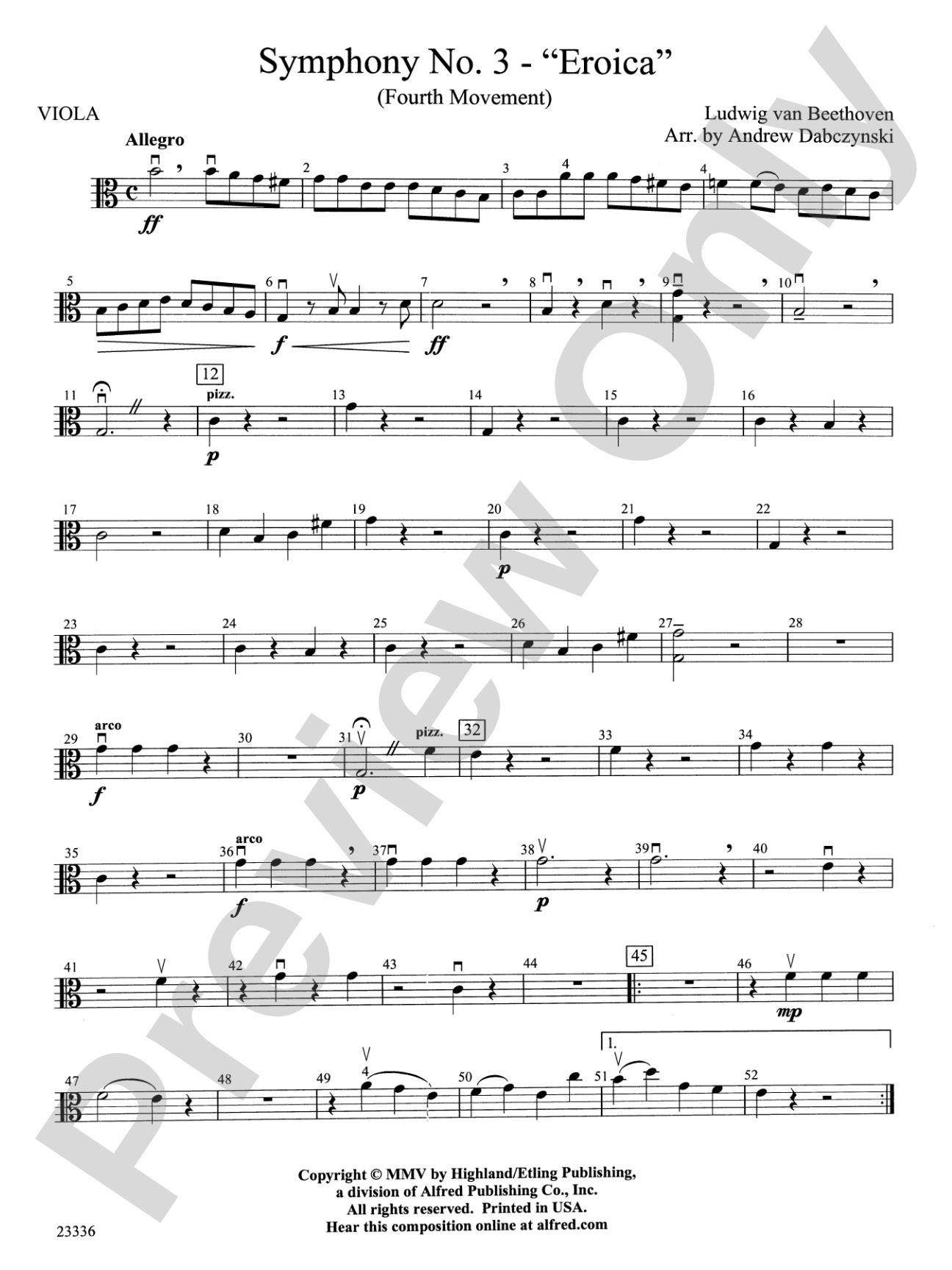

Symphony No. 3 - Eroica (4th Movement): Viola
(Fourth Movement)
By Ludwig van Beethoven / arr. Andrew H. Dabczynski
Grade: 2.5
Item: 00-PC-0000682_VA1
$5.99
Pickup currently not available
Description
This arrangement from one of the greatest symphonies of all time captures the rhythmic essence and delightful melodic craftsmanship of Ludwig van Beethoven. All orchestra members will develop cultural literacy as they learn the famous German "country dance" melody. The movement's thematic variations and extended coda remain true to Beethoven's original ideas, and provide excellent opportunities for performers to focus on counting and ensemble skills. Here's a wonderful classic that can stand as the core of any rehearsal or concert.


Don't just read it, hear it, play along with it, and watch your students grow with it. In MakeMusic Cloud, Symphony No. 3 - Eroica (4th Movement): Viola comes alive with professional accompaniment, adjustable tempo, and built-in practice tools that turn solo practice into real progress.
Open in the Player
Jump straight in and assign it today.
Start Your Free Trial
Open this title and explore the full library in minutes.
Sample Audio
1
Audio File
--:--
0:00
0:00
Sample Video
No sample videos found.
Additional Details
Series:
Highland/Etling String Explorer
Publisher:
Alfred Music
Page Count:
140
SKU:
00-PC-0000682_VA1
More about this title
About the Composer: Ludwig van Beethoven
Ludwig van Beethoven (1770-1827) stands as the bridge between Classical and Romantic music, a composer whose fearless innovations transformed the symphony into a vehicle for heroic expression and philosophical depth. His symphonies, particularly the Third, redefined what orchestral music could accomplish, moving beyond pure entertainment into territory that demanded intellectual engagement and emotional investment from performers and listeners alike.
Why we love this
The Eroica's finale is one of music's great teaching moments: a straightforward German dance melody that Beethoven transforms through relentless variation and rhythmic ingenuity. At Grade 2.5, this arrangement opens the door to that creative process without overwhelming young string players, letting them experience how a master builder constructs something monumental from something simple.
What to expect
Joyful and driving, with an infectious bounce that never becomes frivolous. The famous melody feels almost playful in its simplicity, yet Beethoven's endless reshaping of it creates a sense of discovery, as if watching a skilled dancer find new possibilities in a basic step over and over again. The extended coda builds genuine excitement as the movement spins toward its conclusion.
Who it's for
String orchestras at the intermediate level looking for repertoire that teaches arrangement craft and variation technique without sacrificing musical substance. This works equally well for youth orchestras preparing for festival competition or ensemble classes seeking an engaging masterwork that challenges counting skills and rhythmic precision.
How to get the most out of it
- Establish the country dance melody with confidence in its first statement; this theme is the foundation for everything that follows, so nail the intonation and rhythmic precision early.
- Mark the conductor's beat clearly through the variations so players can track how the melody shifts between sections and transpositions without losing their place.
- Balance the extended coda carefully; as the material accelerates and layers build, resist the urge to rush and keep the ensemble locked together through clear stick work.
- Use sectional rehearsals to isolate the rhythmic figures in viola and cello parts, since these provide the harmonic anchor while violins carry the melodic transformations.
How to use it
Program this as a concert centerpiece that anchors a Classical or Romantic theme, or pair it with other Beethoven arrangements to trace his symphonic thinking. It also serves as an ideal festival selection, since the Grade 2.5 level makes it accessible for many ensembles while the musical content and extended length (140 pages of material) give adjudicators substance to evaluate.
Skills your students will build
- Counting through extended melodic variations and metric consistency
- Ensemble balance when handling rhythmic accompaniment figures against sustained melodic lines
- Recognition and performance of thematic transformation techniques
- Intonation accuracy across different registers as the melody transposes
- Understanding of musical form and sectional architecture