
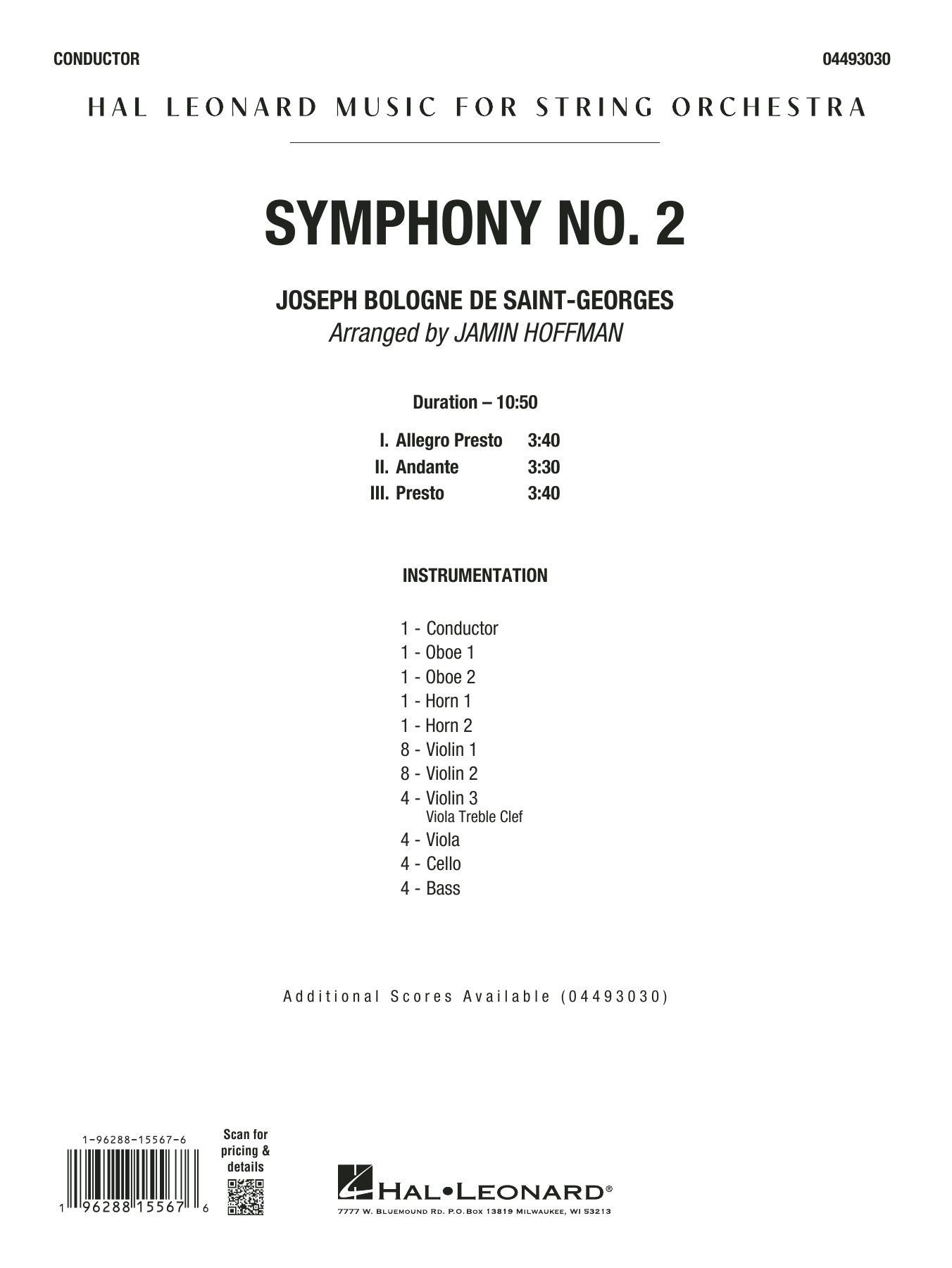

Symphony No. 2 (arr. Jamin Hoffman): String Orchestra Conductor Score & Parts
By Joseph Bologne de Saint-George / Arranged by Jamin Hoffman
Grade: 3-4
Item: 35-PK01371020
$65.00
Pickup currently not available
Buy Extra Parts (Digital PDF Download)
Parts Added to Cart!
Description
One of only two surviving symphonies by the subject of the movie Chevalier, Jamin Hoffman has carefully edited the original manuscript to allow this masterpiece by "the Black Mozart" to be accessible to modern orchestras. This long overdue tribute to a master fencer, military officer, conductor, and composer belongs in every music library! (Includes optional oboes and horns.)


Symphony No. 2 (arr. Jamin Hoffman): String Orchestra Conductor Score & Parts isn't in MakeMusic Cloud just yet...but it could be. Let us know you'd like to see it, and you'll help shape what comes next. In the meantime, start a free trial and dive into thousands of interactive titles your students can play along with today.
Request This Title
Tell us you want it.
Start Your Free Trial
Explore everything that's ready to play right now.
Sample Audio
No sample audio found.
Sample Video
No sample videos found.
Additional Details
Publisher:
Hal Leonard
SKU:
35-PK01371020
More about this title
About the Composer: Joseph Bologne de Saint-George
Joseph Bologne de Saint-George (1745–1799) was a violinist, conductor, and composer of extraordinary range who shaped European concert life during the late 18th century. Born in Guadeloupe to a French plantation owner and an enslaved African woman, he navigated the rigid hierarchies of Parisian society to become one of the most performed composers of his era, founding and directing the Concert des Amateurs and later the Opéra de Paris. Beyond his musical achievements, he served as a military officer and fencing master of legendary skill, yet his legacy was largely erased from historical record until recent decades.
His orchestral works reveal a composer fully command of Classical form and instrumental color. The two surviving symphonies showcase his gift for elegant melody, sophisticated harmonic language, and the orchestration techniques he learned from Haydn's example. His music deserves the place it once held in concert repertoire, and modern audiences finally have access to these works through careful scholarly editing.
Why we love this
This symphony captures the refined elegance of 1780s Parisian concert life while remaining genuinely engaging for student musicians. Jamin Hoffman's editing makes the original manuscript playable for modern ensembles without sanitizing the music's character, and the optional oboes and horns give you flexibility to suit your instrumentation. Programming a work by such a historically significant composer sends a clear message about whose voices belong in the concert hall.
What to expect
Graceful and measured, with the clarity and proportion of 18th-century aesthetics. The melodies sing with restraint rather than grand gesture, and the harmonic language moves with purpose through key areas that feel inevitable once you hear them. There's an understated confidence in the orchestration that rewards careful listening and reveals new details with each rehearsal.
Who it's for
String orchestras at the upper intermediate level who are ready for four-part writing and Classical forms but may still benefit from optional wind reinforcement. Teachers seeking to broaden their programming with historically significant composers and students curious about music history will find real value in learning a work that was once standard repertoire.
How to get the most out of it
- Balance the inner voices carefully; the viola and cello lines often carry harmonic and rhythmic interest that can disappear if the violin sections dominate.
- Use the optional wind parts strategically to highlight key structural moments rather than doubling throughout, which preserves transparency in the string writing.
- Shape phrases with attention to the Classical syntax; many lines resolve over two to four measures, so resist the temptation to break the musical thought into smaller gestures.
- Listen for the dialogue between first and second violins, which drives much of the material; make sure both sections are rhythmically secure and equally engaged.
How to use it
This works beautifully as a concert opener or as the Classical anchor in a program that explores different eras and voices. Pair it with a contemporary work by another overlooked historical figure, or follow it with a Romantic piece to trace the evolution of orchestral writing from the same period. It also serves as an excellent teaching score for studying form, orchestration, and the Classical concerto grosso texture.
Skills your students will build
- Reading and balancing four-part string textures with independent inner voice lines
- Interpreting Classical phrase structure and articulation conventions
- Maintaining secure ensemble intonation across sustained harmonic passages
- Responding to conductor cues in dialogue-based writing between string sections
- Understanding historical context and its connection to performing style