
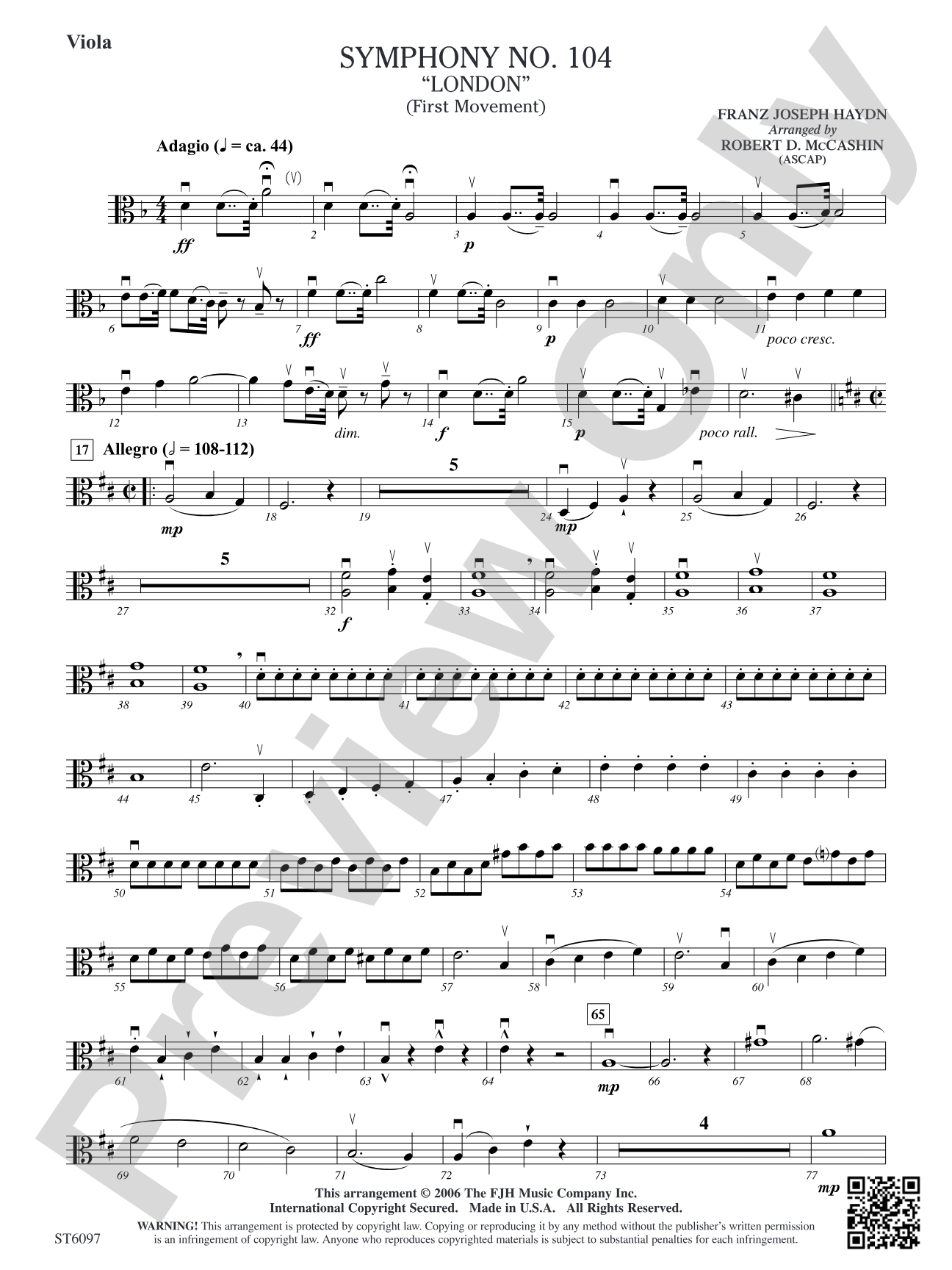

Symphony No. 104 "London" (First Movement): Viola
First Movement
By Franz Joseph Haydn / arr. Robert D. McCashin
Grade: 4.5
Item: 98-PC-DST6097_VA1
$7.00
Pickup currently not available
Description
Robert D. McCashin has put substantial effort into this arrangement to make it as true to Haydn's original intent as possible. As a result, this work captures and retains the bright spirit of the first movement that has made it such a popular work. Moreover, this arrangement brings the piece to a musical and technical level that school orchestras can enjoy. A masterful arrangement.


Don't just read it, hear it, play along with it, and watch your students grow with it. In MakeMusic Cloud, Symphony No. 104 "London" (First Movement): Viola comes alive with professional accompaniment, adjustable tempo, and built-in practice tools that turn solo practice into real progress.
Open in the Player
Jump straight in and assign it today.
Start Your Free Trial
Open this title and explore the full library in minutes.
Sample Audio
1
Audio File
--:--
0:00
0:00
Sample Video
No sample videos found.
Additional Details
Series:
FJH String Orchestra
Publisher:
The FJH Music Company, Inc.
SKU:
98-PC-DST6097_VA1
More about this title
About the Composer: Franz Joseph Haydn
Franz Joseph Haydn (1732-1809) was an Austrian composer whose prolific output shaped the Classical era. He pioneered the symphony as a large-scale instrumental form, bringing wit, structural innovation, and emotional depth to a genre that was still finding its voice. His 104 symphonies span decades of compositional development and remain central to orchestral repertoire.
Haydn's influence on music education extends far beyond his own time. His symphonies reward careful listening and score study because they balance technical clarity with genuine musicality. Teachers and conductors return to Haydn again and again because his writing is transparent enough to hear every voice, yet sophisticated enough to reveal new details with each performance.
Why we love this
McCashin's arrangement honors the architectural elegance of Haydn's original scoring while making it genuinely achievable for school orchestras. The first movement sparkles with character and humor, which means your students play something that matters, not something simplified to the point of blandness. This is the kind of arrangement that earns standing ovations at festivals because both the orchestra and the audience feel the brilliance of the source material.
What to expect
The opening theme arrives with immediate energy and wit, announcing Haydn's Classical confidence in every measure. As the movement unfolds, you encounter dramatic surprises, unexpected harmonic turns, and moments where the entire orchestra locks into crystalline rhythmic precision. The overall effect is one of sophisticated joy, the sound of a master craftsman delighting in the possibilities of orchestral color.
Who it's for
This arrangement serves advanced middle school and high school orchestras ready to tackle a masterwork without requiring college-level technical demands. String players at Grade 4.5 who can handle position shifts, reasonable double-stops, and sustained passagework will find this piece both challenging and rewarding. It is also appropriate for youth orchestras and semi-professional ensembles seeking contest repertoire with genuine musical substance.
How to get the most out of it
- Keep the opening theme crisp and articulate. The bright character depends on clear attacks and clean releases, especially in the first violins.
- Balance the dialogue between upper and lower strings carefully. Haydn's orchestration lets inner voices carry important melodic material, so second violins and violas need to project without drowning out the first violin line.
- Shape phrases with purposeful harmonic motion rather than sudden dynamic shifts. Classical phrasing rewards understanding the underlying chord progression.
- Maintain steady ensemble rhythm in the accompaniment figures. Haydn's driving accompaniment patterns lose their energy if they sag or rush.
How to use it
Program this as a centerpiece work that demonstrates orchestral maturity to adjudicators and audiences. It pairs naturally with lighter contemporary works or other Classical-era symphonic movements, allowing programmers to build a concert that balances formal weight with variety. Consider pairing it with a shorter modern piece to create context for how Haydn's innovations still speak today.
Skills your students will build
- Stylistic interpretation of Classical-era orchestration
- Precision ensemble playing at a brisk tempo
- Reading divisi passages and multiple string textures
- Harmonic understanding through listening and score study
- Sustaining ensemble balance across upper and lower string choirs