
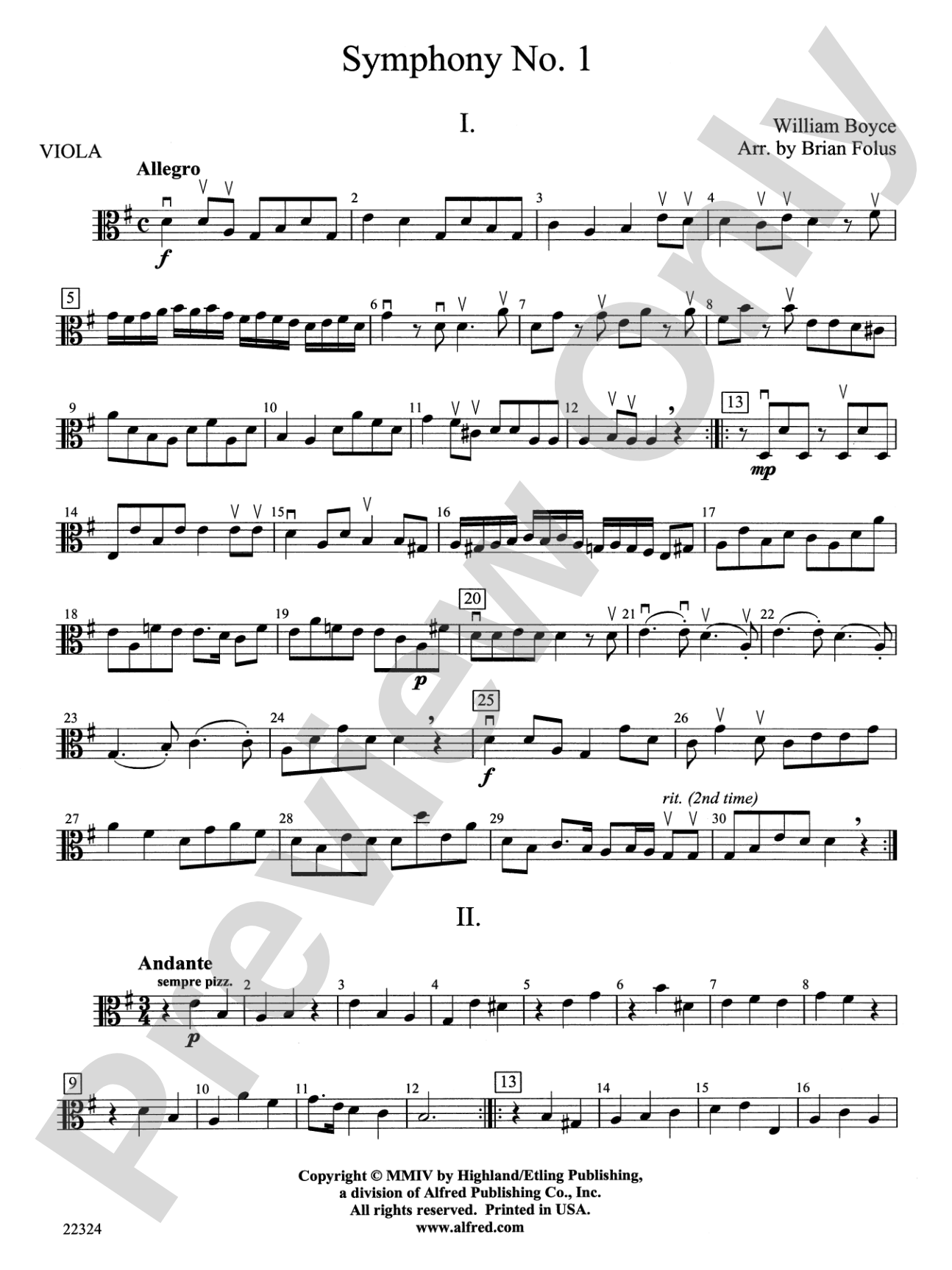

Symphony No. 1: Viola
By William Boyce / arr. Brian Folus
Grade: 3
Item: 00-PC-0000573_VA1
$5.99
Pickup currently not available
Description
This authentic arrangement of William Boyce's Symphony No. 1 preserves the original melodic and harmonic material along with the three-movement Italian sinfonia form; however, the original key of B-flat major has been transposed to G major. The first movement is in an early sonata, the second movement features the first violins, and the last movement is a lively 6/8 dance. This pre-classical symphony will highlight all the members of your orchestra.


Don't just read it, hear it, play along with it, and watch your students grow with it. In MakeMusic Cloud, Symphony No. 1: Viola comes alive with professional accompaniment, adjustable tempo, and built-in practice tools that turn solo practice into real progress.
Open in the Player
Jump straight in and assign it today.
Start Your Free Trial
Open this title and explore the full library in minutes.
Sample Audio
1
Audio File
--:--
0:00
0:00
Sample Video
No sample videos found.
Additional Details
Series:
Highland/Etling String Orchestra
Publisher:
Alfred Music
Page Count:
124
SKU:
00-PC-0000573_VA1
More about this title
About the Composer: William Boyce
William Boyce (1711-1779) was one of the most prolific English composers of the eighteenth century. He worked as a church musician, conductor, and composer, producing symphonies, vocal works, and instrumental music that bridged the late Baroque and emerging Classical styles. His ten symphonies represent some of the finest instrumental writing of the English pre-Classical tradition and remain central to understanding how composers of his era adapted Continental forms for their own musical language.
Boyce's symphonies are remarkable for their structural clarity, melodic invention, and orchestral balance. They demonstrate early sonata form principles while maintaining the energy and textural variety characteristic of the Italian sinfonia. His influence on subsequent English composers was substantial, and his works continue to offer students insight into compositional practice at a pivotal moment in musical history.
Why we love this
This arrangement gives orchestras access to genuine pre-Classical repertoire at a playable level without sacrificing the authenticity of Boyce's compositional craft. The transposition to G major and the thoughtful scoring by Brian Folus make this manageable for Grade 3 ensembles while preserving the elegant three-movement architecture and melodic substance that make Boyce's music rewarding to perform. It's repertoire that sounds mature and historically grounded, not simplified.
What to expect
Elegant and purposeful, with the poise of an accomplished eighteenth-century craftsman. The opening movement unfolds with structural inevitability; the second movement offers a moment of graceful introspection; the finale dances with witty, propulsive energy. Throughout, the music balances formal sophistication with genuine melodic charm.
Who it's for
String orchestras at the Grade 3 level seeking substantive historical repertoire that challenges musicians without requiring advanced technical facility. This work suits ensembles preparing for festival or contest programming and directors who want to build student awareness of Baroque and early Classical instrumental forms through direct experience.
How to get the most out of it
- Shape the opening theme of the first movement with clear phrase breathing; Boyce's melodic lines reward gentle rubato within a steady harmonic foundation.
- Balance the first violin solos in the second movement so they project expressively without overpowering the harmonic support from lower strings.
- Maintain rhythmic precision in the 6/8 finale while keeping the articulation light; this movement sits between dance and scherzo, so energy should feel buoyant rather than heavy.
- Use dynamic contrast between sections to clarify the early sonata form; the juxtaposition of primary and secondary material benefits from clear light-and-shade.
How to use it
Program this as an opener or centerpiece on a concert that explores the Classical era, pairing it with later Classical works or contrasting earlier Baroque string literature. The transposition to G major and accessible Grade 3 scoring make it an excellent choice for festival submissions, and the three-movement form provides an ideal balance between substance and concert pacing.
Skills your students will build
- Reading three-movement sonata and dance forms
- Balancing melody and harmonic accompaniment across string sections
- Executing rhythmic precision in 6/8 meter
- Interpreting early Classical dynamic and articulation conventions
- Playing expressively through sustained passages without loss of ensemble unity