
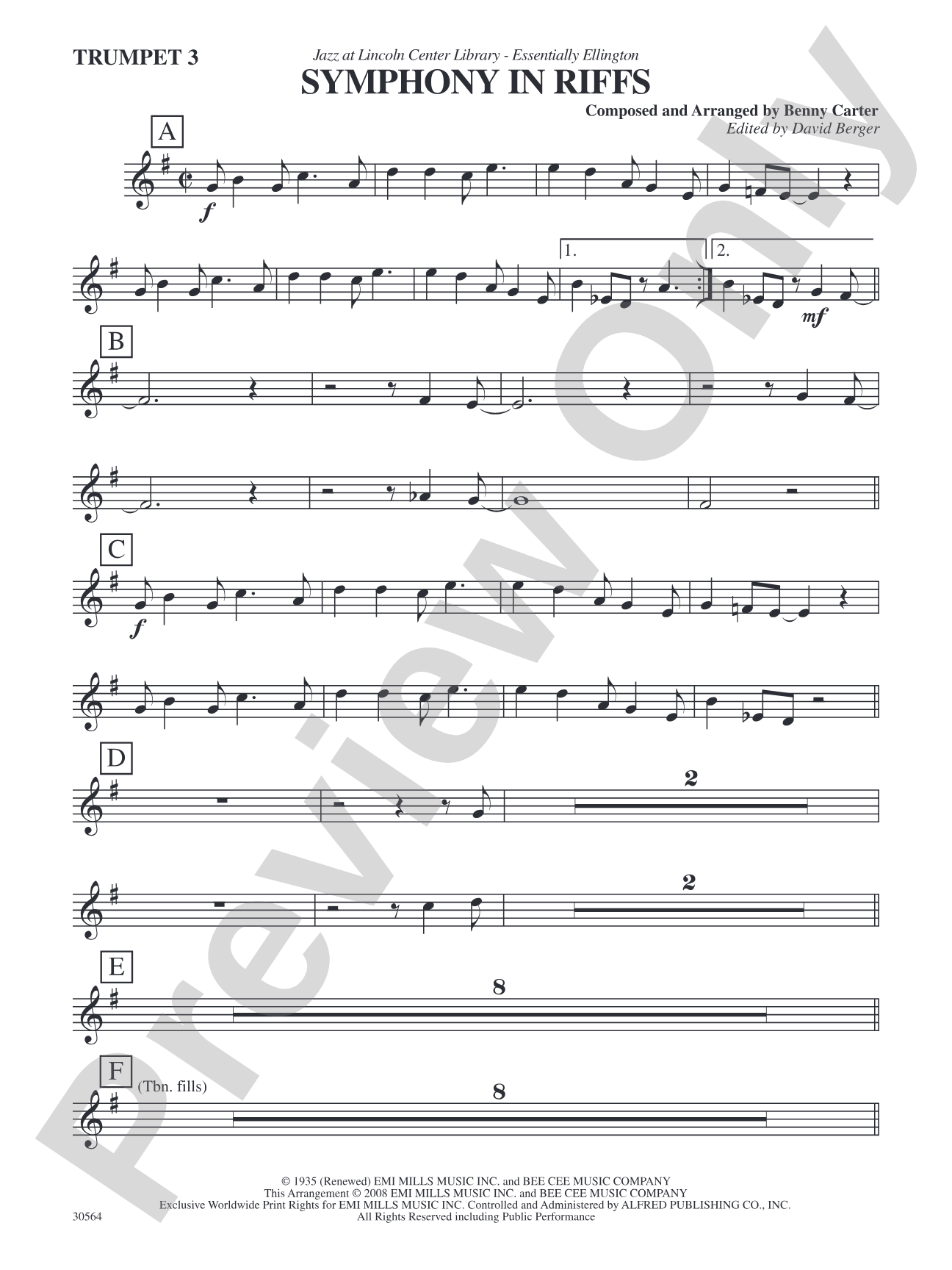

Symphony in Riffs: 3rd B-flat Trumpet
By Benny Carter
Grade: 5 (Advanced / Difficult)
Item: 00-PC-0014297_T3
$3.00
Pickup currently not available
Description
Symphony In Riffs is Benny Carter's most famous piece. Originally composed and arranged in the 1930's for 4 reeds and 5 brass, Benny re-scored this version for a larger band some 50 years later. Benny was known for his idiomatic saxophone writing and this chart is a great example of that. Just when you think that the soli chorus at D is as good as his saxophone writing can get, he modulates and tops it with the brilliant new section at I. This is a transitional piece between the pre-swing of the 1920s and the mid-1930s swing.


Don't just read it, hear it, play along with it, and watch your students grow with it. In MakeMusic Cloud, Symphony in Riffs: 3rd B-flat Trumpet comes alive with professional accompaniment, adjustable tempo, and built-in practice tools that turn solo practice into real progress.
Open in the Player
Jump straight in and assign it today.
Start Your Free Trial
Open this title and explore the full library in minutes.
Sample Audio
1
Audio File
--:--
0:00
0:00
Sample Video
No sample videos found.
Additional Details
Series:
Essentially Ellington: Jazz at Lincoln Center Library
Publisher:
Alfred Music
Page Count:
76
SKU:
00-PC-0014297_T3
More about this title
About the Composer: Benny Carter
Benny Carter (1907-2003) was one of jazz's most versatile and influential musicians, equally accomplished as a saxophonist, trumpeter, trombonist, clarinetist, and arranger. His career spanned nearly eight decades, during which he shaped the sound of big band jazz, composed enduring standards, and mentored generations of musicians. Carter's arranging style was marked by sophisticated harmonies, seamless section writing, and a deep understanding of how to voice instruments idiomatically across the full ensemble.
Carter's work as a composer and arranger made him indispensable to the development of swing. His ability to write singable, memorable lines for reed sections while maintaining complex harmonic movement set him apart from his contemporaries. Beyond the bandstand, he composed for film and television, breaking barriers in Hollywood while continuing to record and perform well into his nineties.
Why we love this
This chart reveals why Carter earned his reputation as one of jazz's finest orchestrators. The saxophone writing is genuinely idiomatic, with soli passages at D that sit perfectly in the voice and a modulation into section I that lands with real structural and harmonic punch. At grade 5, this piece demands precision from your ensemble while rewarding careful rehearsal with music that sounds genuinely sophisticated.
What to expect
A snapshot of jazz at a pivotal moment, when the music was shedding the looser textures of early jazz and embracing the disciplined swing of the big band era. Sophisticated without being austere, energetic without losing control, the piece swings hard while maintaining an almost classical attention to orchestration and voice leading.
Who it's for
Advanced jazz ensembles with strong saxophone and trumpet sections and experienced rhythm players. This conductor score and parts set is designed for groups with the musicianship to handle Grade 5 complexity and the patience to work through Carter's intricate voicings and section writing.
How to get the most out of it
- Balance the reed section carefully during the soli passages, particularly at D and I, where Carter's voicings depend on clarity across all four saxophones. Mark dynamic relationships in rehearsal rather than relying on players to balance by ear alone.
- Establish the swing feel early and maintain it through tempo changes. Carter's writing assumes a confident, settled groove; pushing the rhythm or playing unevenly undercuts the sophistication of his arrangements.
- Give the brass moments to breathe where the reeds carry the melody. Carter frequently trades material between sections, and clean handoffs between ensemble and soli passages define the piece's narrative arc.
- Listen carefully to how the modulation at I recontextualizes familiar harmonic material. Once your ensemble hears that moment landing correctly, lock it in and protect it; it's the chart's emotional climax.
How to use it
Program this as a centerpiece for a jazz ensemble concert focused on the history of big band arranging, or pair it with earlier Carter compositions to trace his evolving voice. Because of its Grade 5 difficulty and historical significance, it works well as a concert closer that showcases both your ensemble's technical command and your program's musical depth.
Skills your students will build
- Reading and executing complex section voicings with intonation and blend
- Swing phrasing and articulation in both ensemble and soli contexts
- Responding to harmonic modulation and tonal shifts within a single chart
- Balancing independent melodic lines within a four-part reed section
- Listening for and executing clean section transitions and handoffs