
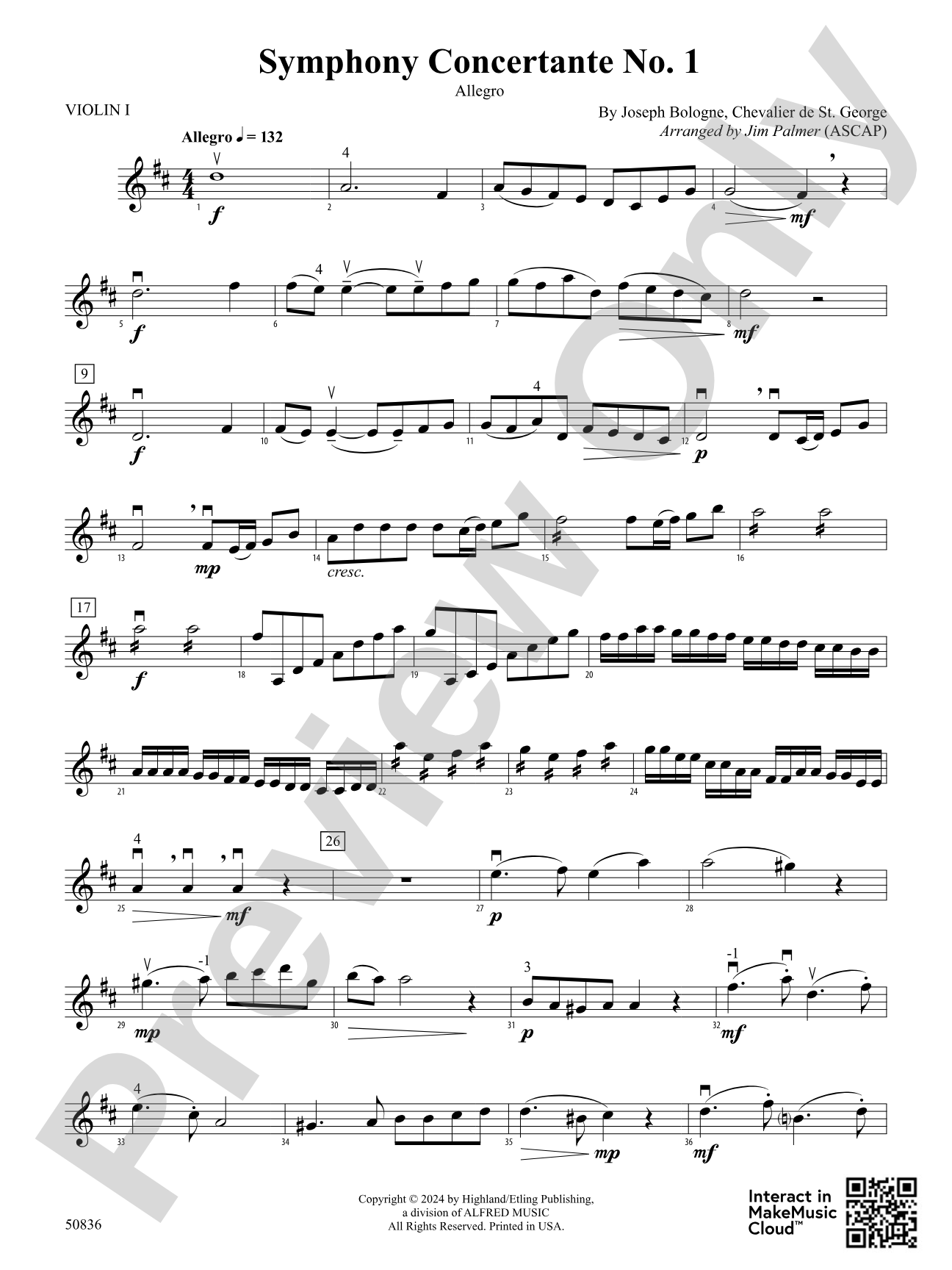

Symphony Concertante No. 1: 1st Violin
Allegro
By Joseph Bologne, Chevalier de St. George / arr. Jim Palmer
Grade: 2.5
Item: 00-PC-0019283_VN1
$3.00
Pickup currently not available
Description
Symphony Concertante No. 1 by Joseph Bologne, Chevalier de St. George, arranged by Jim Palmer, is a beautiful example of a classical work from an underrepresented composer. Detailed dynamics, bowings, and fingerings allow students to experience the classical style. Originally written for two solo violins and string orchestra, this arrangement provides an opportunity for the standard string orchestra to experience this work. The rhythmic drive makes it an excellent opener or closer for any festival or concert. (3:45)


Don't just read it, hear it, play along with it, and watch your students grow with it. In MakeMusic Cloud, Symphony Concertante No. 1: 1st Violin comes alive with professional accompaniment, adjustable tempo, and built-in practice tools that turn solo practice into real progress.
Open in the Player
Jump straight in and assign it today.
Start Your Free Trial
Open this title and explore the full library in minutes.
Sample Audio
1
Audio File
--:--
0:00
0:00
Sample Video
Additional Details
Series:
Highland/Etling String Orchestra
Publisher:
Alfred Music
SKU:
00-PC-0019283_VN1
More about this title
About the Composer: Joseph Bologne
Joseph Bologne, Chevalier de St. George (1745-1799), was a virtuoso violinist, composer, and conductor who commanded one of Europe's finest orchestras during the late 18th century. Born in Guadeloupe to a French plantation owner and an African woman, he rose to prominence in Paris despite the racial barriers of his era, earning respect as a musician of extraordinary skill and sophistication.
Bologne composed over 100 works across multiple genres, including symphonies, concertos, string quartets, and operas. His music reflects the elegance and structural clarity of the Classical period, yet his orchestral writing shows remarkable originality and color. Though his reputation dimmed after his death, modern scholarship and ensemble recordings have restored recognition of his contributions to the symphonic and chamber music traditions.
Why we love this
This arrangement brings a historically significant Classical work within reach of intermediate orchestras, making it possible to program a genuine masterwork rather than a pastiche. The careful editing preserves authentic Classical style while the Grade 2.5 accessibility means your students can focus on beautiful phrasing and controlled ensemble sound rather than wrestling with technical barriers.
What to expect
Elegant and propulsive, with the refined orchestral textures of the Classical era. Solo passages sing with lyrical grace while the full ensemble moves with architectural clarity and rhythmic vitality.
Who it's for
String orchestra directors looking to program substantive Classical repertoire at the intermediate level. Students get to play genuine 18th-century music from a historically important composer rather than arranged folk songs or simplified adaptations.
How to get the most out of it
- Balance the string choir texture carefully; Classical writing depends on clarity between parts rather than blended density. Let each section breathe rather than pushing volume.
- Anchor the rhythmic drive with a steady, confident conducting tempo. Bologne's Classical lineage means precise rhythmic articulation serves the style better than expressive rubato.
- Shape dynamic contrasts deliberately through the opening and closing sections. The detailed dynamic markings guide listeners through the form, so honor them rather than smoothing them out.
- Maintain separation between upper and lower strings in the accompaniment figures to let the solo violin lines emerge naturally without excessive balancing adjustments.
How to use it
The three-minute-forty-five-second duration and festival-quality writing make this an effective concert opener that establishes serious musical intent. It also works as a closing piece, leaving audiences with a clear, satisfying Classical statement.
Skills your students will build
- Playing in Classical style with appropriate phrasing and dynamic control
- Balancing transparent texture in multi-part string writing
- Executing bowings and fingerings for stylistic period accuracy
- Responding to detailed dynamic markings that shape musical form