
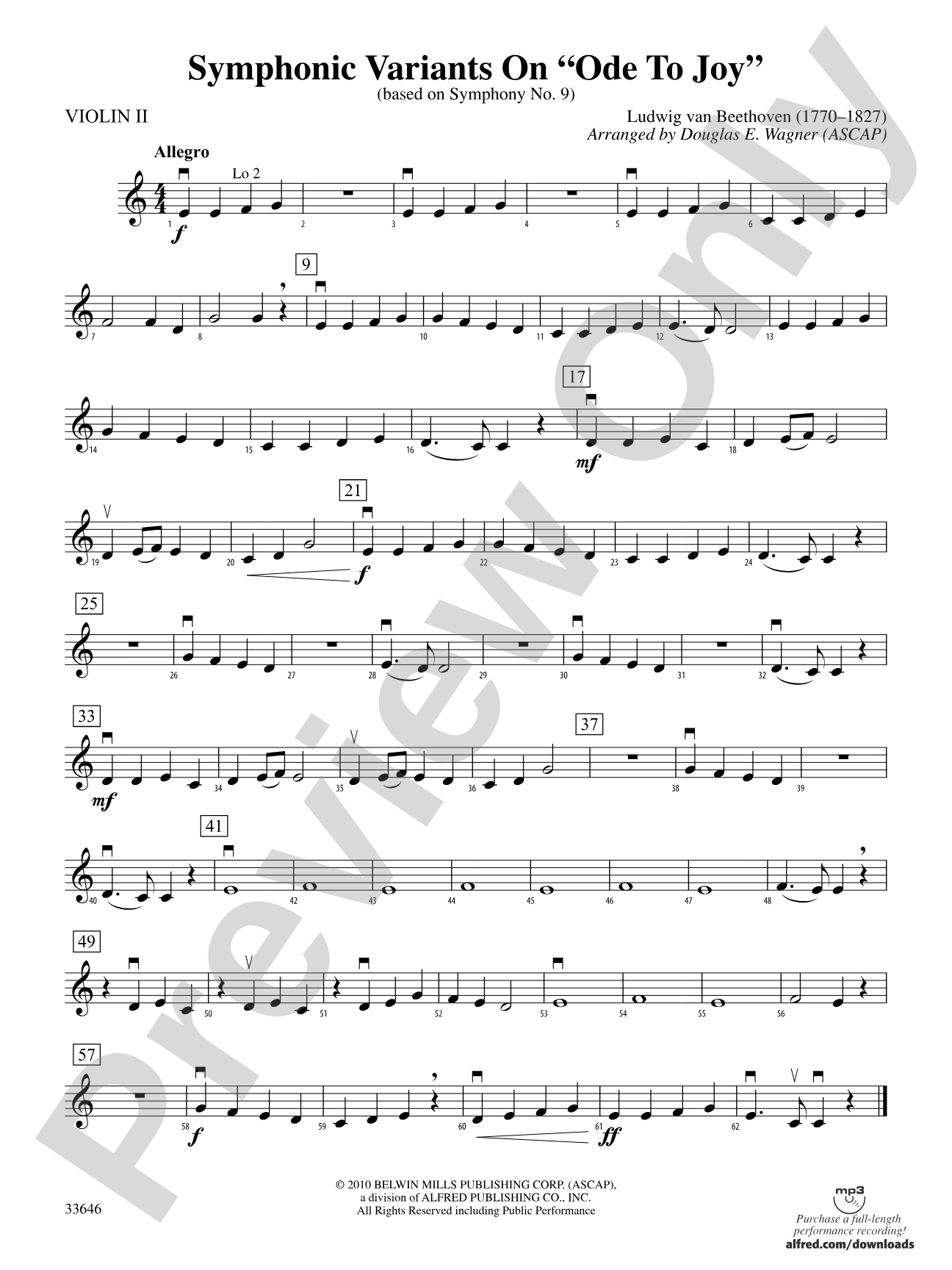

Symphonic Variants on Ode to Joy: 2nd Violin
Based on Symphony No. 9
By Ludwig van Beethoven / arr. Douglas E. Wagner
Grade: 1.5
Item: 00-PC-0014440_VN2
$5.99
Pickup currently not available
Description
Beethoven's resplendent "Ode to Joy," from the last movement of his Symphony No. 9, is brought to life in an exciting arrangement designed to foster instant success for ensembles of less experienced players. The solid scoring will boost confidence and help to insure a secure performance. An added feature of this work is that all instruments have some part of the main theme to play throughout its course. Audiences will thrill to the instantly recognizable tune, and players will be amazed at how quickly they master their parts. This title is available in MakeMusic Cloud.


Don't just read it, hear it, play along with it, and watch your students grow with it. In MakeMusic Cloud, Symphonic Variants on Ode to Joy: 2nd Violin comes alive with professional accompaniment, adjustable tempo, and built-in practice tools that turn solo practice into real progress.
Open in the Player
Jump straight in and assign it today.
Start Your Free Trial
Open this title and explore the full library in minutes.
Sample Audio
1
Audio File
--:--
0:00
0:00
Sample Video
No sample videos found.
Additional Details
Series:
Belwin Beginning String Orchestra
Publisher:
Alfred Music
Page Count:
76
SKU:
00-PC-0014440_VN2
More about this title
About the Composer: Ludwig van Beethoven
Ludwig van Beethoven (1770-1827) stands as one of history's most consequential composers, bridging Classical and Romantic musical languages while expanding the expressive and structural possibilities of nearly every genre he touched. His late works, composed while he was profoundly deaf, represent some of Western music's most visionary and emotionally powerful creations. The "Ode to Joy" from Symphony No. 9 has become one of the world's most recognizable melodies, adopted as the anthem of the European Union and performed at countless celebrations of human dignity and freedom.
For music educators, Beethoven's legacy offers more than historical importance. His melodies are memorable enough to sustain student engagement, his harmonic language remains fresh and expressive, and his structural clarity provides a foundation for understanding how great composers organize musical ideas. Arrangements like this one make his profound work accessible to developing ensembles without sacrificing the integrity of his vision.
Why we love this
Beethoven's "Ode to Joy" is genuinely beloved by audiences of all ages, which means your students perform for listeners who already care about the outcome. This arrangement distributes the iconic melody across your entire section, ensuring every player owns a moment in the sun rather than sitting on rhythmic accompaniment. The Grade 1.5 scoring maintains harmonic clarity and structural integrity while eliminating the technical barriers that would frustrate young players.
What to expect
Triumphant and inclusive. The melody soars with quiet dignity and joy, never demanding virtuosity but always sounding noble. Even at Grade 1.5, the scoring creates a full, warm harmonic environment that lifts beginning players into a realm of genuine musical expression rather than mere technical exercise.
Who it's for
This arrangement serves beginning string orchestras, youth symphony programs, and chamber music ensembles where musicians are still developing solid intonation, rhythmic independence, and note-reading skills. Directors seeking a showpiece that builds morale while delivering genuine artistry will find success here; the combination of familiarity and accessibility means students genuinely want to perform well for an audience.
How to get the most out of it
- Conduct with clarity and intention. Young string players respond to specific, economical gesture work. Reserve exuberance for moments where the ensemble has secure rhythmic grounding.
- Balance the melody line carefully in rehearsal. Since all instruments carry thematic material, identify which section holds the primary voice at each moment, and assign other parts a supporting dynamic level.
- Shape the phrasing as one continuous arc rather than treating each thematic statement as separate. Beethoven's genius lies in the melody's natural momentum; let it breathe organically across sections.
- Record a rehearsal early in the process. Student players gain confidence faster when they hear how good they already sound, and recordings reveal ensemble balance issues you might miss from the podium.
How to use it
Open a concert with this piece to establish an immediate connection with your audience and settle your ensemble into ensemble focus. The instant recognizability of the tune means audiences engage fully from the first note, giving your students the gift of a room that's already listening. It pairs especially well in a concert arc that moves from this accessible masterwork into more challenging contemporary or classical repertoire.
Skills your students will build
- Reading and performing sustained melodic lines across multiple instruments
- Balance and blend within a harmonic framework
- Understanding phrasing and musical shape at longer scale
- Confidence in performing recognizable repertoire for audiences
- Listening to other sections while maintaining independent part integrity