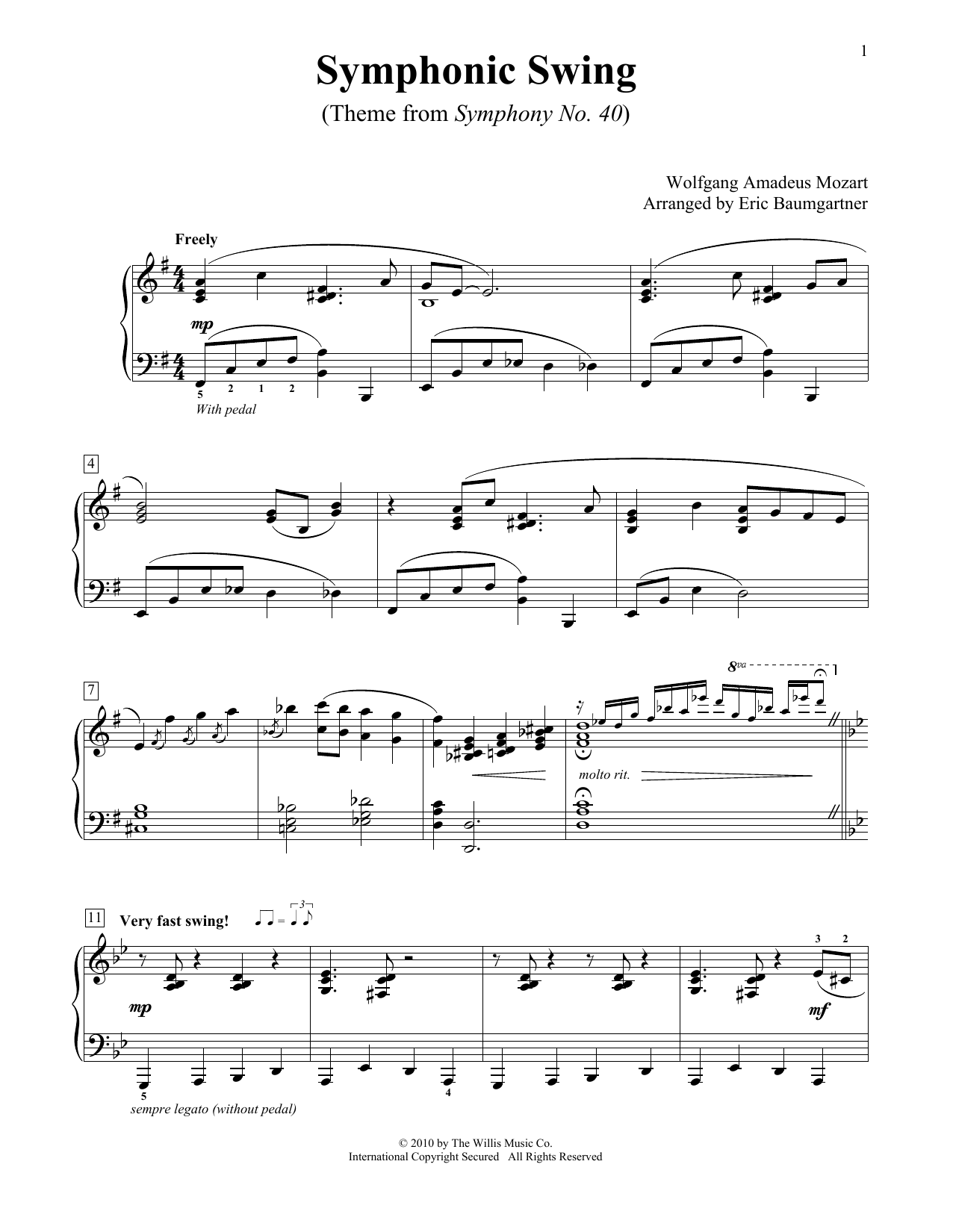
Symphonic Swing (Theme From Symphony No. 40) Sheet Music Preview

Symphonic Swing (Theme From Symphony No. 40): Educational Piano

As performed by Wolfgang Amadeus Mozart / Arranged by Eric Baumgartner

Grade: 3

Item: 35-DS00151084

Digital Download
$4.99
One moment…
Description

Discover MakeMusic Cloud: thousands of interactive titles your students can play along with today.

Sample Audio
No sample audio found.
Sample Video
Additional Details
Publisher: Hal Leonard
Page Count: 5
SKU: 35-DS00151084

More about this title

About the Artist: Wolfgang Amadeus Mozart

Wolfgang Amadeus Mozart (1756-1791) transformed classical music through his prolific output across every major genre. His symphonies, concertos, and operas established the structural and harmonic language that defined the Classical era, and his gift for memorable melody remains unmatched in Western music. For music students, Mozart's works offer crystalline examples of form, orchestration, and compositional clarity that reward close study.

Why we love this

This arrangement captures the urgent, propulsive character of Mozart's G minor symphony in a way that intermediate pianists can actually execute. Baumgartner respects the original's dramatic edge while scaling the technical demands so students engage with real Classical material rather than watered-down approximations.

What to expect

Restless and elegant. The music pulses with forward momentum, its minor tonality giving it an emotional weight unusual for many pieces at this level. There's a dignity here that rewards careful listening and careful playing.

Who it's for

Grade 3 pianists ready to explore Classical repertoire with substance. This works for students who have solid technique but are still building interpretive confidence, and who benefit from studying a recognized masterwork at manageable difficulty.

How to get the most out of it

  • Keep the opening theme crisp and forward-moving; resist the temptation to soften Mozart's minor key drama with excessive rubato.
  • Balance the left hand accompaniment so it supports without overwhelming the melodic line in your right hand.
  • Pay attention to articulation markings as guides to character; they shape the difference between elegant and merely fast.

How to use it

Feature this in a recital spotlight on Classical composers, or pair it with other symphonic arrangements to give students context for how orchestral ideas translate to keyboard. It also serves as a bridge into more ambitious Mozart later in their studies.

Skills your students will build

  • Reading in minor keys with multiple flats (G minor)
  • Maintaining steady tempo through rapid scalar passages
  • Balancing melody and accompaniment in both hands simultaneously
  • Interpreting Classical articulation and phrasing conventions
  • Building familiarity with sonata form through a real symphonic theme

You May Also Like