Symphonic Statement: Mallets Sheet Music Preview

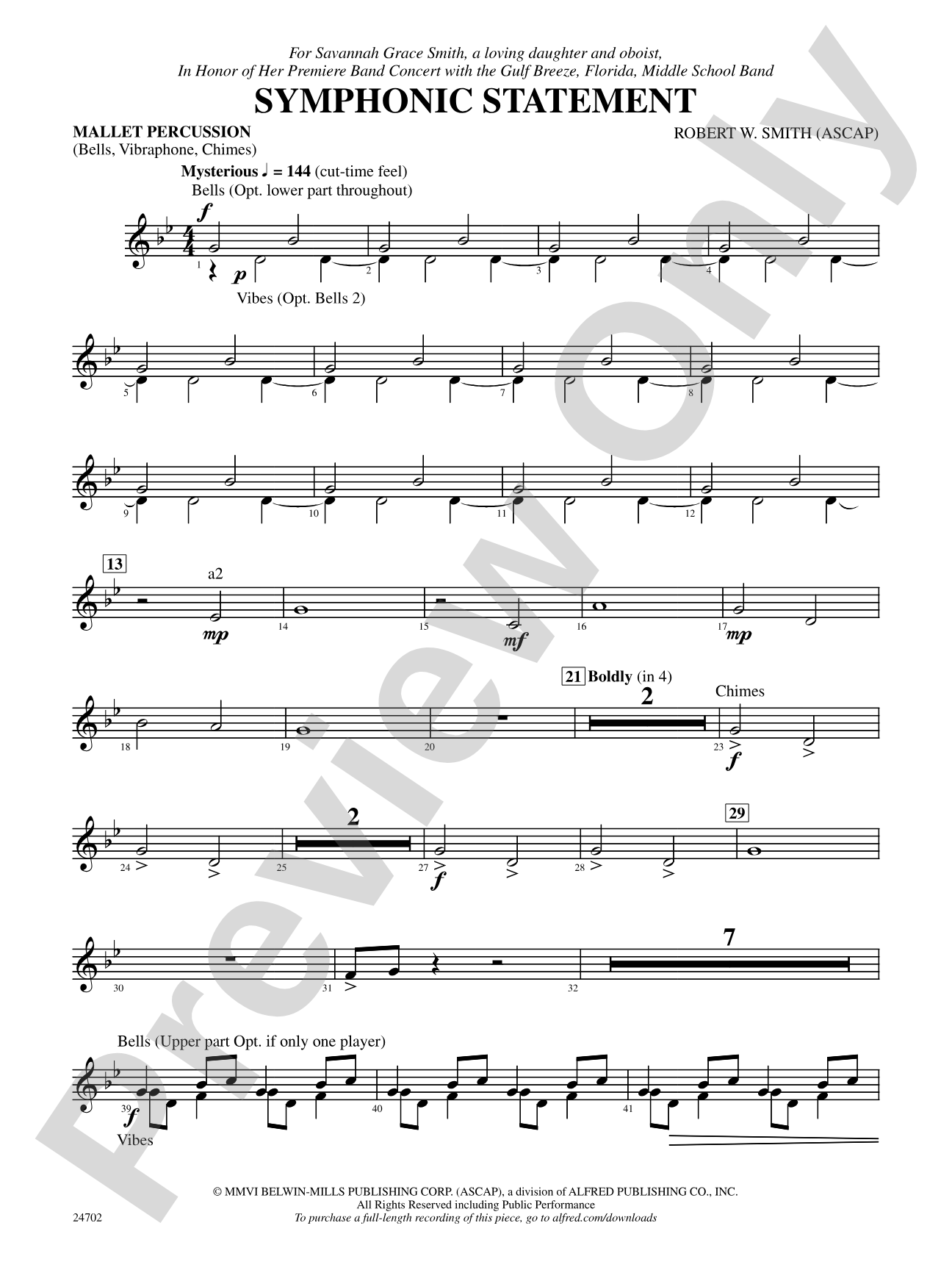
Symphonic Statement: Mallets

By Robert W. Smith

Grade: 1 (Very Easy)

Item: 00-PC-0000860_M1

Digital Download
$3.00
Description
You'll be startled at the bold presence and sonority of this fresh new festival work for your beginners. Created by Robert W. Smith, "Symphonic Statement" is dedicated to his daughter, Savanna Grace Smith. A bold choice for your contest or any program.

Don't just read it, hear it, play along with it, and watch your students grow with it. In MakeMusic Cloud, Symphonic Statement: Mallets comes alive with professional accompaniment, adjustable tempo, and built-in practice tools that turn solo practice into real progress.

Sample Audio
0:00
0:00
Sample Video
Additional Details
Series: Belwin Beginning Band
Publisher: Alfred Music
Page Count: 216
SKU: 00-PC-0000860_M1

More about this title

About the Composer: Robert W. Smith

Robert W. Smith

Robert W. Smith stands among America's most performed composers for concert band and orchestra, with over 400 works in circulation through Alfred Music. His education includes a Bachelor of Music Education from Troy State University and a Master of Music from the University of Miami. Smith's symphonic works, including The Divine Comedy and The Odyssey, have reached audiences across North America, Europe, Australia, and Asia, while pieces like The Tempest have become repertoire standards for developing ensembles.

Beyond the concert hall, Smith's music has appeared in major television broadcasts, Olympic ceremonies, the Macy's Thanksgiving Day Parade, and notable civic events worldwide. His dual expertise as both composer and clinician has taken him across the United States, Canada, Japan, Australia, Italy, Austria, and the United Kingdom, where he continues to shape the sound of contemporary band literature.

Why we love this

Smith writes for Grade 1 bands with genuine respect for what young musicians can accomplish, and this piece proves it. The orchestration carries real heft and sophistication without demanding technical virtuosity, which means your ensemble will sound far more advanced than the page suggests. It's the kind of work that builds confidence while never insulting the listener's ear.

What to expect

From the opening moments, this work announces itself with bold confidence and rich harmonic color. Young musicians will feel the weight of professional orchestration while playing parts that sit securely under their fingers, creating that rewarding sensation of sounding genuinely good without overextending their skills.

Who it's for

Young concert bands aiming for a festival or contest work that sounds far more accomplished than its difficulty level suggests. This is ideal for directors seeking to build student confidence while maintaining musical integrity and impressing an adjudicator or audience with mature sonority.

How to get the most out of it

  • Balance the full band sound by resisting the urge to over-amplify the upper woodwinds; let the brass and lower reeds provide the foundation that gives this piece its symphonic weight.
  • Shape dynamic changes gradually across the ensemble rather than having sections shift independently, which strengthens the unified presence the title promises.
  • Mark entrances clearly in parts so younger players don't miss their moment to contribute to the sonic architecture; this piece works only when every voice is heard.

How to use it

Anchor a contest entry with this as your required piece or centerpiece selection; its impressive sound makes an excellent first impression and leaves adjudicators favorably disposed toward the rest of your program. For a regular concert, it pairs well as a strong opener that demonstrates your band's growth since the previous concert.

Skills your students will build

  • Balancing blend across different voice registers while maintaining uniform tone color
  • Following conductor gestures through sustained passages and dynamic contours
  • Reading and executing major key signatures with confidence in early-intermediate ranges
  • Playing with stylistic maturity in a concert band setting
  • Responding to key changes and harmonic shifts within an accessible tonal framework

You May Also Like