
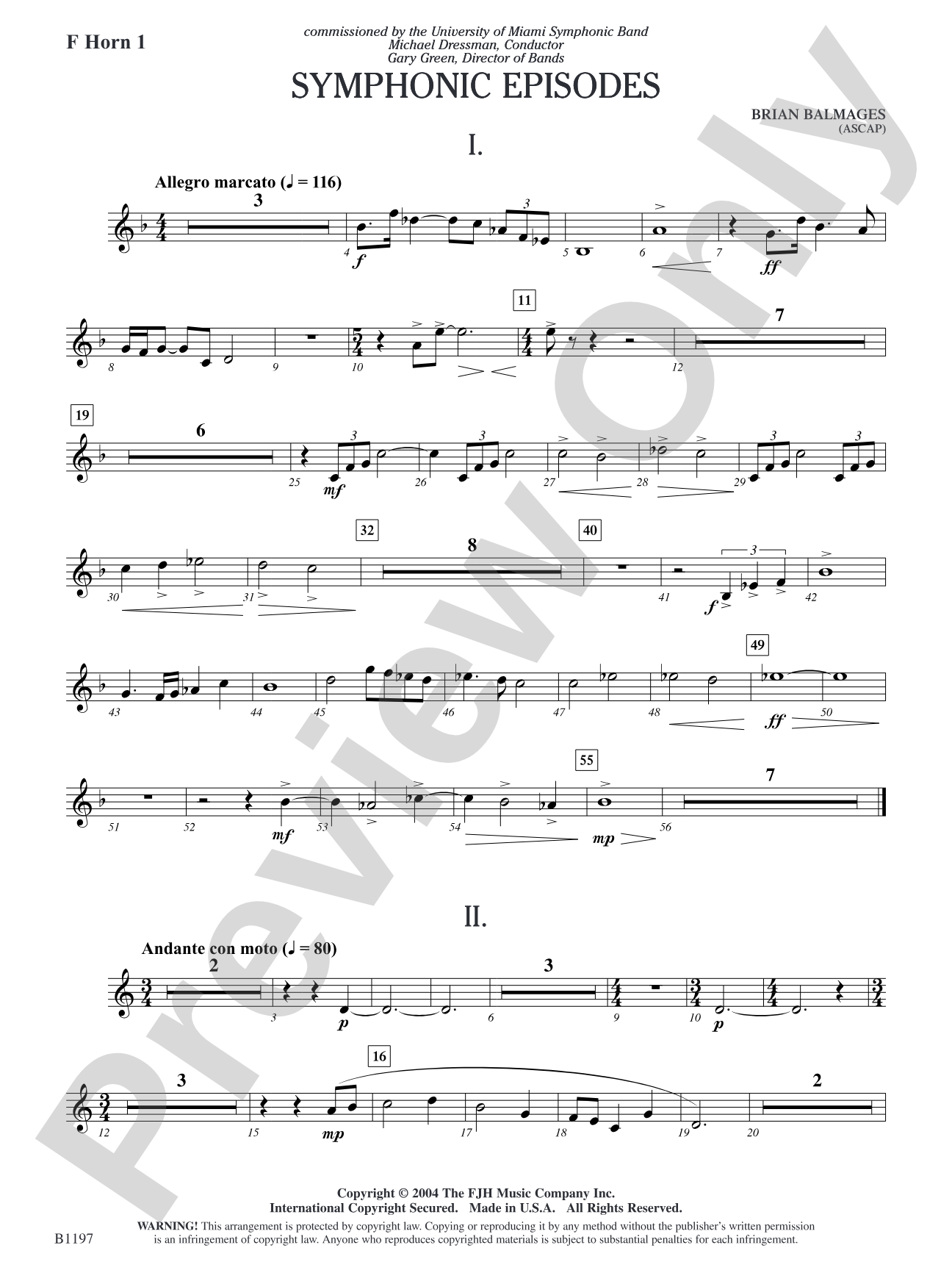

Symphonic Episodes: F Horn 1
By Brian Balmages
Grade: 5
Item: 98-PC-DB1197_H1
$7.00
Pickup currently not available
Description
Commissioned by the University of Miami, this three-movement work covers the full gamut of emotions and has already been performed by numerous all-state and district bands. The short opening movement establishes one of the main themes in the work before coming to a soft conclusion. The second movement can easily be performed on its own with its beautiful lyrical melodies and powerful emotional impact. The third movement makes use of themes heard throughout the other movements before coming to a grand conclusion. You won't want to miss this one!


Don't just read it, hear it, play along with it, and watch your students grow with it. In MakeMusic Cloud, Symphonic Episodes: F Horn 1 comes alive with professional accompaniment, adjustable tempo, and built-in practice tools that turn solo practice into real progress.
Open in the Player
Jump straight in and assign it today.
Start Your Free Trial
Open this title and explore the full library in minutes.
Sample Audio
1
Audio File
--:--
0:00
0:00
Sample Video
No sample videos found.
Additional Details
Series:
FJH Symphonic Band
Publisher:
The FJH Music Company, Inc.
SKU:
98-PC-DB1197_H1
More about this title
About the Composer: Brian Balmages

Brian Balmages has established himself as a composer and conductor equally fluent across orchestral, band, and chamber idioms. His works have been championed by ensembles at every level, from professional orchestras to school programs, in prestigious venues including Carnegie Hall, the Kennedy Center, and the Sydney Opera House. He holds membership in the American Bandmasters Association and received the A. Austin Harding Award from the American School Band Directors Association, along with the 2020 NBA William D. Revelli Composition Contest prize for his composition Love and Light.
Balmages maintains an active guest conducting schedule with all-state and university ensembles worldwide, appearing at major conferences including the Midwest Clinic and Western International Band Clinic. The University of Miami commissioned him to compose for the inauguration of its sixth president, and his music has been performed at the Presidential Inaugural Prayer Service. He currently serves as Director of MakeMusic Publications and Digital Education for Alfred and MakeMusic.
Why we love this
Balmages constructs this three-movement arc with genuine structural thinking: the opening establishes thematic material that returns transformed in the finale, creating architectural coherence without sacrificing accessibility at Grade 5. The middle movement's independence means you can reprogram it into other contexts, while the whole work delivers contest-ready sophistication without demanding a specialized instrumentation or extended rehearsal time.
What to expect
The opening establishes a contemplative mood before settling into quieter reflection. The second movement breathes with genuine lyricism, allowing the ensemble to explore expressive depth. By the third movement, earlier ideas return with accumulated weight, building toward a satisfying and conclusive finale.
Who it's for
Band programs preparing for festival or contest performance with students who have solid fundamentals and are ready to engage with multi-movement form. Directors seeking a work that challenges without overwhelming, with enough musical substance to reward serious study.
How to get the most out of it
- Identify the main theme in the first movement and have students mark where it reappears in later sections; this deepens their understanding of the work's unity and gives them something concrete to listen for during performance.
- The second movement's lyrical character will emerge more clearly if you establish a deliberate tempo in rehearsal and resist the temptation to rush through the quieter passages; these moments deserve space.
- Balance the thematic recall in the finale carefully so returning material registers as familiar rather than derivative; it's an opportunity to highlight how ensemble maturity from the earlier movements now takes on deeper meaning.
How to use it
This work functions well as a concert centerpiece or festival selection, its three-movement structure giving you flexibility in programming. The optional performance of the second movement independently allows you to program a substantial excerpt in a preview concert before unveiling the complete work later in the season.
Skills your students will build
- Following thematic development and recognizing material across multiple movements
- Sustaining lyrical phrasing and dynamic control in expressive passages
- Balancing ensemble texture when thematic ideas layered over harmonic foundation
- Responding to large-scale formal design while maintaining focus on sectional execution
- Building and releasing tension through architectural awareness of multi-movement form