Symphonic Dance No. 2: Tuba Sheet Music Preview

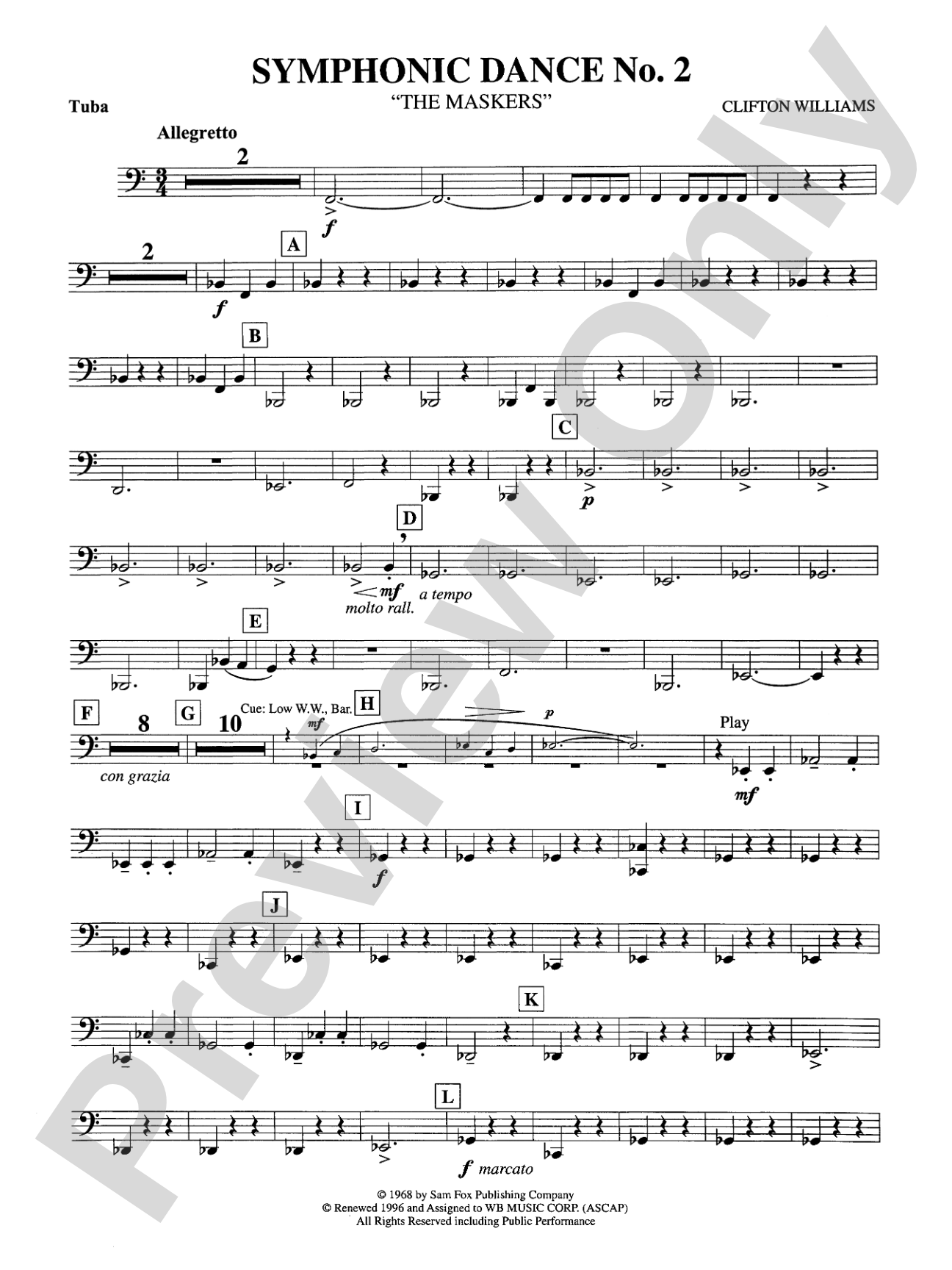
Symphonic Dance No. 2: Tuba

By Clifton Williams

Grade: 5 (Difficult)

Item: 00-PC-0014708_TB1

Digital Download
$3.00
Description

Don't just read it, hear it, play along with it, and watch your students grow with it. In MakeMusic Cloud, Symphonic Dance No. 2: Tuba comes alive with professional accompaniment, adjustable tempo, and built-in practice tools that turn solo practice into real progress.

Sample Audio
0:00
0:00
Sample Video
Additional Details
Series: Belwin Concert Band
Publisher: Alfred Music
Page Count: 248
SKU: 00-PC-0014708_TB1

More about this title

About the Composer: Clifton Williams

Clifton Williams (1923-1976) was a prolific composer and arranger whose concert band works became staples of the American wind ensemble repertoire. A native of Arkansas, Williams studied composition and orchestration, eventually establishing himself as one of the most performed contemporary composers for band during the mid-twentieth century. His works are known for their accessibility, strong melodic writing, and orchestrational clarity, making them equally valuable in university ensembles and high school programs.

Williams composed and arranged over 150 works for concert band, many of which remain in active rotation at festivals and concerts across North America. His writing demonstrates a deep understanding of band sonorities and a gift for creating pieces that challenge musicians while remaining musically rewarding. Symphonic Dance No. 2 exemplifies his signature style: energetic, well-crafted, and technically demanding.

Why we love this

Williams builds authentic orchestral drama into concert band textures without resorting to bombast. The piece sits comfortably at Grade 5, offering technical challenges that feel musical rather than arbitrary, and it programs beautifully alongside both standard concert band repertoire and transcriptions of orchestral works. Conductors return to this one again and again because it consistently produces results.

What to expect

Symphonic Dance No. 2 unfolds with confidence and rhythmic vitality, balancing moments of lyrical warmth with driving, syncopated textures. The piece conveys the energy and narrative sweep of orchestral writing adapted specifically for the concert band medium, creating a sense of forward momentum punctuated by well-earned moments of reflection.

Who it's for

This score and parts package is designed for concert band conductors programming Grade 5 repertoire and seeking substantial yet musical material that challenges advanced high school or university ensembles. It serves musicians ready for pieces that demand technical facility and interpretive maturity without requiring specialized or experimental techniques.

How to get the most out of it

  • Balance the sectional interplay carefully; Williams layers melodic content across woodwinds, brass, and percussion in ways that can easily obscure the primary voice if section balances aren't refined.
  • Maintain rhythmic precision in the faster sections through isolated sectional work on the syncopated figures that appear across parts; a single section's uncertainty will destabilize the ensemble sound.
  • Shape the sustained passages with deliberate attention to harmonic progression; resist the temptation to let full-band textures settle into uniformity.
  • Use dynamics as a structural tool rather than as mere accent marks; Williams's dynamic markings often indicate phrase architecture, and honoring them reveals the architecture of the work.

How to use it

Program this as a centerpiece for a concert heavy on American wind repertoire, or pair it with a lighter opening work and a larger choral finale to create programming with varied energy and texture. It also serves as an excellent pre-contest or pre-festival preparation piece, offering the kind of musical content and technical demands that prepare students for more intensive repertoire.

Skills your students will build

  • Balancing multi-layered melodic content across sections
  • Executing syncopated rhythmic figures with precision and style
  • Shaping sustained harmonic progressions with intentional dynamic control
  • Reading and realizing Williams's specific orchestration in the full-band texture
  • Managing tempo and momentum through dance-like metric structures

You May Also Like