
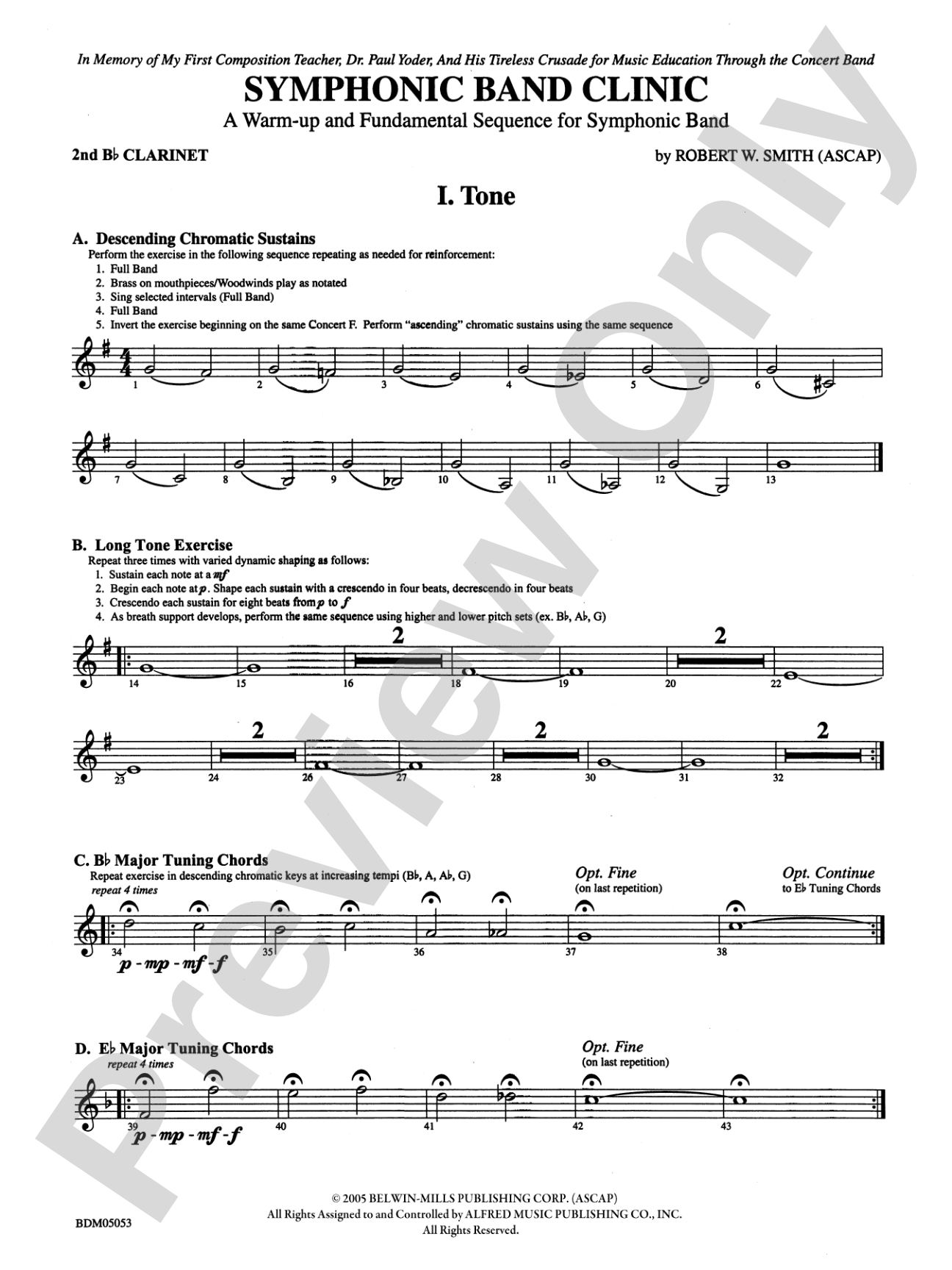

Symphonic Band Clinic: 2nd B-flat Clarinet
A Warm-Up and Fundamental Sequence for Concert Band
By Robert W. Smith
Grade: 4 (Medium)
Item: 00-PC-0015602_C2
$5.99
Pickup currently not available
Description
Progressive in depth and organization, this is the fourth of four comprehensive warm-up programs used by Robert W. Smith at the podium of every honor band he guest conducts. This warm up program is designed for use in any key with just a standard student part to be included in the band's folders. This "Clinic" will provide everything you need for your daily warm-up and support your teaching objectives, as well as accommodate the National Standards for Music Education. There are four segments in each Clinic: tone, technique, theory and composition, and chorale. The recording included is only the fourth portion; the chorale. (chorale only: 1:08)


Don't just read it, hear it, play along with it, and watch your students grow with it. In MakeMusic Cloud, Symphonic Band Clinic: 2nd B-flat Clarinet comes alive with professional accompaniment, adjustable tempo, and built-in practice tools that turn solo practice into real progress.
Open in the Player
Jump straight in and assign it today.
Start Your Free Trial
Open this title and explore the full library in minutes.
Sample Audio
1
Audio File
--:--
0:00
0:00
Sample Video
No sample videos found.
Additional Details
Series:
Belwin Symphonic Band
Publisher:
Alfred Music
Page Count:
260
SKU:
00-PC-0015602_C2
More about this title
About the Composer: Robert W. Smith

Robert W. Smith stands among America's most prolific composers for concert band and orchestra, with over 400 published works distributed primarily through Alfred Music. He earned his Bachelor of Music Education from Troy State University in Alabama and his Master of Music from the University of Miami, grounding his compositional voice in both pedagogical practice and advanced musical training.
Smith's orchestral and band works have been performed across North America, Europe, Australia, and Asia. His symphonies The Divine Comedy and The Odyssey are known to concert musicians worldwide, while The Tempest and other pieces for developing ensembles have become repertoire standards. Beyond composition, Smith has conducted honor bands throughout the United States and internationally, and his music has appeared in major television broadcasts, Olympic ceremonies, and high-profile public events.
Why we love this
Smith designed this warm-up program from decades of conducting experience at honor band clinics, so every segment serves a real pedagogical purpose rather than filling rehearsal time. The four-part structure (tone, technique, theory and composition, chorale) means you're not simply running exercises but systematically building musicianship with clear teaching objectives. Most directors will appreciate that it works in any key and integrates seamlessly with existing band materials without requiring separate parts to distribute.
What to expect
Moving through these four segments creates a sense of building momentum and intentionality. The tone work sits quietly and introspectively, technical passages sharpen focus and precision, compositional study engages the mind, and the chorale offers spacious, breathing musicality that lets students hear themselves within a harmonic context.
Who it's for
This is designed for concert bands at the intermediate to advanced high school level and developing college ensembles that want structured, philosophically coherent warm-up work grounded in professional conducting practice. Directors seeking a comprehensive daily routine that addresses tone production, technical facility, music theory application, and ensemble singing will find the scaffolded approach valuable.
How to get the most out of it
- Use the included chorale recording as a reference for balance and blend while students hear themselves singing the harmonic progression rather than playing mechanical warm-up patterns.
- Transpose through multiple keys across different rehearsals rather than staying in one comfortable key; moving between concert B-flat, concert F, and concert E-flat will deepen students' facility and reduce the temptation to rely on muscle memory.
- Build each segment in sequence during the same rehearsal so students experience the cumulative effect of tone foundation supporting technical work, which then informs their approach to the chorale.
- Let the composition segment become a teaching moment by asking students to analyze the harmonic or melodic choices before they play, making them active listeners rather than passive executors.
How to use it
Adopt this as your daily warm-up framework across an entire rehearsal season, rotating through different keys to keep it fresh and developmentally meaningful. The chorale segment also works well as the opening moment of a rehearsal concert, giving the audience insight into how your band approaches ensemble singing before moving into main repertoire.
Skills your students will build
- Tone production and sustained vowel quality across the full range
- Technical facility in scales and articulation patterns
- Harmonic analysis and chord recognition through compositional study
- Blend and balance in four-part vocal writing
- Transposition in multiple concert keys
- Music literacy beyond note reading (harmonic function, compositional structure)