
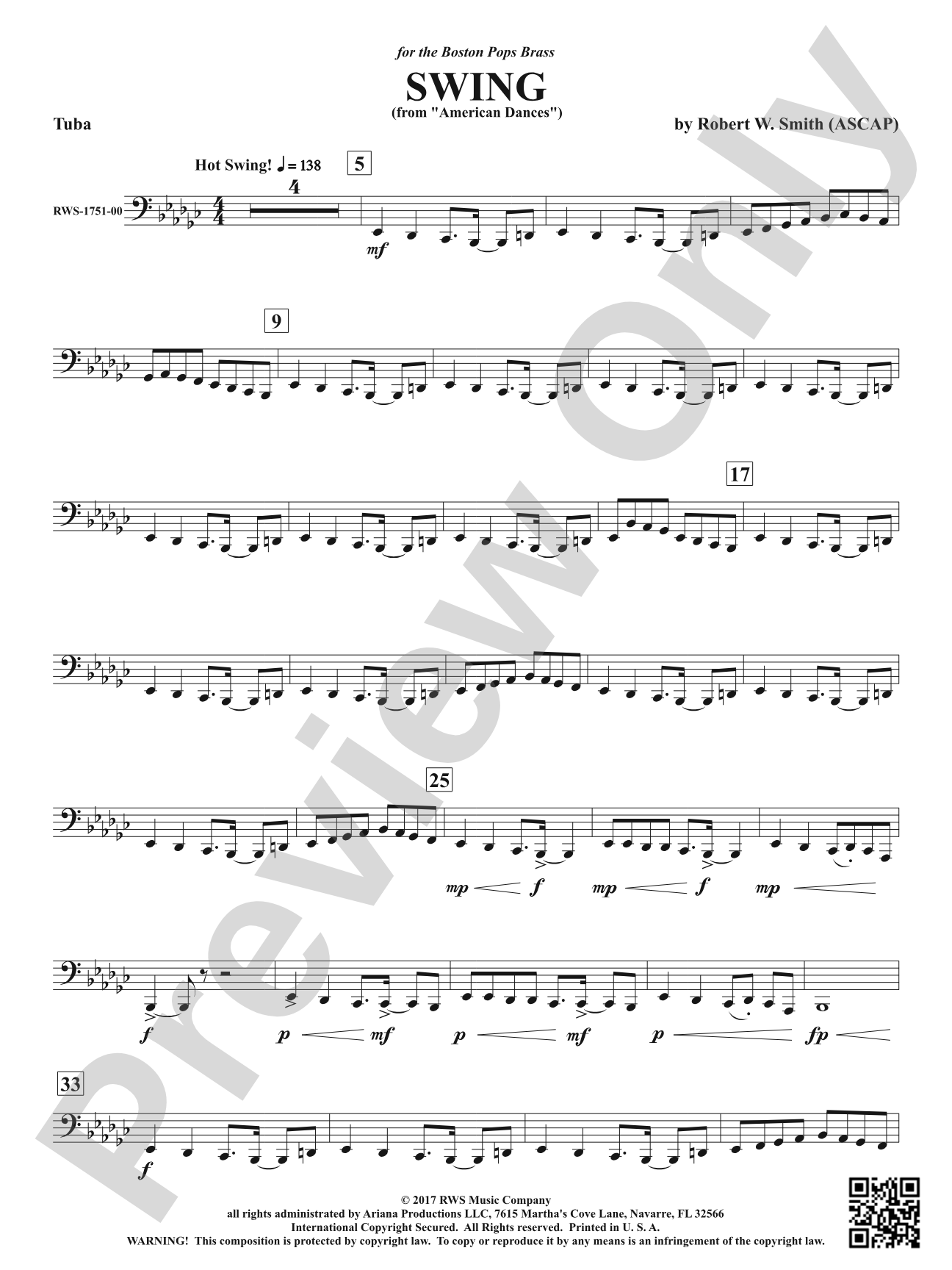

Swing - From American Dances: Tuba
From American Dances
By Robert W. Smith
Grade: 4
Item: 98-PC-RWS1756_TB1
$3.99
Pickup currently not available
Description
"American Dances" is a three movement suite originally composed for the Boston Pops Brass. Each movement features an American popular music genre. The third movement, "Swing," was composed based upon the American jazz and big band tradition that was popular in the 1930s and 1940s. This will have your audience tapping their toes and clapping their hands as your brass band sizzles throughout.
Original Item#: RWS-1756-00


Original Item#: RWS-1756-00
Swing - From American Dances: Tuba isn't in MakeMusic Cloud just yet...but it could be. Let us know you'd like to see it, and you'll help shape what comes next. In the meantime, start a free trial and dive into thousands of interactive titles your students can play along with today.
Request This Title
Tell us you want it.
Start Your Free Trial
Explore everything that's ready to play right now.
Sample Audio
1
Audio File
--:--
0:00
0:00
Sample Video
No sample videos found.
Additional Details
Series:
RWS - Festival Ensemble
Publisher:
RWS Music Company
SKU:
98-PC-RWS1756_TB1
More about this title
About the Composer: Robert W. Smith

Robert W. Smith stands among America's most recorded and performed composers of instrumental music. His catalog exceeds 400 published works, the majority distributed through Alfred Music, and spans concert band, orchestral, and chamber repertoire that has reached audiences across North America, Europe, Australia, and Asia. His symphonic works, including The Divine Comedy and The Odyssey, have become cornerstones of the standard repertoire, while pieces like The Tempest have secured permanent places in music education curricula.
Smith's compositions have transcended the concert hall, appearing on major television broadcasts, Olympic opening ceremonies, the Macy's Thanksgiving Day Parade telecast, and countless other high-profile events. He holds degrees from Troy State University (AL) and the University of Miami (FL), and has worked internationally as both a conductor and clinician, bringing his musical vision directly to ensembles across multiple continents.
Why we love this
Smith captures the authentic swagger of 1930s-1940s big band idiom without resorting to pastiche or oversimplification. The piece swings hard, giving brass players genuine stylistic challenges beyond reading notes, while the drumset part anchors the groove in a way that electrifies rehearsals. Grade 4 brass ensembles rarely encounter writing this musically substantial and historically grounded.
What to expect
The piece radiates the infectious energy of a 1940s ballroom, where big bands drove dancers with precision and joy. Syncopated lines dance across the ensemble while the drumset propels everything forward with a shuffle that feels effortless once the band locks in. It's music designed to move bodies and lift spirits, grounded in an American musical tradition that remains perpetually swingable.
Who it's for
Grade 4 brass ensembles seeking repertoire that teaches authentic jazz style without requiring an ensemble to be jazz-experienced. Directors looking for a piece with genuine audience appeal that also builds musicianship beyond the standard fanfare or march. Brass groups preparing for jazz-influenced programming or festival performances.
How to get the most out of it
- Establish the groove pocket early with the drummer; the whole band's time and articulation depends on locking into that shuffle feel.
- Balance the melodic statements between sections by listening for which instruments carry the tune at any given moment rather than letting everyone play at equal volume.
- Lean into the chromatic voices and inner harmonies characteristic of swing arranging; these details separate a flat reading from a swinging one.
- Shape phrases by thinking in terms of call-and-response patterns between brass choirs rather than treating each measure with equal weight.
How to use it
Pair this with other Smith concert works to showcase a single composer's range, or program it alongside other American popular music styles to create a thematic evening of American musical traditions. It works beautifully as a second-half opener after a more formal opening movement, and its accessibility makes it an excellent choice for pops concerts, community performances, or festival programs seeking high-energy, audience-engaging selections.
Skills your students will build
- Reading and executing jazz articulation (shorts, accents, and stylistic phrasing)
- Listening for swing rhythm feel and maintaining proper shuffle subdivision
- Balancing individual voice independence while supporting a sectional ensemble sound
- Responding to rhythmic cues from the drumset and drummer as a timing reference