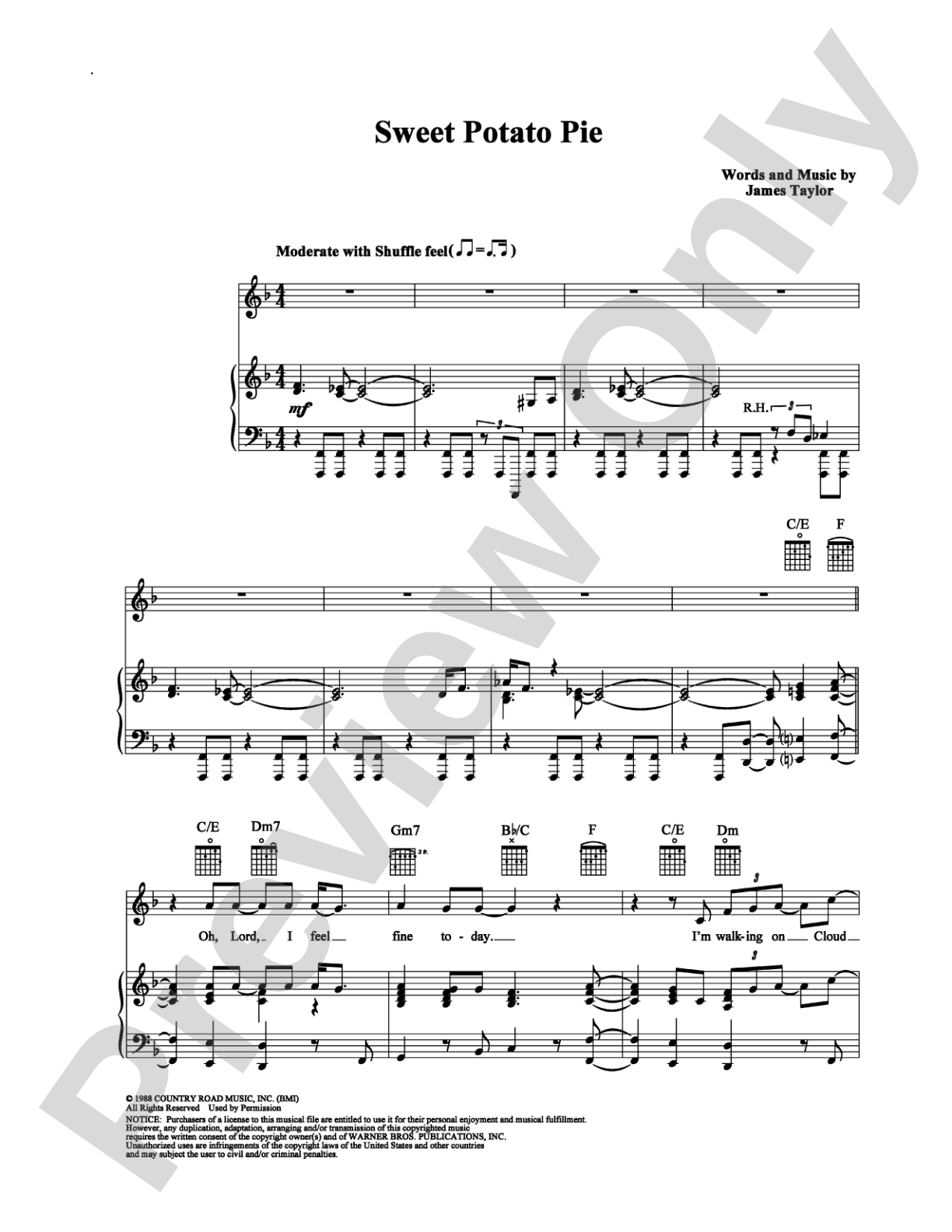
Sweet Potato Pie: Piano/Vocal/Chords Digital Sheet Music

Sweet Potato Pie: Piano/Vocal/Chords Digital Sheet Music

James Taylor

Item: 00-PS-0002733

Digital Download
$3.99
Description

Sweet Potato Pie: Piano/Vocal/Chords Digital Sheet Music isn't in MakeMusic Cloud just yet...but it could be. Let us know you'd like to see it, and you'll help shape what comes next. In the meantime, start a free trial and dive into thousands of interactive titles your students can play along with today.

Sample Audio
No sample audio found.
Sample Video
Additional Details
SKU: 00-PS-0002733

More about this title

About the Artist: James Taylor

James Taylor emerged as one of America's most influential singer-songwriters in the early 1970s, known for his introspective lyrics, fingerstyle guitar work, and warm vocal delivery. His career spans five decades of consistent recording and touring, with a catalog that ranges from intimate acoustic ballads to sophisticated pop arrangements, making him a cornerstone of contemporary American music.

Why we love this

This arrangement brings together Taylor's gift for conversational melody with accessible piano voicings that work equally well in a classroom or recital setting. The pop-rock idiom keeps students engaged while the lyrical content and harmonic movement offer real interpretive choices about dynamics and phrasing.

What to expect

Warm, nostalgic, and grounded in everyday language, the song feels like someone reflecting quietly over a cup of coffee. The music moves gently through its harmonic progressions, never demanding but always present, with a folk-pop sensibility that invites the listener into an intimate moment.

Who it's for

Student singers working on contemporary vocal repertoire will find this piece accessible yet rewarding, with enough harmonic sophistication to develop ear training and interpretation skills. Pianists accompanying vocalists will strengthen their ability to balance accompaniment texture with melodic support, while solo pianists can use this as a bridge between classical technique and pop-rock arranging.

How to get the most out of it

  • Treat the vocal line as a conversation rather than a formal statement. Taylor's phrasing often sits slightly ahead of or behind the beat, so listen to his recorded version to capture the rhythmic ease he brings to the melody.
  • Pay attention to chord substitutions and inversions in the piano part. They create movement and color even in relatively simple accompaniment patterns, so voice them deliberately rather than playing them mechanically.
  • Balance the vocal and piano textures so neither overwhelms the other. This is intimate music; the piano supports rather than showcases, and the voice remains the focal point throughout.
  • The bridge often calls for a subtle shift in energy and tempo feel. Slight rubato here can highlight the lyrical turn without losing the overall groove.

How to use it

Program this alongside other contemporary singer-songwriter material in a coffeehouse concert or acoustic recital series. It also works well as a teaching piece in vocal coaching or piano accompaniment classes, where students can study how popular songwriters balance simplicity with emotional depth.

Skills your students will build

  • Singing with conversational phrasing and rhythmic flexibility in pop-rock contexts
  • Reading chord symbols and realizing accompaniment textures on piano
  • Balancing vocal melody with piano accompaniment
  • Interpreting dynamics and rubato in contemporary popular music
  • Understanding voice leading in folk-influenced pop arrangements

You May Also Like