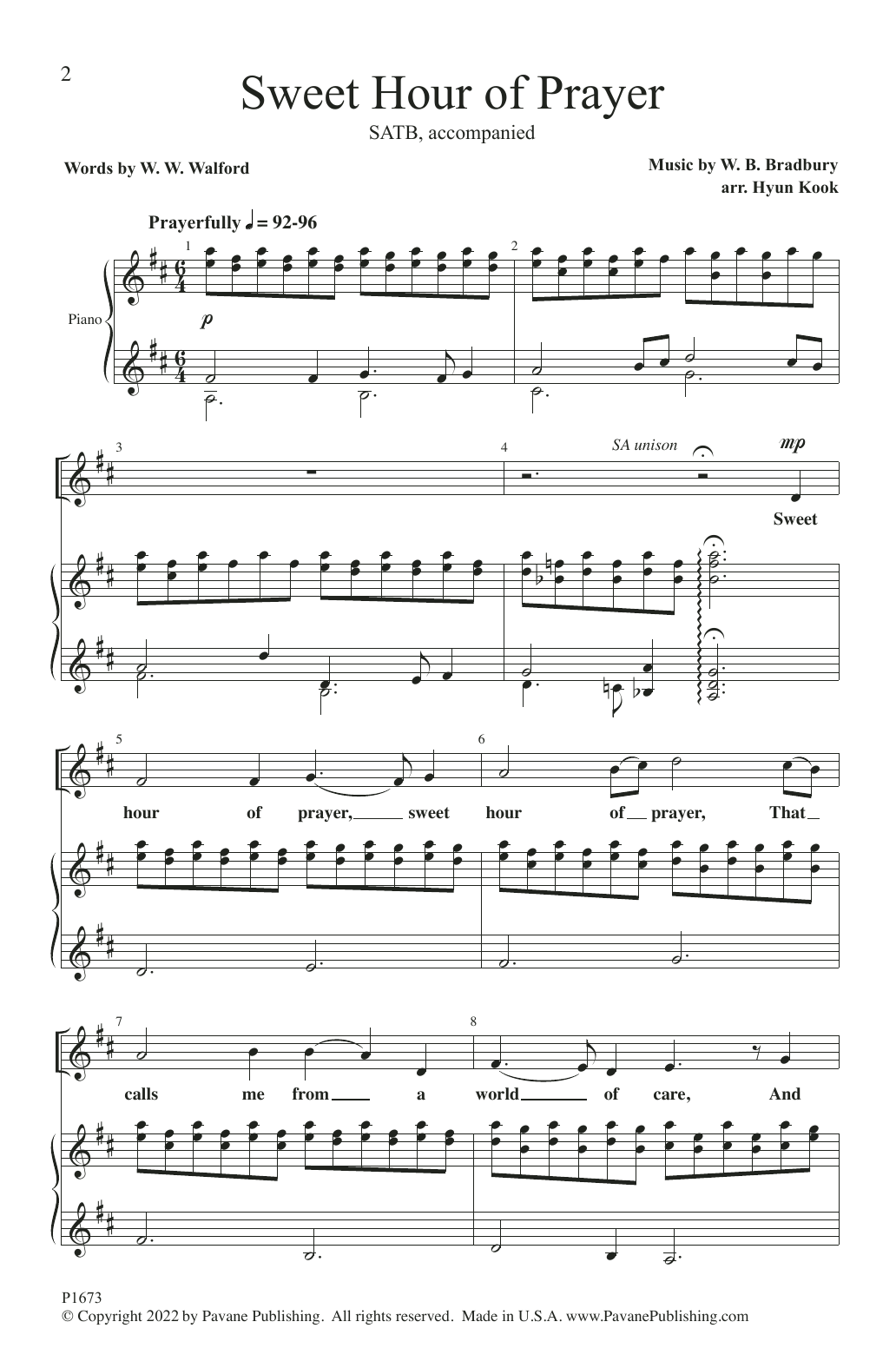
Sweet Hour of Prayer (arr. Hyun Kook) Sheet Music Preview

Sweet Hour of Prayer (arr. Hyun Kook): SATB Choral Octavo

By W.B. Bradbury / By W.W. Walford / Arranged by Hyun Kook

Item: 35-DS01104015

Digital Download
$3.35
Description

Sweet Hour of Prayer (arr. Hyun Kook): SATB Choral Octavo isn't in MakeMusic Cloud just yet...but it could be. Let us know you'd like to see it, and you'll help shape what comes next. In the meantime, start a free trial and dive into thousands of interactive titles your students can play along with today.

Sample Audio
No sample audio found.
Sample Video
Additional Details
Publisher: Hal Leonard
Page Count: 11
SKU: 35-DS01104015

More about this title

About the Composer: W.B. Bradbury

William Bradbury (1816-1868) was an American composer and music educator who shaped congregational singing during the 19th century. His prolific output of hymn tunes and sacred works reflects his commitment to making music accessible to everyday singers, and his influence on American musical life extended well beyond his lifetime.

Why we love this

Hyun Kook's arrangement honors the hymn's intimate spirituality while giving SATB choirs genuine harmonic interest. The eleven pages allow space for textural variety without overwhelming singers who may be encountering this repertoire for the first time, making it equally valuable in a concert setting or a service context.

What to expect

The music settles into a quiet reverence. There's an earnestness here that feels both timeless and intimate, as though the singers are gathered in a moment of genuine reflection rather than performing for an audience.

Who it's for

This arrangement serves choirs of moderate skill who want to expand their sacred repertoire with a work that honors tradition while offering fresh harmonic language. It works equally well for volunteer church choirs, community ensembles, and school groups preparing for winter or spring concerts.

How to get the most out of it

  • Shape the phrases by thinking of them as prayers rather than melodies. Allow the text to guide your phrasing and breathing decisions, which will feel more natural than strict musical symmetry.
  • Balance the soprano line carefully so it floats above rather than dominates. This hymn's power comes from the unified sound of all four voices, not the top line alone.
  • Approach the dynamics as reflective. Resist the urge to build continuously; instead, let each phrase complete its thought before the next begins.

How to use it

Pair this with other hymn arrangements or sacred works to create a thematic concert segment that appeals to broader audiences. It also serves well as a service anthem or as the centerpiece of a program exploring American sacred music traditions.

Skills your students will build

  • Blending four-part harmony with careful attention to balance across voices
  • Sustaining legit singing through longer phrases without forcing volume
  • Interpreting text with musical sensitivity rather than mechanical phrasing
  • Singing consonants cleanly in unison moments while maintaining individual vocal line integrity

You May Also Like